


Pharmacy and cosmetics: comply with EU Regulation 2026/78 without errors


The EU regulation is clear: starting from May 1st, a regulatory update will come into effect for pharmacies that will require checking the assortment and inventory. Being unaware of this or making mistakes in this area can prove really harmful.
EU Regulation 2026/78 was officially adopted on January 12, 2026, by the European Commission and has entered as an amendment to Regulation EC No. 1223/2009. What are we talking about? We are referring to the basic regulation on cosmetics. The regulation introduced this year effectively changes the framework for cosmetic products, aiming to address certain substances classified as CMR, that is, substances considered carcinogenic, mutagenic, or toxic.
An organizational effort that allows no mistakes
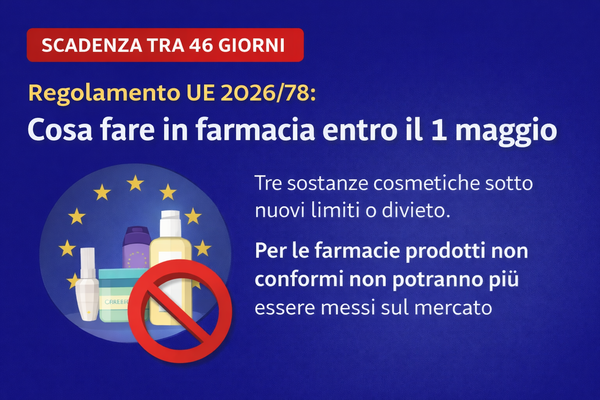
The situation is therefore complicated and delicate at the same time, especially for those working with cosmeceuticals and for those who operate daily among shelves, orders, and references, since no transition period is foreseen. No tolerance is allowed in this case, and from May 1st, non-compliant products can no longer be marketed or held for professional use.
Pharmacies, cosmetologists, and manufacturing companies are not only called to understand the new regulation but also to verify products, request documents from suppliers, and organize in advance, avoiding reaching the deadline with doubts, blocked stock, or poorly defined internal procedures. Let’s therefore try to understand more about what the new European regulation provides and how to prepare.
New cosmetics regulation: what really changes
EU Regulation 2026/78 fits into the European cosmetic safety system and updates Regulation (EC) No. 1223/2009. So, we are talking about an update to the reference standard for cosmetics in the European Union. A change of course that is not as drastic as it seems but that disrupts routines.
Its concrete impact concerns the presence in cosmetics of CMR substances classified according to the CLP Regulation, that is, the European regulation on classification, labeling, and packaging of substances. In simple terms, for pharmacies, this means having to immediately check whether potentially affected products are present in their assortment.
So, this is not an abstract issue or reserved for producers. Anyone who sells, distributes, or professionally uses cosmetics must know if the references in stock are still compliant as of May 1, 2026.
CMR substances in cosmetics 2026: which ingredients must be checked
The substances identified as central to this specific update are
Silver CI 77820
Hexyl Salicylate
o-Phenylphenol.
A clearer picture now emerges, leaving little room for doubt. These are the substances to verify; the most sensitive areas for pharmacies seem to be certain nail polishes or products with metallic effects, scented lines, and cosmetics that use specific preservatives or fragrant substances.
What does this mean? It does not mean that every product in these categories is automatically non-compliant, but that these are the first to be checked. A good help to focus efforts and not disperse them in such a short time frame.
Non-compliant cosmetic products: what to do with inventory, suppliers, and returns
From May 1, 2026, non-compliant products cannot be sold or held for professional use, as we have already said. However, the methods for return or disposal are not directly regulated by the regulation and depend on contractual relationships with suppliers. This can certainly represent a weak point of the regulation, where pharmacies and staff may feel left alone, yet with some care and timely adjustments, it is possible to reach the deadline without unpleasant surprises.
The management of non-compliant products must be addressed well before the deadline and according to a practical schedule that we suggest:
Identifying at-risk references is the first verification phase;
Requesting confirmation of compliance is the second step;
Defining with the supplier any returns, replacements, or other management methods is the final and definitive step.
It may be advisable to internally separate at-risk products from those displayed to the public to avoid sanctions or unintentional violations of the regulation. In fact, another aspect not to be overlooked in the recently passed regulation is inspections.
Compliance inspections
All sector communications are clear and all draw attention to the fact that the presence on shelves or use of products considered no longer compliant can expose any business to checks by the competent authorities with possible administrative sanctions that can be quite hefty.
Product compliance in this case is not only a matter of documentation or health attention but also part of the proper management of the cosmetics department and a way to avoid sanctions and inspections.
Acting in time is therefore not only about complying with the rules but also about working better and more clearly, reducing the margin of error. In a sector like cosmetics, regulatory updates develop through scientific paths and regulatory progress; staying updated means using one’s professionalism in the service of cosmetics, and this is an essential part that must never be forgotten.
For those working in pharmacies, the message is simple: acting now means having time to verify, request confirmations, reorganize stock, and face the deadline in an orderly manner.

RECENT POSTS


