

Marta comes in at a quarter to six, when the pharmacy has just emptied. She goes straight to the deodorant shelf, picks up two or three and turns them over in her hand without really reading them, then puts them back. Then she comes to the counter.
“I need a stronger deodorant. The ones I use don’t work.”
She is thirty-eight, still wearing her coat, and as she speaks she touches her sleeve at underarm level. She does not even notice.
“How strong? What have you tried so far?”
“I don’t know, everything. I threw away the last two after three days.” She pauses for a moment. “They burned.”
Then she looks at the clock because she is in a hurry and adds the phrase that almost always ends conversations of this kind: “give me the one that works best.”
That request contains three different problems presented as if they were one. Marta is asking for a more aggressive product for skin that is already telling her it cannot tolerate what she is using. If we give her what she is asking for, she will be back in two weeks.
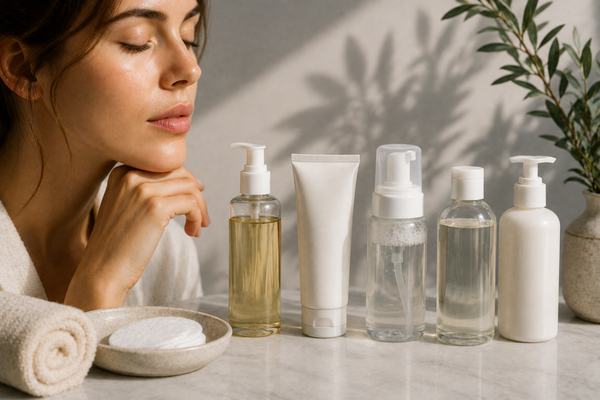
Cover image generated with the support of artificial intelligence.
[INDICE:h2]
What the request does not say
“Stronger” is not technical information. It may mean that Marta sweats a lot, that she notices a bad odor, or both. These are three scenarios with three different responses.
- If odor is the main issue without any actual excess sweating, the approach is deodorant.
- If the amount of sweat is the main issue, an antiperspirant is needed.
- If the two coexist, consider a combination formula or two products that act separately on the two mechanisms.
The most important piece of information in the conversation, however, is that “they burned” mentioned in passing. It indicates that the skin is reacting and changes all the subsequent choices. In everyday practice, it is also what most often goes unnoticed because it comes after the request and seems like an incidental comment.
The questions to ask, in the right order
Four sections. They take less than two minutes and completely change the recommendation.
1. What is really bothering you
Is it the amount of sweat, the odor, or both? Is the problem limited to the underarms, or does it also affect the hands, feet, or forehead? How long has it been present? Did it appear gradually or suddenly? When does it increase: heat, physical activity, stress?
They help distinguish the three phenomena before choosing the product category and immediately identify any criterion that warrants referral to a doctor.
2. Associated factors
Any known medical conditions? Fever or any other recent changes in your health? Have you recently started taking any medication? Do you also sweat at rest or during the night?

The insight from Elisa Avalle · Founder
You will not find the question about night sweats in the manuals; I added it myself. In my experience, it is the question that most clearly distinguishes sweating linked to stimuli from sweating that warrants further evaluation. If someone sweats at rest and at night, the conversation changes direction before products are even discussed.
3. Actual skin condition
Is the skin in the area intact? Is there redness, itching, burning, or maceration? Does the burning occur mainly with alcohol-based products? Does it worsen on freshly depilated skin? Is there a history of intertrigo or folliculitis?
This section is not optional: as we will see later, the condition of the skin also determines a regulatory condition of use, not just a tolerability preference.
4. Actual routine
How many times a day do you wash the area, and with which product? Do you already use antiseptic cleansers? Is the product a spray, roll-on, or stick? Do you apply it to perfectly dry skin? How long does the effect last? Have you stopped using products because of dryness or irritation?
Many failures attributed to the product are actually application errors, and they only come to light when you ask.
Why more washing does not solve the problem
Sweat secretion comes from two types of glands. Eccrine glands are distributed over much of the skin's surface, serve mainly for thermoregulation, and produce a hypotonic, acidic secretion. Apocrine glands, found in the armpits among other areas, become functional at puberty and produce a milky secretion rich in mucopolysaccharides and proteins, with a basic pH of around 8-8.5.
Sweat itself is odorless or nearly so. Odor arises from the transformation of secretions by the skin flora: the activity of lipophilic corynebacteria is associated with the formation of low-molecular-weight fatty acids, ammonia, amines, indoles, and mercaptans; that of some Gram-positive micrococci with the production of isovaleric acid and the characteristic rancid odor.
Two practical consequences follow from this. Increasing washing affects the last link in the chain and only for a few hours. And a daily antiseptic cleanser is not an automatic solution, because the resident microbiota is vulnerable and, if depleted, leaves the skin more exposed. The full reasoning is in the article on when an antibacterial cleanser is needed.
The burning sensation: what lies behind it
Alcohol is not included in deodorants by chance. It has good solvency, possesses inherent antibacterial activity, and its rapid evaporation produces the immediate sensation of freshness that consumers associate with efficacy. A high content, however, can cause dryness and local irritation, and alcoholic formulas are not recommended for sensitive, reactive skin.
A formulation alternative does exist. Other volatile vehicles are used, especially cyclomethicones, which are generally better tolerated. There is, however, a compromise that should be explained at the time of sale: because they have a lower heat of vaporization, cyclomethicones do not provide the same immediate sensation of cold.
The insight from Elisa Avalle · Founder
In the laboratory, the active ingredient and the cosmetic form are never two separate decisions, and this helps at the counter explain why certain products do not exist. Triethyl citrate is an interesting enzyme inhibitor, but it cannot be included in a basic stick formulated with alkaline stearates: it is incompatible. The same logic applies to alcohol. Removing it solves one tolerability problem and creates one of perception, and that second problem can be managed only with the right words at the time of handover.
What to say to Marta
The advice works if it is also provided as a phrase that can be said aloud. Three examples that can be used as they are.
- “A less noticeable cooling sensation on application does not mean lower efficacy.” Without this sentence, the better-tolerated product is perceived as the product that does not work, and the customer will not come back.
- “First, let’s get the irritation under control, then we’ll choose the right product.” It puts priorities in the right order without making it seem as though you are refusing the sale.
- “Apply to perfectly dry skin, never after hair removal.” This is the instruction that most often turns a suitable product into a product that stings.
The requirement that is not a precaution
Among antiperspirant active ingredients, hydrated aluminum and zirconium mixed chlorohydrates are regulated by Regulation (EC) No. 1223/2009, Annex III, reference 50. Among the conditions laid down, one carries more weight at the counter than the others: the ban on application to irritated or damaged skin.
This is not a precautionary warning. It is a condition of use established by the regulatory framework. In Marta’s case, as she reports burning, this means first checking the condition of the skin and, if necessary, restoring its integrity. Only then should the antiperspirant product be assessed.
A note on efficacy, also useful during assortment planning: an antiperspirant is considered effective when it reduces sweating by more than 20%. A product that reduces it by less is not a weak antiperspirant; it is a product that does not meet the criterion.
The 24-hour claim, correctly understood
Among the requirements that can reasonably be expected of a good deodorant or antiperspirant product is that a single application should ensure proper action throughout the day, along with skin tolerability and no staining of clothing.
The insight from Elisa Avalle · Founder
When I assess a supplier’s technical documentation, the presence of an ingredient in the INCI does not demonstrate a 24-hour claim. What demonstrates it is the finished formula, tested under real-life conditions of use, with efficacy and tolerability considered together. It is the same question I recommend asking during assortment planning: not “what’s in it,” but “what did you measure the 24 hours on?”
The cleanser no one asks for
Marta came in for a deodorant and will probably leave with one too. But the surface the product touches every day has been prepared by the cleanser, and on reactive skin, that is the first lever available.
Daily hygiene, once or twice a day as needed, with a gentle cleanser; for particularly reactive skin, shower oil. Avoid alkaline soaps, alcohol-based wipes, and overly degreasing cleansers. Pat dry, paying particular attention to the folds. The complete technical overview is in the guide to surfactants in cosmetics and the guide to skin cleansing.
Let’s be clear: deodorant is not a LeLang category, and we are not recommending our own. Cleansing reactive skin is, and it is the part of the advice that is almost always skipped at the counter.

RELAX SHOWER GEL Moisturizing shower gel for sensitive skin Shower gel with neurocosmetics, for a shower that relaxes skin and mind. ... Discover RELAX SHOWER GEL
When Marta is no longer just a counter case
The criteria for referring someone to a doctor are precise, and it is worth having them in mind before the consultation, not afterward.
- Generalized hyperhidrosis, widespread and not limited to one area.
- Sudden onset of excessive sweating.
- Suspected pathological or drug-related cause: factors that can trigger secondary forms include nervous causes; pathological causes such as hyperthyroidism, diabetes and febrile processes; and environmental, physical and pharmacological factors.
- Intertrigo, folliculitis or other significant skin changes.
- When the problem significantly interferes with everyday life.
Bromhidrosis, chromhidrosis and certain forms of hyperhidrosis considered pathological fall under the care of a dermatologist or endocrinologist, and therefore outside cosmetic legislation. Anhidrosis and hypohidrosis still require medical evaluation.
What remains at the counter
The difference between selling a deodorant and offering advice lies in two minutes of questions. The result is not merely technical: someone who has been told why a less “fresh” product may be more effective comes back to the counter, instead of switching channels as soon as they find a better price.
It is work that only makes sense where someone is available to do it. That is why LeLang is available only in pharmacies: here is the list of partner pharmacies.
Would you like to bring LeLang to your pharmacy?
Let's talk about product range, staff training and consultation protocols at the pharmacy counter. Thirty minutes by video call, with no obligation.
On the website: Sensitive skin · Body Skincare · LeLang Partner
Sources for this article
- Del Pozo A. Body hygiene. Fundació IL3 – University of Barcelona, 2023.
- Del Pozo A. Body odour. Deodorants and antiperspirants. Fundació IL3 – University of Barcelona, 2023.
- Regulation (EC) No. 1223/2009 on cosmetic products, Annex III, ref. 50. CosIng database, European Commission.
- Scientific Committee on Consumer Safety (SCCS), Opinion on the safety of aluminium in cosmetic products, SCCS/1613/19.
Marta is a case created for training purposes: the name and details do not correspond to a real person. The situation described is one of the most common at the pharmacy counter.
Elisa Avalle is the founder of LeLang Skin Care, specializing in dermocosmetics at the University of Barcelona.