


Bisabolol is the main soothing active in chamomile: a molecule that reduces redness and the sensation of irritation, and one of the best-tolerated ingredients in cosmetics. On the label, you will find it as Bisabolol, and it helps calm reactive skin — which is why it appears in after-sun products, aftershave, post-hair-removal products, and almost all formulas for sensitive skin.
In a nutshell: it is not the active that solves a problem on its own; it is the one that makes everything else tolerable. It is added alongside more potent actives to balance their effects, which is why you find it in hundreds of formulas without anyone putting it on the front label.
[INDICE:h2]
What is bisabolol used for?
Four functions, in order of real importance.
Soothe redness and irritation
This is the main reason it is included in formulas. Alpha-bisabolol reduces the sensation of irritation and redness, and it is commonly found in after-sun creams, post-hair-removal products, aftershave, and products intended for sensitive skin, including those for children. It is also used in shampoos, intimate cleansers, and facial makeup removers.
Protect against oxidative stress
It helps combat free radicals, which is why it often appears in anti-aging formulas as a supporting ingredient.
Support an even complexion
It has been studied for its ability to modulate tyrosinase activity, the enzyme involved in melanin production. It can therefore make a supportive contribution to formulas designed for skin discoloration. However, it is not a brightening active: it complements, rather than replaces.
Improve the comfort of dry, cracked skin
It can be found in hand creams, lip balms, and restorative products, where it helps keep skin stressed by the cold comfortable, supporting the skin barrier.
Bisabolol is a cosmetic ingredient: it improves the comfort and appearance of reactive skin, but it does not treat dermatitis, eczema, or acne. In the presence of a skin condition, the dermatologist remains the appropriate point of reference.
Where it comes from
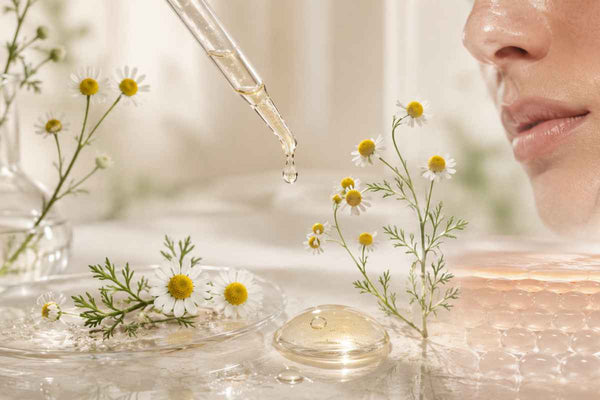
Bisabolol is found in several plants, but its best-known source is chamomile (Matricaria chamomilla): it is extracted from the flower heads, the same parts used for the infusion. Another important source is Candeia, a Brazilian tree whose wood yields high-purity natural alpha-bisabolol.
There are currently two versions on the market: the natural version and the synthetic version, which is chemically equivalent but produced in a laboratory. Both are permitted in cosmetics.
The practical difference comes down to two things. The first is purity: the natural extract also contains other plant components, which may contribute to the effect but, in rare cases, may also cause sensitization in people allergic to Asteraceae. The second is sustainability: Candeia is a slow-growing species and harvesting is regulated, which has led many producers to switch to the synthetic form or certified cultivation.
Alpha-bisabolol: why the form matters
Bisabolol belongs to the sesquiterpene class and exists in several mirror-image forms. The most active is (-)-α-bisabolol, also known as alpha-bisabolol: this is the form responsible for its documented soothing properties. When the label states "alpha-bisabolol" or "levomenol", it is referring specifically to the most effective variant.
Thanks to its lipophilic structure, it penetrates well into the skin's superficial layers, which is also why it is used as an absorption enhancer for other active ingredients in formulations.
Why is it used so much
The reason is practical: bisabolol is well tolerated, has a favorable safety profile, does not add color, and has no overpowering scent; it also combines easily with other actives without interfering with the formula. In formulations, it is generally used in very low concentrations, on the order of fractions of a percentage point: it is effective even at these levels, and increasing the amount does not improve the result.
Its plant-based origin also makes it a fitting choice for those seeking naturally derived formulations.
Bisabolol in LeLang products
We chose this compound for some of our formulas dedicated to skin that needs extra gentleness.
The Perlage face cream harnesses bisabolol's soothing properties, complementing Argireline and the antioxidants from red grapes: a way to make an anti-aging formula comfortable even for the most demanding skin.

PERLAGE Anti-wrinkle face cream with Argireline® for expression lines Antioxidant and protective, for all skin types. Reduce... Discover PERLAGE
The Nutralight Sensitive cream, with its soft, nourishing texture, incorporates bisabolol for its calming properties, together with hazelnut oil.

NUTRALIGHT SENSITIVE Soothing face cream for sensitive, redness-prone skin With thermal water from the Piedmont Alps, for sensitive and re... Discover NUTRALIGHT SENSITIVE
You can also find it in the Skinage Advance mask, where it is combined with calendula extract, chamomile, and mallow: four different soothing ingredients that target different mechanisms, alongside more powerful anti-aging actives. It is a practical example of what I said at the beginning — bisabolol is not the star of the formula; it is what makes it well tolerated.

SKINAGE ADVANCE Anti-wrinkle face mask with Q10 and peptides With Calamine, Ceramides, Palmitoyl Tripeptide-5 and Hyaluronic Acid Vi... Discover SKINAGE ADVANCE
A useful clarification, because confusion is common: not all products for reactive skin work with bisabolol. The Couper Relief serum, for example, takes a different approach: a specific biomimetic peptide for redness and ceramides, not the active ingredient from chamomile. These are two distinct strategies for the same symptom.
The complete, up-to-date list of LeLang formulas containing it can be found in the bisabolol ingredient guide.
Frequently asked questions
What is bisabolol?
It is a molecule from the sesquiterpene family, extracted mainly from chamomile or Candeia wood, or obtained synthetically. In cosmetics, it is one of the most widely used and best-tolerated soothing active ingredients. In the INCI list, it appears as Bisabolol.
What is it used for in creams?
To soothe. It reduces redness, itching, and the feeling of tight skin, and makes formulas containing stronger active ingredients more comfortable. In a face cream, its role is almost always supportive: it does not treat wrinkles or dark spots; rather, it helps ensure that the treatment is well tolerated.
What is the difference between bisabolol and alpha-bisabolol?
Alpha-bisabolol is the most active form of the molecule. When a label specifies “alpha-bisabolol” or “levomenol,” it indicates the variant with the best-documented soothing properties; the generic term “bisabolol” is broader.
What is the difference between bisabolol and calendula?
They belong to the same botanical family, but the active molecule is different, and they act in different ways. With bisabolol, the target is irritation and redness; in calendula, the main active ingredient is faradiol monoester, a fat-soluble triterpenoid that research even proposes as a quality parameter for the extract. This is why, in a well-designed formula, they can coexist rather than replace one another—and indeed, Skinage Advance contains both.
Is it suitable for sensitive skin?
It is one of the most suitable active ingredients for this very situation, and one of the few also found in pediatric formulas. The only precaution concerns anyone with a confirmed allergy to Asteraceae—the family that includes chamomile, arnica, and calendula: in that case, it is advisable to perform a patch test on the crook of the elbow before applying it to the face.
Can it be used together with acids or retinol?
Yes, and it is actually one of the most sensible combinations: its function is precisely to contain the irritation that those active ingredients can cause. It does not reduce their effectiveness; it improves tolerability.
Is bisabolol better than other soothing ingredients?
They are not in competition, and they coexist in well-formulated products. Bisabolol acts on irritation and redness; calendula provides triterpenoids and mucilage, so it also works on the surface film; allantoin works on surface repair; panthenol provides hydration and comfort; aloe provides immediate but superficial relief. If your skin reddens easily, bisabolol has the most precise target.
How much should there be in a cream?
A little: it is used in concentrations on the order of fractions of a percentage point. It is one of those ingredients where “higher up in the INCI” does not mean “more effective,” and finding it toward the bottom of the list is completely normal.
You can also find LeLang products at partner pharmacies throughout Italy.
15-Minute Free Consultation with the Founder
Do you have reactive skin and don’t know which active ingredients it can tolerate? Book a free virtual skincare consultation with Elisa Avalle, founder of LeLang.
On the website: calendula and faradiol · what sensitive skin is · erythrosis, couperose and rosacea · bisabolol profile