


[INDICE:h2]
Skincare is not just about using active ingredients such as hyaluronic acid, vitamin C, or retinol. It also means caring for the skin's pH and its microbiome: two invisible elements that determine whether your skin looks radiant and supple or is prone to frequent blemishes and inflammation.
What is skin pH?
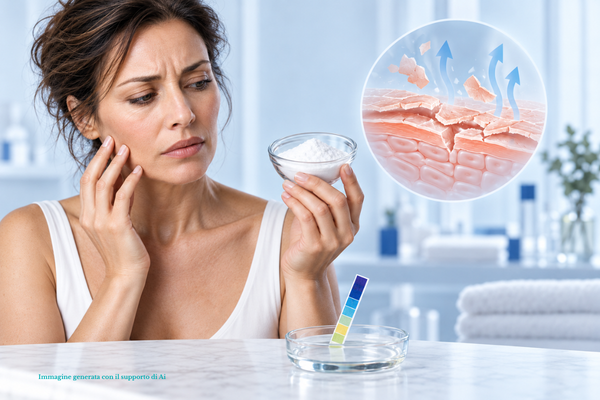
pH measures acidity or alkalinity on a scale from 0 to 14, where 7 is neutral. The skin does not have a neutral pH: its physiological pH is slightly acidic and generally ranges from 4.5 to 5.5.
This acidity depends on the hydrolipidic film made up of sebum, amino acids, and sweat—the film that covers the most superficial layer of the epidermis. The so-called acid mantle serves three functions:
- Protective barrier: acidic pH hinders the proliferation of pathogenic bacteria.
- Microbiome balance: beneficial microorganisms thrive in an acidic environment.
- Structural integrity: acidity regulates the enzymes that control physiological desquamation.
How to determine your skin's pH
There is no way to know it precisely at home, but there are three levels of approximation.
Indicator strips
They are available at pharmacies and are applied to clean, slightly damp skin, at least two hours after the last product was applied. They provide a rough indication, not a reliable reading: the result is affected by sweat, cosmetic residue, and room temperature.
The skin pH meter
This is the tool used in professional and dermatological settings, with a flat electrode placed against the skin. It is the most accurate method, but it is a tool for a clinic, not for your home bathroom.
The signs your skin gives you
In everyday practice, symptoms tell you more than a number. If your skin feels tight for more than a few minutes after cleansing, the cleanser is probably too alkaline. If roughness, itching, or fine flaking appear, the acid mantle is weakened. If, on the other hand, your skin burns or becomes red after repeated peels, its pH may have shifted too far toward the acidic side.
pH varies with skin type
The value is not identical for everyone and also varies depending on the area of the body.
- Oily skin tends to have a lower pH in seborrheic areas because of the greater presence of free fatty acids in sebum. This does not mean it tolerates alkaline cleansers: on the contrary, the compensatory response is more pronounced.
- Dry skin often has a higher pH, closer to neutral, because the hydrolipidic film is poorer. This is the condition in which alkaline soaps cause the most damage.
- With age, pH tends to increase, contributing to the greater fragility of mature skin.
- In newborns, pH is close to neutral and becomes more acidic during the first months of life.
How the pH of cosmetics affects the skin
Every product applied temporarily alters the skin's pH. Healthy skin returns to its optimal level within a few hours, but repeated use of unsuitable products can overwhelm this recovery capacity.
- Cleansers should have a pH between 4.5 and 5.5.
- Toners are designed to rebalance the pH after cleansing. They are a different category from serums, which deliver active ingredients.
- AHA and BHA exfoliants temporarily acidify the skin: controlled use supports renewal, but they should be combined with soothing actives.
One clarification is worth making, because labels often suggest the opposite: the right pH alone is not enough to make a cleanser gentle. A clinical study published in the International Journal of Cosmetic Science compared skin-pH cleansing systems with neutral-pH systems and concluded that gentleness depends on the ingredients and how they interact with the stratum corneum at that pH. The value is a necessary condition, not a guarantee.
The danger of alkaline cleansers
Cleansing is the most critical step. Many traditional soaps have a markedly alkaline pH—often around 9–10—and can compromise the acid mantle, alter the microbiome, and leave the skin defenseless.
The same reasoning applies to the body, though almost no one thinks about it: body wash comes into contact with a much larger surface area than facial cleanser, every day. For more on what truly distinguishes one body cleanser from another—cleansing base, pH, and emollients—see the article on shower gel, body wash, and shower foam.
That is why acne often gets worse when harsh soaps are used in an attempt to “degrease” the skin: by raising the pH, they weaken the very defense that would hinder bacterial proliferation. The more aggressively it is treated, the more deeply the problem takes root.
How to restore balance
The first step is to eliminate harsh soaps, replacing them with oil-based or cream cleansers with a balanced pH.

CLEANSING GENTLE OIL Makeup-removing facial cleansing oil non-comedogenic, the first step of double cleansing Dissolves makeup, including... Discover CLEANSING GENTLE OIL
Cleansing Gentle Oil cleanses by affinity without altering physiological pH, thanks to lightweight oils such as grapeseed oil and hazelnut oil.
The second is to support the barrier with creams rich in ceramides and fatty acids.

NUTRALIGHT SENSITIVE Soothing face cream for sensitive, redness-prone skin With thermal water from the Piedmont Alps, for sensitive and re... Discover NUTRALIGHT SENSITIVE
Finally, a balancing toner applied immediately after cleansing helps bring the pH back to optimal levels.

THERMAL WATER PRO AGE Anti-aging thermal water with hyaluronic acid Plumping spray toner with Valdieri Thermal Water, dual Hyaluronic Acid ... Discover THERMAL WATER PRO AGE
How long does it take? On healthy skin, recovery after washing takes anywhere from a few hours to half a day. If the barrier is already compromised, weeks of proper cleansing are needed for the acid mantle to rebuild stably.
Frequently asked questions
What is the best pH for the skin?
The physiological pH of healthy skin is slightly acidic, between 4.5 and 5.5. Cosmetics that remain within this range, especially cleansers, respect the acid mantle and do not compromise the barrier.
How can you tell your skin’s pH?
Using indicator strips applied to clean, damp skin at least two hours after the last product, you can get a rough indication. Accurate measurement requires a professional skin pH meter. In daily practice, the signs matter more: skin that feels tight after washing, roughness, or flaking indicate an altered pH.
How is the skin’s pH restored?
By replacing alkaline soaps with pH-balanced cleansers, using a slightly acidic toner after cleansing, and supporting the barrier with ceramides and fatty acids. Skin that is already compromised requires several weeks of consistency.
Does pH change if the skin is oily or dry?
Yes. Oily skin tends to have lower values in seborrheic areas, while dry skin tends to have values closer to neutral. pH also increases with age, and this is one of the reasons mature skin is more fragile.
In conclusion
pH is not a laboratory number: it is the condition that makes a strong skin barrier and an active microbiome possible. Choosing cosmetics that respect it means allowing the skin to defend itself.
15-minute free consultation with the founder
Does your skin feel tight after cleansing and you’re not sure whether it’s caused by the cleanser or something else? Book a free virtual skincare consultation with Elisa Avalle, founder of LeLang.
Sources for this article
01 Lambers H., Piessens S., Bloem A., Pronk H., Finkel P., « Natural skin surface pH is on average below 5, which is beneficial for its resident flora », International Journal of Cosmetic Science, 28(5), 2006, pp. 359-370 — multicenter study of 330 subjects, with forearm pH dropping from 5.12 to 4.93 after 24 hours without showering or cosmetics
02 « Role of pH in skin cleansing », International Journal of Cosmetic Science, 2021 — clinical study using the Forearm Controlled Application Test protocol, comparing cleansing systems with skin pH and neutral pH
On the website: the skin microbiome · the skin barrier · guide to AHA, BHA and PHA · shower gel, bubble bath and body wash