The nasolabial fold is not a wrinkle. It is the anatomical boundary between the cheek and the area around the mouth, and it has been there since birth: you can see it in children when they smile. Over the years, it does not appear; it deepens.
This distinction changes everything that follows. A pronounced nasolabial fold is the result of volume descending and volume being lost, not of a repeated crease on the surface. It is the facial feature for which a cosmetic has the narrowest margin for improvement, and anyone claiming otherwise is promising something they cannot deliver.
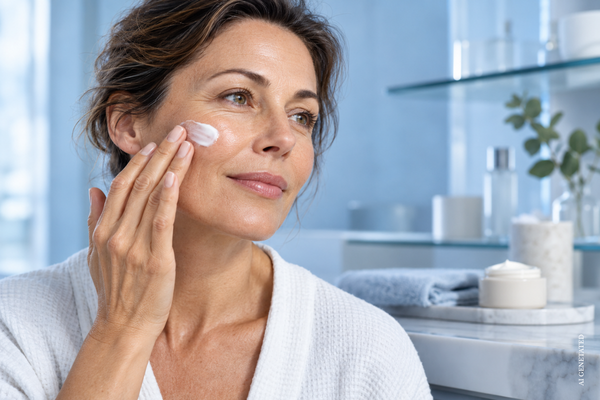
Article written by Elisa Avalle, founder of LeLang Skin Care and a dermocosmetics specialist. Cover image generated with the support of artificial intelligence.
[INDICE:h2]
What exactly is it
The crease marks the line along which the muscles that lift the upper lip attach to the skin. Above that line is the cheek fat pad; below it is the perioral region, which is mobile and has a different structure.
In a young face, the cheek fat pad is full and positioned high: the transition is smooth, and the crease is noticeable only when smiling. Over time, three changes occur that act in the same direction.
Volume decreases. The deep facial fat compartments lose mass, and the upper part of the cheek becomes hollow.
Volume descends. What remains shifts downward and accumulates right above the crease line, which becomes a step rather than a transition.
The skin loses support. The collagen and elastin network no longer holds the tissues in their original position. The mechanism is described in how collagen is lost.
The resorption of the facial bones also contributes, because it reduces the framework supporting the soft tissues. This is why the crease deepens even in people who are slim and have no wrinkles elsewhere.
Why creams have little effect, plainly stated
A cosmetic acts on the epidermis and, for the active ingredients that reach it, on the superficial dermis. The nasolabial fold depends on structures located much deeper: fat compartments, supporting fascia, and bone.
This does not mean there is nothing you can do; it means the goal needs to change. A good product can make the surrounding skin firmer and more hydrated, changing the way light falls on the crease and making it less noticeable. It can slow further loss of support. It cannot lift volume that has descended.
The difference between an immediate, temporary surface-tightening effect and structural firming that takes months is explained in immediate lifting effect. It is important to understand this distinction in this area, because many marketing claims rely precisely on confusing the two.
“No cream lifts volume that has descended. Saying so is the fastest way to stop people from wasting money.”
The factors that deepen it, and that can be addressed
There are four, and they are all more impactful than any product.
- Repeated weight fluctuations. Each cycle of losing and regaining weight leaves the tissues less supported than before. This is more noticeable in this area than anywhere else.
- Smoking. It accelerates the breakdown of elastic fibers and reduces microcirculation. Its effect on the perioral region is among the best documented.
- Unprotected sun exposure. Photoaging acts precisely on the support network that holds the tissues up.
- Sleeping position. Always sleeping on the same side compresses the cheek against the pillow for hours and accentuates the asymmetry between the two sides. If one crease is more pronounced than the other, this is almost always the explanation.
The results achieved by addressing these four points are greater than those of any routine, and they cost nothing.
What makes sense to use
The right strategy is not to treat the crease; it is to treat the cheek above the crease. Firmness and hydration in the malar area change the appearance of the transition much more than any product applied inside the fold.
Useful active ingredients are those that work on the dermal matrix: retinoids, vitamin C, signal peptides, and daily sun protection, which protects the work of the other three. These are the same ones described in the five active ingredients for preventing premature skin aging.
Regarding the motion: apply it by moving upward from the center of the face and toward the outside, never dragging downward. It is a small detail that, over time, prevents adding traction where the tissues are already descending.

ELYX PERFORMANCE Snail slime face cream, anti-wrinkle and regenerating Organic Snail Slime: regenerates and promotes cell renewal. Re... Discover ELYX PERFORMANCE

Elisa's note
This is the point at which, during a consultation, I say that a cosmetic product is not the right tool. It has never cost me a sale: it cost me that one, and earned me trust in everything else. A pronounced nasolabial fold belongs to another field, and pretending otherwise has a two-month expiration date.
When the answer lies elsewhere
If the goal is visible correction of the crease, the appropriate field is aesthetic medicine, with techniques that act on volume and deep support. These are procedures with indications, contraindications, and risks, and they must be assessed by a doctor: they are not the subject of this article or of a cosmetic consultation.
What is worth knowing is that the two approaches are not alternatives. People who maintain good skin quality achieve better and longer-lasting results even from medical treatments, because the surface above the correction is in better condition.
Realistic expectations
For this area, it is best to establish from the outset what you are trying to achieve; otherwise, you will change products every month for no reason.
With a consistent routine and daily sun protection, it is reasonable to achieve: firmer surrounding skin, a crease that is less noticeable in direct light, and above all, a slowing of its worsening over the following months and years.
The crease will not disappear. And if a product promises that it will, the promise conflicts with the common criteria established by European regulations for cosmetic claims, which require every claim to be truthful and substantiated.
The distinction between the different types of facial lines, and which ones a cosmetic product can actually address, is explained in expression lines and static wrinkles.
Frequently asked questions
Why do I have pronounced grooves even though I'm young?
Because their depth depends greatly on the individual shape of the face. Pronounced cheekbones and thin cheeks make them more noticeable at any age, without there being anything to correct.
Does losing weight make them worse?
Significant weight loss reduces the volume of the face's fat compartments and may make them more pronounced. This is not a reason not to lose weight; it is a reason to do so gradually.
Do facial exercises reduce them?
The available evidence is limited and mainly concerns perceived tone. For a groove caused by volume loss, muscle activity does not restore what is missing.
Do patches or nighttime devices work?
They mechanically reduce the crease while in use. The effect is superficial and wears off in the following hours.
Why is one deeper than the other?
Mild asymmetry is physiological in almost all faces. If the difference is pronounced, habitual sleeping position is the most frequent explanation.
Does hyaluronic acid in cream fill them in?
No. Hyaluronic acid applied topically hydrates the stratum corneum and improves its apparent firmness; it has nothing to do with injectable fillers, which are medical devices.
Sources for this article
01 Regulation (EC) No. 1223/2009 on cosmetic products
02 Regulation (EU) No. 655/2013 on common criteria for claims relating to cosmetic products
03 Anatomical literature on the superficial and deep fat compartments of the face and how they change with age
04 Documentation on bone resorption in the facial skeleton and its contribution to soft-tissue ptosis
On the website: expression and static wrinkles · immediate lifting effect · how collagen is lost