

Two anti-wrinkle serums in the same aisle: one costs fifteen euros, the other sixty. The same promise on the box, the same actives prominently named, and INCI lists that look similar at first glance. I'm often asked which one is the right choice, and almost always the real question is something else: what exactly am I paying for?
The price of an anti-wrinkle serum is justified by four verifiable things: the dose at which the active ingredient was studied, the form of the raw material, tests on the finished formula and packaging that protects the active ingredients. Not the jar, not the number of ingredients on the label. An inexpensive serum can work; an expensive one may not. Price alone proves nothing, either way.
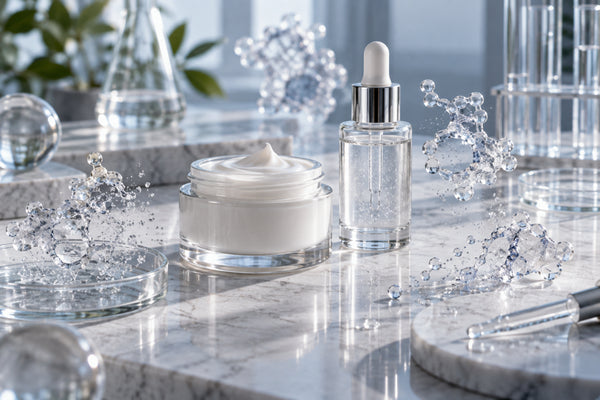
Cover image generated with the support of artificial intelligence.
[INDICE:h2]

Elisa Avalle · Founder and dermocosmetics specialist
A serum isn't worth what it costs. It's worth what it can prove, and you pay the difference either way.
Langhe, November 21, 2026
Why do two anti-wrinkle serums cost so differently?
Because the cost of a cosmetic product is made up of components you can't see from the outside. The final price includes raw materials, production, testing, packaging, distribution and the seller's margin. For a serum, what most distinguishes one product from another is the first: which active ingredient, in what form and at what dose.
The problem is that the label doesn't tell you. L'INCI lists ingredients in descending order only above 1%; below that threshold, the order is unrestricted. A peptide may be dosed as it was in the studies or at a fraction of that dose, and the label shows the same line. I wrote about this in my piece on what the INCI really tells you. That's why comparing prices alone can be misleading.
The four things that justify the price
1. The dose at which the active ingredient was studied
An active ingredient makes sense at the concentration at which it was tested. A study on Acetyl Hexapeptide-8, conducted in China on 60 people against a placebo, measured a reduction in eye-area wrinkles after four weeks using a formula with a defined dose. Below that dose, the mechanism remains plausible, but the data no longer apply. Biomimetic actives are expensive, and dosing them as in the studies is the first thing that sets one serum apart from another.
2. The form of the raw material
The same INCI name can refer to very different raw materials. LHyaluronic acid is the clearest example: in a study of 76 women, creams with hyaluronic acid of different molecular weights, applied for sixty days, improved hydration and elasticity, with results varying according to molecular weight. Vitamin C can be pure, which is unstable, or in a stabilized form. A purer, more stable or better-delivered raw material costs more, and you can’t see that on the label.
3. Tests on the finished formula
There’s a big difference between ingredient data provided by the manufacturer and testing on the finished product. Regulation (EU) 655/2013 requires every claim to be supported by adequate evidence, and the strongest evidence comes from testing the formula you buy: tolerance on sensitive skin, nickel, instrumental efficacy. These tests cost money, and a reputable brand lists them in its product information.
4. Packaging that protects the active ingredients
Peptides, vitamin C and antioxidants are sensitive to air and light. An airless or dark glass bottle, or a dropper that limits exposure to air, comes at a cost: it’s not about aesthetics, but stability. This is where packaging justifies the price. A heavy jar, on the other hand, doesn’t: I talked about it in a heavy jar isn’t luxury.
“You don’t pay for the active ingredient you see on the label. You pay for how much of it is really there.”
What doesn’t justify the price
- The weight and shape of the packaging, when they don’t protect the formula.
- A very long list of active ingredients, many of which appear near the bottom of the INCI list, after the preservatives.
- Claims without specifics, like “clinically tested” without saying what it was tested for, on how many people, or for how long.
- The name of a trendy ingredient printed prominently on the box, with no information about how much of it is included.
Can an affordable anti-wrinkle serum work?
Yes, and I say that without reservation. Some well-supported active ingredients cost very little, like niacinamide or hyaluronic acid, and a simple, well-formulated and well-preserved serum can do a good job on fine lines and hydration. The point is knowing what you can expect from it. Expression lines and loss of firmness call for more specific active ingredients, which naturally cost more.
There’s also a floor below which certain formulas can’t exist: a biomimetic peptide dosed as it was in the studies has an unavoidable cost. But it’s a floor, not a ceiling. Even when looking at a very expensive serum, you should ask the same questions.
How I do the math
I study, develop, and create the formulas for LeLang Skin Care; the laboratory's chemists make them and oversee their testing. When I decide whether an active ingredient belongs in a formula, my first question isn't how much it costs, but at what concentration it has been tested and whether I can afford to use it at that concentration. If the answer is no, the ingredient doesn't go in: I prefer one fewer ingredient to one included just so it can be named. I describe the process in what happens before an active ingredient goes into a cream.
Multi Peptide Lift Formula is the serum where this reasoning matters most: it combines two peptides that act on different mechanisms involved in facial expression contractions, Botoxil Technology®, with hyaluronic acid, resveratrol, arginine, and vitamin E. It is dermatologically tested on sensitive skin and nickel tested, and is available at pharmacies and para-pharmacies and on the official website.

MULTI PEPTIDE LIFT FORMULA - BOTOXIL TECHNOLOGY Anti-wrinkle face serum with Botoxil Technology® Two biomimetic peptides for expression lines, biotechnological resve... Discover MULTI PEPTIDE LIFT FORMULA - BOTOXIL TECHNOLOGY
Questions to ask before paying
- Are the promised active ingredients near the top of the INCI list or near the bottom?
- Does the brand say what the finished product was tested on, how many people took part, and for how long?
- Does the container protect the formula from air and light?
- Does the product make sense for your skin and the type of wrinkle you want to treat?
L'ast question is the most important one, and a label can't answer it. That's why at LeLang Skin Care partner pharmacies and para-pharmacies, you can also bring the products you're already using and ask for advice. The criteria for each type of wrinkle are in the guide to the best anti-wrinkle serum at the pharmacy.
What I really think
The price of a serum is a legitimate question, and the answer should be verifiable. Don't ask yourself whether a serum is expensive or affordable: ask what concentration of active ingredients it contains and what it has been tested on. If it doesn't tell you, the price is just a number.
Frequently asked questions
What sets a premium anti-wrinkle serum apart from an affordable one?
In a well-made serum, the main differences lie in the concentration of more expensive active ingredients, such as biomimetic peptides, the form of the raw material, tests on the finished formula, and packaging that protects the formula from air and light. The jar and the number of ingredients on the label don't make a meaningful difference.
Are there affordable yet effective anti-wrinkle serums?
Yes, especially for hydration and fine lines: niacinamide and hyaluronic acid are well supported by evidence and inexpensive. Expression lines and loss of firmness generally require more targeted active ingredients, such as biomimetic peptides, which cost more when used at the concentrations found in studies.
How do you compare high-end and mid-range anti-wrinkle creams?
Compare the position of active ingredients in the INCI, information about tests on the finished product, the type of container, and how well it suits your skin. Then try one at a time for at least eight weeks: that's the minimum time needed to judge an anti-wrinkle product.
Does an expensive anti-wrinkle cream work better?
Not simply because it costs more. A high price is justified only if it reflects active ingredients at concentrations used in studies, quality raw materials, and tests on the finished formula. A reputable brand makes this information verifiable on the product page.
Free 15-minute consultation with the founder
Are you holding two serums and unsure which one to choose, or want to know whether the one you use is right for your skin? Let's take a look together.

Elisa Avalle is the founder of LeLang Skin Care and specializes in dermocosmetics at the University of Barcelona.
Sources for this article
01 Wang Y. et al., The anti-wrinkle efficacy of argireline, a synthetic hexapeptide, in Chinese subjects: a randomized, placebo-controlled study, American Journal of Clinical Dermatology, 14(2), 2013, pp. 147-153
02 Pavicic T. et al., Efficacy of cream-based novel formulations of hyaluronic acid of different molecular weights in anti-wrinkle treatment, Journal of Drugs in Dermatology, 10(9), 2011, pp. 990-1000
03 Gorouhi F., Maibach H.I., Role of topical peptides in preventing or treating aged skin, International Journal of Cosmetic Science, 31(5), 2009, pp. 327-345
04 Regulation (EC) No 1223/2009 on cosmetic products, Articles 10 and 19
05 Regulation (EU) No 655/2013 on common criteria for claims relating to cosmetic products
On the website: how to read the INCI · how I choose active ingredients · the heavy jar · effective anti-wrinkle ingredients · anti-wrinkle serum at the pharmacy