


At a raw materials trade show, someone puts a folder in your hands. Inside there’s a new active, a name ending with a registered trademark symbol, and a percentage.
The percentage is almost always the same thing: an improvement of something by a certain percentage in a few weeks. That’s the moment when I have to decide whether that number means anything, and it’s the work no one sees because it happens two years before the product reaches a pharmacy.
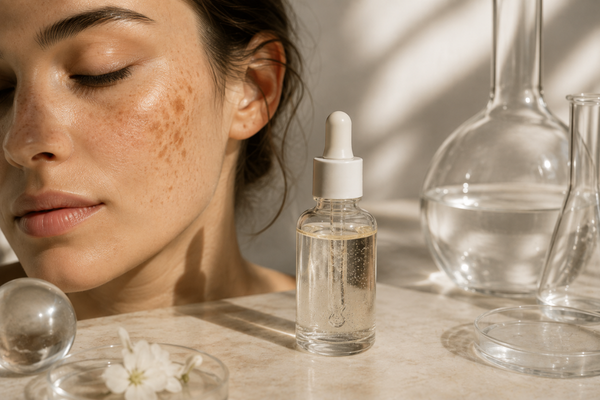
Cover image generated with the support of artificial intelligence.
[INDICE:h2]

Elisa Avalle · Founder and dermocosmetics specialist
Every now and then, someone asks me why the LeLang catalogue is so essential. The answer lies in a question that every active should pass before entering a formula.
The folder
Presentations for actives all look alike. There’s the mechanism of action explained with a colourful diagram, a drawn molecule, a bar chart with two columns (before and after), and an upward arrow.
The first thing I look at isn’t the tallest bar. It’s the small line beneath the chart, the one in size-eight type, where the thing that matters is stated: how many people, for how long, and above all on what.
Very often, that line says “in vitro”. It means the result was obtained on cells in culture, in a dish, in direct contact with the active. It’s useful data: it shows that the molecule does something at a biological level. But between a cell in a dish and a fibroblast beneath the stratum corneum of a real person, there are several layers of skin in between, and their exact job is to let as little as possible through.
The question that stops the conversation
When the data comes from people, I ask the question I’m really interested in, and I always phrase it the same way.
Was this study conducted on the pure active or on the finished product?
It sounds like a subtle distinction, but it changes everything. An active tested at five per cent, in a vehicle specifically designed to help it penetrate, at an optimal pH, is not the same active added at zero point two per cent to a cream that also needs to be stable, fragrant, pleasant, and shelf-stable for thirty months.
Very often, there is no answer, and not because anyone is lying: that data simply doesn’t exist. Testing the finished product costs much more than testing the active, and companies that sell raw materials often have no reason to do it.
“An active with excellent literature may do absolutely nothing inside the wrong formula. It isn’t the ingredient that works: it’s the formula.”
Then you test it, and that’s where almost all of them die
Let’s say the data convinces me. At that point, the long part begins, the part where the active enters a prototype and you see what really happens.
Very unromantic things happen. An active that works brilliantly at pH six and loses half its activity in a formula that needs to be at pH five. A plant extract that changes colour after three weeks in a heating cabinet, and no one sells a product that turns yellow. A texture that feels perfect on the first day and separates after a month. An active that conflicts with another active we need more.
And then there’s the worst-case scenario, the one people rarely talk about: the prototype works, it’s stable, it’s beautiful, but getting the active to the required concentration would put the final price beyond the market. Then you have two choices: include it at a token dose so you can write it on the label, or not make it. I choose the second, which is why some products I would have liked to make don’t exist.
Most of the actives I evaluate die here. Not because they’re bad, but because there’s an enormous distance between interesting and usable, and that distance can only be measured by testing.
Good suppliers exist, and you recognise them immediately
I don’t want to give the impression that it’s an adversarial relationship, because it isn’t. There are suppliers who work extremely well, and you recognise them by two things.
First: they also tell you what their active doesn’t do. They tell you at what concentration it loses effectiveness, what it is incompatible with, and under what conditions it degrades. When someone lists the limitations of their product, I trust everything else in the presentation more.
Second: when they don’t know something, they say they don’t know. It’s the rarest and most valuable answer. “We don’t have data on the finished product” is a perfectly acceptable sentence. What isn’t acceptable is pretending the question wasn’t asked.
Why the catalogue is essential
Every now and then, someone asks me why LeLang’s new products arrive so slowly.
The reason is all here. For me, a new product means months of evaluating data, prototypes, stability tests, corrections, and testing. It also means accepting that some of those months will end up amounting to nothing, because the formula doesn’t hold up or because the result doesn’t justify the price.
Here’s an example of what happens when it does hold up: for forehead and glabellar expression lines, I was looking for a recent-generation peptide, and the condition I set myself was to include it at the concentration stated in the studies, not at a token dose. The serum came out much later than expected, but it came out with that number in it.

MULTI PEPTIDE LIFT FORMULA - BOTOXIL TECHNOLOGY Anti-wrinkle face serum with Botoxil Technology® Two biomimetic peptides for expression lines, biotechnological resve... Discover MULTI PEPTIDE LIFT FORMULA - BOTOXIL TECHNOLOGY
I don’t think it’s the only way to make cosmetics. But I do think it’s the right way to be able to look a pharmacist in the eye when they ask me whether a product works, and give them an answer more precise than “yes”.
What does this mean for you, the person buying?
This article isn’t meant to turn you into a formulator. It’s meant to give you one thing: when you read a percentage on packaging or in a post, ask yourself what it was measured on.
If it isn’t written, that doesn’t necessarily mean the product doesn’t work. It means that percentage, on its own, isn’t telling you anything. It’s the same distinction I use when I look at a trendy ingredient: I wrote about it in relation to PDRN, where the gap between the available data and the story being told is particularly wide.
And there’s an honest shortcut if you don’t feel like doing this work every time: ask someone who has seen the formulas. It’s why we chose pharmacies and para-pharmacies as our channel: at our partner pharmacies, the person advising you knows the concentration of an active and which skin type it makes sense for, and can also tell you when the answer is that the product isn’t right for you.
And if you want to find your own way among the molecules, the cosmetic ingredients guide is where I would start.

Elisa Avalle is the founder of LeLang Skin Care, specialising in dermocosmetics at the Universitat de Barcelona. She founded the brand in the Langhe, for Italian pharmacies and para-pharmacies.
Where to continue
01 PDRN: where the studies end and marketing begins
02 Cosmetic ingredients guide
03 Peptides in cosmetics: what they are and which one to choose
04 LeLang partner pharmacies
05 About LeLang