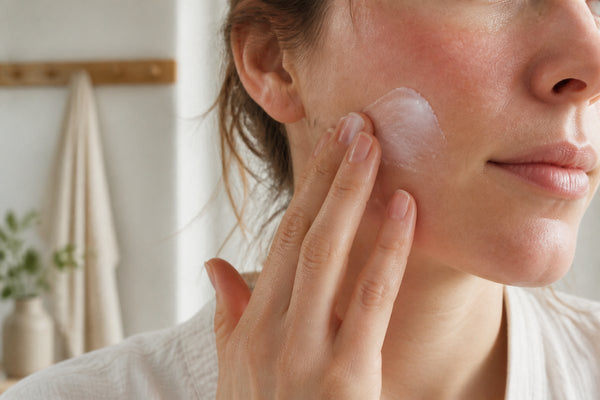


In November, sunscreen goes back in the drawer. The sky is gray, the days are short, and you don’t get a tan. And yet UVA rays, which penetrate deeply and accelerate skin aging, don’t disappear in winter and pass through clouds and car side windows. The point isn’t whether the sun is out, but how much light reaches your skin every day, year after year.
The short answer: yes, you need sun protection on your face every day, even in winter and under cloudy skies, because UVA rays are present year-round and are among the main causes of sunspots and wrinkles. Apply it as the last step in your skincare routine, before makeup, in the right amount. LeLang Skin Care’s Spot Defence 50 SPF, available at pharmacies and drugstores, is a fluid broad-spectrum UVA/UVB sunscreen serum designed for daily use and as a makeup primer.
Quick guide
| Situation | Do you need SPF on your face? | What to do |
|---|---|---|
| A winter day in the city | Yes | Broad-spectrum SPF 30-50 in the morning, as the last step in your skincare routine |
| Cloudy skies | Yes | Light clouds let most UV rays through |
| In the car | Yes, especially on the side by the window | The windshield blocks almost all UVA rays, while side windows block far fewer |
| Under makeup | Yes | Apply SPF first, wait a few minutes, then apply foundation |
| Mountains and snow | Yes, high protection | SPF 50, reapply every two hours |
| Dark spots or melasma | Yes, always | Broad-spectrum, ideally with antioxidants; visible light also matters with melasma |
Article written by Elisa Avalle, founder of LeLang Skin Care and dermocosmetics specialist. Cover image generated with the help of artificial intelligence.
[INDICE:h2]
Is sunscreen on your face really necessary every day?
It’s one of the few skincare habits verified in a long-term randomized study. In Australia, 903 adults under 55 were randomly divided into a group that applied broad-spectrum sunscreen every day and one that used it only when they thought it necessary. After four and a half years, skin aging had not increased to a measurable degree in the daily-use group and was 24% lower than in the other group.
The important point isn’t a high SPF, it’s the word “daily.” A 2021 international review on photoprotection to prevent photoaging reached the same conclusion: broad-spectrum protection should be used every day, ideally with antioxidants, and there is no conclusive evidence that daily use is unsafe or compromises vitamin D synthesis. The relationship between sunscreen and vitamin D is explained in the dedicated article on sun protection and vitamin D.
Why is it needed in winter and on cloudy days?
It's important to distinguish between two types of rays. UVB rays cause sunburn: in winter, at our latitudes, they drop considerably, which is why we don't get red. UVA rays, on the other hand, vary much less with the seasons, penetrate deeper into the dermis, and silently affect collagen, elastin, and pigment. They don't burn, so we don't notice them.
An Australian study that used dosimeters to measure office workers' actual exposure across all four seasons found that UVA exposure was at a similar level in winter and summer, while exposure that causes sunburn was lower in winter. The setting was subtropical, not Italy, but the principle still applies: the season mainly affects sunburn, much less so the slow-acting damage.
Another situation people underestimate is driving. A measurement of 29 cars found that windshields block an average of 96% of UVA rays, while side windows block only 71%, with figures falling to 44% in some models. People who drive every day receive a dose of UVA through the side window that builds up over the years.
How much sunscreen should you apply to your face?
More than you might think. L'SPF on the label is measured using 2 milligrams of product per square centimeter of skin, but in real life people usually apply between 0.8 and 1 milligram, about half the amount. With half the amount, the layer becomes thin and uneven, and the actual protection falls well below the value on the label.
The rule of thumb: you need about two finger-lengths of product for your face and neck, meaning two strips of cream along your index and middle fingers. With a fluid sunscreen serum, apply the same amount in several layers, letting each one absorb before applying the next. If the texture feels pleasant, you'll apply all of it; if it's heavy, you'll use less: that's why texture matters as much as SPF.
When you're away from home all day, sunscreen needs to be reapplied, especially before heading out during the middle of the day. The differences between SPF categories and the meaning of the UVA symbol on the label are explained in the guide to the best facial sunscreen.
How do you apply sunscreen under makeup?
Sunscreen is the last step in your skincare routine and the first step in your makeup routine. Here’s the order I recommend:
- Serum and moisturizer as usual, letting them absorb well.
- Sunscreen in the full amount, spread evenly over the temples, hairline, ears and neck too.
- Wait two or three minutes before applying foundation: the protective film will set and the makeup won’t disturb it.
- Pat on foundation with a sponge or brush, without rubbing.
- During the day, if you need to reapply over makeup, use a fluid formula and pat it on with your fingers or a clean sponge.
Foundation with SPF alone isn’t enough: to get the protection stated on the label, you’d have to apply an amount that no one uses as makeup. It’s a useful addition, not a substitute. If sunscreen tends to pill under foundation, the cause is usually applying one product too soon after the previous one, not incompatibility between the formulas.
Mineral sunscreen: what are the advantages and disadvantages?
Mineral filters, zinc oxide and titanium dioxide, are well tolerated and suitable for very reactive skin. Their drawback is cosmetic: a lot is needed to achieve a high SPF, and the texture tends to leave a white cast, especially on darker skin. The latest-generation organic filters, permitted in Europe only if they are listed in the Cosmetics Regulation, allow for lighter textures and high UVA protection.
There’s no single best choice: the best one is the one you use every day in the right amount. The differences are explained in the guide to chemical and physical sunscreens.
Which sunscreen should you use to prevent dark spots?
For dark spots, SPF alone is not the deciding factor. You need broad-spectrum protection with high UVA protection, because long UVA rays are involved in pigmentation. A study of volunteers with skin phototypes IV to VI showed that visible light also causes darker, more persistent pigmentation than long UVA rays; this was not observed in skin phototype II. For this reason, the 2021 international review recommends formulas containing pigments such as iron oxides for melasma, as they also shield against visible light.
Antioxidants add a second line of defense: a vitamin C serum under sunscreen neutralizes some of the free radicals that filters let through. The causes of sun spots are explained in the article about sun spots on the face.
At the seaside or in the mountains: what changes?
In the mountains, UV intensity increases with altitude, and fresh snow reflects up to 80% of radiation, which also reaches you from below: areas like the chin and nostrils, which are shaded in the city, receive a high dose. At the seaside, water and sand reflect less than snow, but exposure lasts for hours. In both cases, use SPF 50, a water-resistant formula, and reapply every two hours and after every swim or heavy sweating.
Everyday sun protection by LeLang Skin Care
Spot Defence 50 SPF is LeLang Skin Care’s facial sunscreen serum for everyday use. It provides broad-spectrum UVA/UVB protection, is tested in accordance with UNI EN ISO 24444:2020 and ISO 24443:2012 standards, and is water-resistant. Alongside the filters, it features plant glycogen, stabilized and encapsulated vitamin C, postbiotic ferments, and maritime pine bark extract for extra antioxidant protection against spots. Its fluid, non-comedogenic texture is also suitable for sensitive, combination, or acne-prone skin, and works as a makeup base.

SPOT DEFENCE 50 SPF SPF 50 anti-dark-spot facial sunscreen serum With encapsulated vitamin C, plant glycogen and postbiotic ferments, for... Discover SPOT DEFENCE 50 SPF
For reapplication when you're out, there's SPF 50 Pocket Face Sunscreen: single doses to keep in your bag, designed to make correct application and reapplication easy. It was inspired by a winter walk, with the UV index above the threshold and no sun protection at hand.

Face Sunscreen SPF 50 Pocket Size, Travel Size (5 pcs) Pocket-sized SPF 50 facial sunscreen in single doses The problem isn’t applying sunscreen. It’s reapplying it. Smalle... Discover Face Sunscreen SPF 50 Pocket Size, Travel Size (5 pcs)
Under sunscreen in the morning, Ferulic + HA Serum adds stabilized vitamin C, ferulic acid, and vitamin E. They’re all available at LeLang partner pharmacies and drugstores and on the official website.
Frequently asked questions
Is sunscreen on your face really necessary every day?
Yes. In a randomized Australian study, people who applied sunscreen every day showed 24% less skin aging after four and a half years than those who used it only at their discretion. UVA rays are present year-round, even when it's cloudy.
How do you apply facial sunscreen under makeup?
As the final step in your skincare routine, apply about two finger lengths to your face and neck, and wait two or three minutes before applying foundation. Pat on foundation rather than rubbing it in. LeLang Skin Care’s Spot Defence 50 SPF is a lightweight sunscreen serum also designed to work as a makeup primer.
What sunscreen should you use to prevent sunspots?
Use broad-spectrum protection with high UVA protection, ideally with antioxidants, every day and reapply when spending time outdoors. Those with melasma benefit from formulas with iron oxides, which also block visible light. Applying a vitamin C serum under sunscreen strengthens protection.
Mineral sunscreen: what are the advantages and disadvantages?
Mineral filters are well tolerated and suitable for reactive skin, but high SPF requires large amounts, which can leave a white cast. New-generation organic filters allow for lighter textures. The right choice is the one you use every day in the correct amount.
Is foundation with SPF enough?
No. To get the stated level of protection, you’d need to apply much more than you would when using it as makeup. Foundation with SPF is a useful addition on top of proper sunscreen, not a substitute.
Do I need sunscreen if I’m at home or in the office?
If you stay away from windows all day, you need very little protection. If you work near a window, go out for lunch, or drive, then yes: window glass and car side windows let some UVA rays through.
Do you need different sun protection at the beach or in the mountains?
Use water-resistant SPF 50, reapplying every two hours and after every swim or when you sweat. In the mountains, UV intensity increases with altitude, and snow reflects up to 80% of radiation, so protect your face below the chin and around the nose too.
Free 15-minute consultation with the founder
Does sunscreen feel greasy, pill under makeup, or are you unsure which one to choose for your dark spots? Book a free virtual skincare consultation with Elisa Avalle, founder of LeLang Skin Care: together, we’ll find the protection you’ll really use every day.
Sources for this article
- Hughes M.C.B., Williams G.M., Baker P., Green A.C. (2013). «Sunscreen and prevention of skin aging: a randomized trial». Annals of Internal Medicine, vol. 158, no. 11, pp. 781-790.
- Krutmann J., Schalka S., Watson R.E.B., Wei L., Morita A. (2021). “Daily photoprotection to prevent photoaging”. Photodermatology, Photoimmunology & Photomedicine, vol. 37, no. 6, pp. 482-489.
- Wainwright L.K., Parisi A.V., Downs N.J. (2017). “Concurrent evaluation of personal damaging and beneficial UV exposures over an extended period”. Journal of Photochemistry and Photobiology B: Biology, vol. 170, pp. 188-196.
- Boxer Wachler BS. (2016). “Assessment of Levels of Ultraviolet A Light Protection in Automobile Windshields and Side Windows”. JAMA Ophthalmology, vol. 134, no. 7, pp. 772-775.
- Grigalavicius M., Iani V., Juzeniene A. (2016). “Layer Thickness of SPF 30 Sunscreen and Formation of Pre-vitamin D”. Anticancer Research, vol. 36, no. 3, pp. 1409-1415.
- Mahmoud B.H., Ruvolo E., Hexsel CL. et al. (2010). “Impact of long-wavelength UVA and visible light on melanocompetent skin”. Journal of Investigative Dermatology, vol. 130, no. 8, pp. 2092-2097.
- Passeron T., Lim HW., Goh CL. et al. (2021). “Photoprotection according to skin phototype and dermatoses: practical recommendations from an expert panel”. Journal of the European Academy of Dermatology and Venereology, vol. 35, no. 7, pp. 1460-1469.
- World Health Organization (2002). Global Solar UV Index: A Practical Guide.
- Regulation (EC) No 1223/2009 of the European Parliament and of the Council on cosmetic products, Annex VI (permitted UV filters).
On the website: Best facial sunscreen · Sunspots on the face · Chemical and physical sunscreens · Sun protection and vitamin D · Photoaging collection