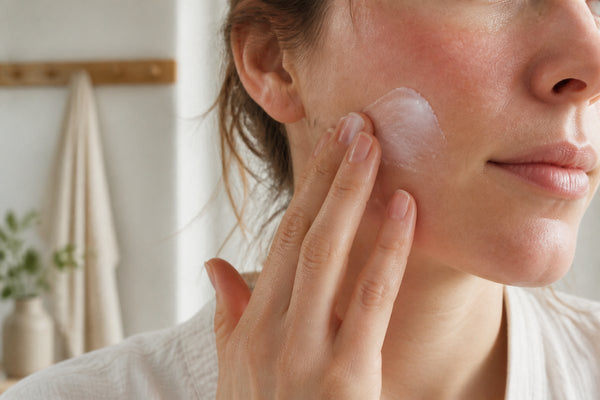


Between the eyebrows are two small, thick muscles that work all day: when we concentrate, when the light is too bright, when something doesn’t seem right. That’s where frown lines form: vertical creases that give the face a stern or tired look, even when we don’t feel that way. They aren’t the first wrinkles to appear, but they’re often the most noticeable because they’re right at the center of our gaze.
In brief: frown lines (or glabellar wrinkles) are expression lines caused by repeated contraction of the corrugator and procerus muscles. A cosmetic product won’t erase them, but it can make them less pronounced by working on two fronts: muscle contraction, with biomimetic peptides such as Acetyl Hexapeptide-8, and skin quality, with hydration and sun protection. In LeLang Skin Care’s range, available at pharmacies and drugstores, Multi Peptide Lift Formula with Botoxil Technology® is formulated to work on the glabella too.
Article written by Elisa Avalle, founder of LeLang Skin Care and dermocosmetics specialist. Cover image generated with the support of artificial intelligence.
[INDICE:h2]
Quick guide
| What your wrinkle looks like | What it means | What skincare can do |
|---|---|---|
| Visible only when you frown | Dynamic wrinkle: the skin creases but smooths out again | A lot: peptides, hydration, and SPF slow the transition to a permanent wrinkle |
| Barely visible when your face is relaxed | Wrinkle in transition | Good: consistent use for 2-3 months, with ingredients that target muscle contraction and the skin matrix |
| Deeply etched and always visible | Static wrinkle, the crease is now part of the skin’s structure | Partial: the surrounding skin improves and the crease softens, but remains |
| More pronounced on waking, on one side only | Possible contribution from nighttime compression | Changing your sleeping position matters as much as the product |
What are frown lines, and why are they called that?
The area between the eyebrows is called the glabella, and the wrinkles that form there are known as glabellar wrinkles. The common name, “frown lines,” comes from the frowning expression these creases create: one or two vertical lines, sometimes with a horizontal crease above the bridge of the nose.
Unlike forehead wrinkles, which are horizontal and depend on the frontalis muscle, glabellar wrinkles are vertical because the muscles that cause them pull in a different direction: they draw the eyebrows together and lower them. This difference matters because it affects what a product can do. For a complete overview of wrinkles above the eyes, see our guide to forehead wrinkles.
Which muscles form the line between the eyebrows?
There are two. The corrugator supercilii, a paired muscle that starts at the bone near the bridge of the nose and attaches to the skin of the eyebrow: when it contracts, it draws the eyebrows together and carves vertical lines. The procerus, a small muscle in the center that lowers the inner part of the eyebrows and forms the horizontal crease at the bridge of the nose.
An ultrasound study published in Toxins observed these muscles in motion: in 13 out of 16 people, frowning is driven by the corrugator and procerus muscles; in a minority, the frontalis muscle also comes into play, raising the vertical lines and adding horizontal wrinkles. These muscles are thicker than the frontalis, and their contraction is concentrated in just a few centimeters: that's why the glabellar line tends to cut more deeply than forehead lines.
Why it forms: causes that aren't just about age
Less elastic skin comes with age, but the glabellar line forms mainly through repetition. Each contraction folds the skin in the same place; as long as the dermis is rich in collagen and elastin, the fold springs back, but at a certain point it remains. The causes that increase the number of contractions can often be changed.
- Bright light without sunglasses. You frown to protect your eyes, in winter as well as summer, while UV rays degrade the collagen in the area.
- Uncorrected vision problems. People who squint to focus contract their corrugator muscles dozens of times an hour.
- Screens and concentration. Many people frown while reading, working at a computer, or driving without realizing it.
- Sleep position. Sleeping on your side or stomach compresses and stretches the skin on your face: sleep wrinkles run in a different direction from expression lines, and a review in Aesthetic Surgery Journal describes them as a distinct phenomenon that can add to the former.
- Photoaging. In a randomized study of 903 adults, those who used sunscreen every day showed no measurable increase in skin aging over 4.5 years, unlike those who used it at their discretion.
Before looking for the right serum, it’s worth asking how many times a day those muscles work and why. Sunglasses, an eye exam, and keeping your screen at the right height reduce contractions at no cost.
What can a serum do for frown lines?
It’s important to distinguish between three approaches, which work over different time frames.
Reduce the intensity of contractions
This is the role of biomimetic peptides that interfere with signaling between the nerve and the muscle. L’Acetyl Hexapeptide-8 was designed to partially imitate the mechanism of botulinum toxin by interfering with the protein complex (SNARE) that enables neurotransmitter release: in the original study, it demonstrated this action in the laboratory, with much lower efficacy than the toxin and without primary irritation. In a placebo-controlled study of 60 people, four weeks of application measurably reduced wrinkles around the eyes. The effect is gradual and reversible: it works as long as you use it.
Support the structure beneath the fold
A wrinkle becomes established when the dermis beneath the furrow loses firmness. Signal peptides, antioxidants such as resveratrol and vitamin C, and a retinoid at night if your skin tolerates it all work to improve the quality of the matrix. This is the slowest approach: assess the results after three months.
Improve the appearance of the surface
Well-hydrated skin reflects light more evenly, making the furrow less noticeable. L’hyaluronic acid does this in a few hours, but the effect wears off if you stop using it.
LeLang Skin Care’s Multi Peptide Lift Formula combines all three approaches. Botoxil Technology® combines Acetyl Hexapeptide-8 and Acetyl Hexapeptide-1, which act on different mechanisms involved in facial muscle contractions; biotechnological resveratrol, hyaluronic acid, and Alteromonas Ferment Extract work to improve firmness and smoothness. The forehead and glabella are among the areas listed for use. It is dermatologically tested on sensitive skin and nickel tested.

MULTI PEPTIDE LIFT FORMULA - BOTOXIL TECHNOLOGY Anti-wrinkle face serum with Botoxil Technology® Two biomimetic peptides for expression lines, biotechnological resve... Discover MULTI PEPTIDE LIFT FORMULA - BOTOXIL TECHNOLOGY
To seal in the serum and nourish mature skin, the protocol’s cream is Perlage.

PERLAGE Anti-wrinkle face cream with Argireline® for expression lines Antioxidant and protective, for all skin types. Reduce... Discover PERLAGE
How do you apply serum to the glabella?
It’s a small area that gets little product, because our usual application focuses on the cheeks and eye contour. The method I recommend during consultations:
- Clean, dry skin. Apply the serum before your moisturizer, morning and evening.
- A dedicated drop. After spreading the serum over your face, add a small amount to the tip of your middle finger and apply it directly between your eyebrows.
- Movements that open up the crease. Use two fingers to tap and smooth the skin outwards, towards the eyebrows, without pulling it downwards.
- Up to the forehead. Move upwards towards the hairline, because the glabella and forehead work together.
- Sun protection in the morning. Apply it up to the root of the nose and between the eyebrows, an area that is often left uncovered.
The first changes in smoothness are generally noticeable after four weeks, with results building between four and eight weeks of consistent use. For wrinkles that remain when your face is at rest, the timeline is that of the skin matrix: two or three months.
You don’t need a different product for every wrinkle. You need the right serum to actually reach where it’s needed: with the glabella, the problem is almost always stopping the application too soon.
Can you prevent frown lines?
Yes, and this is when cosmetics are most effective. With a dynamic wrinkle that only appears when you frown, avoiding each contraction and wearing sun protection every day help slow its progression into a static wrinkle. The rules are simple: wear sunglasses year-round, get your vision checked, position your screen at eye level, apply SPF every morning, and start using a peptide serum in your thirties if the wrinkle appears early. The difference between a dynamic and a static wrinkle is explained in our guide to expression lines and static wrinkles.
When isn’t a cosmetic product enough?
It’s important to be clear. For a deep glabellar line that has been visible at rest for years, a topical product improves the surrounding skin, making it firmer and more hydrated, and softens the crease, but it won’t deliver results comparable to a medical treatment. If your goal is a noticeable change in a few weeks, the right person to talk to is a doctor. If your goal is to slow the process, maintain your skin, and help it stay in better condition between treatments, the serum is your daily tool. Multi Peptide Lift Formula is a cosmetic treatment and does not replace aesthetic medical procedures; the two approaches can be used together.
Frequently asked questions
What are the alternatives to Botox for glabellar lines?
Among cosmetics, the most researched alternative is biomimetic peptides such as Acetyl Hexapeptide-8, which gradually reduce the intensity of facial muscle contractions, alongside hydration and daily sun protection. They don’t deliver the same results as a medical treatment, but they can soften expression lines and slow their deepening. LeLang Skin Care’s Multi Peptide Lift Formula, available at pharmacies and para-pharmacies, targets this mechanism with Botoxil Technology®.
At what age does the frown line appear?
Dynamic lines between the eyebrows can appear as early as your mid-twenties to early thirties, especially in people who often furrow their brows or spend time in the sun without sunglasses. Age matters less than when the wrinkle starts to show even when your face is relaxed: that’s a sign the crease is becoming permanent.
Can you get rid of the frown line with a cream?
Eliminate it? No. Soften it? Yes. A serum with biomimetic peptides, hyaluronic acid, and antioxidants can make the wrinkle less pronounced and the surrounding skin firmer, with results building over four to eight weeks of consistent use. Results are partial for a deep crease that has been visible for years.
Do patches for the line between the eyebrows work?
They keep the skin in place overnight and can soften the crease when you wake up, but the effect is temporary and superficial: it lasts a few hours after you remove them. They can complement your routine, not replace it.
Why is the frown line more noticeable in the morning?
At night, your position on the pillow can compress your face, and fluids redistribute: the lines look more pronounced in the early hours and fade throughout the day. If the wrinkle is more noticeable on one side, it’s worth looking at your sleeping position too.
Which ingredient should you look for in a serum for glabellar lines?
Peptides that target muscle contraction, such as Acetyl Hexapeptide-8 and Acetyl Hexapeptide-1, near the top of the INCI list; followed by firming ingredients such as resveratrol and hyaluronic acid. In the morning, always follow the serum with SPF 50 sunscreen.
Want to understand what kind of wrinkle you have?
In fifteen minutes, we’ll look at your skin together, whether the wrinkle is still dynamic, and which routine makes sense for you. You can also ask for advice at LeLang Skin Care partner pharmacies and para-pharmacies.
Sources for this article
- Kim S.B., Kim H.M., Ahn H., Choi Y.J., Hu K.S., Oh W., Kim H.J. (2021). «Anatomical Injection Guidelines for Glabellar Frown Lines Based on Ultrasonographic Evaluation». Toxins, vol. 14, no. 1, 17.
- Anson G., Kane M.A.C., Lambros V. (2016). «Sleep Wrinkles: Facial Aging and Facial Distortion During Sleep». Aesthetic Surgery Journal, vol. 36, no. 8, pp. 931-940.
- Blanes-Mira C., Clemente J., Jodas G. et al. (2002). «A synthetic hexapeptide (Argireline) with antiwrinkle activity». International Journal of Cosmetic Science, vol. 24, no. 5, pp. 303-310.
- Wang Y., Wang M., Xiao S., Pan P., Li P., Huo J. (2013). «The anti-wrinkle efficacy of argireline, a synthetic hexapeptide, in Chinese subjects: a randomized, placebo-controlled study». American Journal of Clinical Dermatology, vol. 14, no. 2, pp. 147-153.
- Gorouhi F., Maibach H.I. (2009). «Role of topical peptides in preventing or treating aged skin». International Journal of Cosmetic Science, vol. 31, no. 5, pp. 327-345.
- Hughes M.C.B., Williams G.M., Baker P., Green A.C. (2013). «Sunscreen and prevention of skin aging: a randomized trial». Annals of Internal Medicine, vol. 158, no. 11, pp. 781-790.
- Regulation (EC) No. 1223/2009 on cosmetic products and Regulation (EU) No. 655/2013 on common criteria for claims relating to cosmetic products.
On the website: Forehead wrinkles · Expression and static wrinkles · Best peptide serum at the pharmacy · Peptides in cosmetics · Deep wrinkle collection