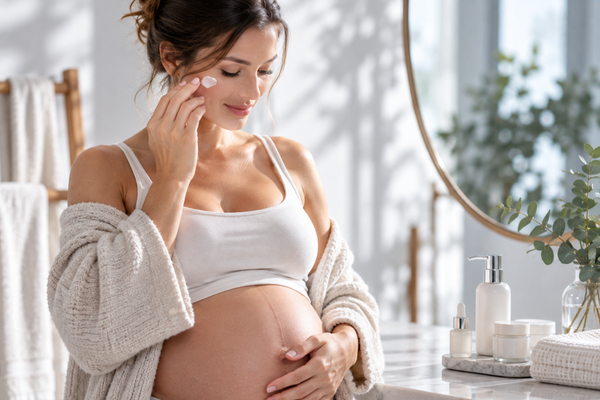



Stretch marks are not a superficial blemish. They are scars: the breakdown of collagen and elastin fibres in the dermis, meaning a layer that no cosmetic product reaches to any significant extent. Understanding this completely changes expectations, and above all changes when it makes sense to take action.
The window of opportunity is when they are still red. Once they are white, they are considered mature scars, and a cosmetic product has nothing more to offer.
Article written by Elisa Avalle, founder of LeLang Skin Care and dermocosmetics specialist. Cover image generated with the support of artificial intelligence.
Why they form
Two conditions are needed together. The first is mechanical: the skin is stretched faster than the dermis can reorganise itself, which happens during pregnancy, adolescent growth spurts, rapid weight changes and fast increases in muscle mass. The second is hormonal: glucocorticoids reduce collagen synthesis and make the tissue less able to withstand stretching. This is why they can also appear in situations where the skin has not been stretched that much.
Underlying all of this is individual predisposition, which matters more than any cream: two identical pregnancies produce different results in two different people. If stretch marks appear without an obvious cause, diffusely or in adulthood, an endocrine problem should be ruled out: this requires medical, not cosmetic, assessment.
Red or white: they are two different things
Recent stretch marks are red or purplish because there is an active inflammatory component and the capillaries are visible through a thinned dermis. At this stage, the tissue is still responding: consistent hydration, daily massage and active ingredients that support repair make sense, and the appearance can improve noticeably.
White stretch marks are the final result: atrophic scar tissue, without pigment or skin appendages. They cannot be “filled in” with a cream, for the same reason that no cream makes a cut scar disappear. Substantially improving their appearance requires procedures that remodel the dermis, and those fall within the medical field.
What a cosmetic product can really do
Three things, and it is worth being precise because a lot is promised on this subject. It can keep the skin elastic and hydrated while it is being stretched, making the tissue less rigid. It can reduce itching and the feeling of tight skin, which are often the symptoms that announce the appearance of stretch marks. And it can improve the appearance of recent ones by acting on the inflammatory component and skin microtexture.
Active ingredients with some supporting evidence include centella asiatica, hyaluronic acid, peptides and plant oils rich in essential fatty acids. However, the available studies are few and involve small numbers of participants: anyone who tells you that an ingredient definitely prevents stretch marks is going beyond what the data allow us to say.
A detail that matters as much as the formula: daily application with massage. Consistency over several months is what makes the difference, and a product you enjoy using every night is worth more than a more sophisticated one that stays in the drawer.

RELAX BODY MASSAGE OIL Massage body oil With neurocosmetic ingredients, it promotes relaxation Improves density and elasticity Provides int... Discover RELAX BODY MASSAGE OIL
What to be wary of
- “Eliminates stretch marks”. No cosmetic product eliminates a scar. This is a claim that holds up neither scientifically nor from a regulatory standpoint.
- Before-and-after photos taken in different lighting. White stretch marks can look very different depending on the lighting and the surrounding tan. A serious comparison is made under the same conditions.
- Kitchen remedies. Butters and food oils moisturise, and that is all they do: they have no action on the dermis.
- Tanning as a solution. White stretch marks do not develop pigment: in the sun, the surrounding skin becomes darker and they stand out more, not less.
When you need a dermatologist
Fractional lasers, microablative radiofrequency and microneedling act by remodelling collagen and are the only tools with documented results for white stretch marks. The choice of technique, number of sessions and assessment of skin type are the doctor’s responsibility. A cosmetic product does not replace them: it can prepare the skin and help maintain the result, which is not insignificant but is something else.
Prevention: what makes sense to do
- Start early, not when they appear. During pregnancy, start in the first few months, not the eighth: it is also worth reading about what can be used during pregnancy in general.
- Apply every day to the hips, abdomen, breasts, thighs and buttocks, massaging for a few minutes.
- Moisturise the rest of the body as well, because dry skin is less extensible: a body care routine is not an accessory at this stage.
- Where possible, avoid very rapid weight changes: this is the most effective measure of all, and it does not come from a cosmetic product.
Frequently asked questions
Do stretch marks disappear on their own?
No, but they change. Over the course of several months, they go from red to white and become less noticeable than they were at first. This spontaneous improvement is often attributed to the cream being used during that period.
Do they only occur during pregnancy?
No. They are common during adolescence, with weight changes and in people who rapidly increase their muscle mass. In men, they typically appear on the back and shoulders.
Do you need a specific product, or is a body cream enough?
During prevention, consistency matters more than the formula. For stretch marks that have already appeared and are still red, a more targeted product makes sense, with active ingredients that work on repair and not just hydration.
Sources for this article
- Dermatological literature on the pathogenesis of striae distensae: the role of mechanical stretching, glucocorticoids and individual predisposition.
- Clinical classification into striae rubrae and striae albae, and histological differences between the inflammatory phase and mature atrophic scarring.
- Systematic reviews of topical treatments for preventing stretch marks during pregnancy: limited sample sizes and low-quality evidence.
- Studies on device-based treatments for striae albae: fractional lasers, radiofrequency and microneedling for dermal collagen remodelling.
It all comes down to timing. For a red stretch mark, it is worth applying treatment every evening for months; for a white one, honesty means saying that the cream serves to keep the skin comfortable and that the rest is the dermatologist’s domain.