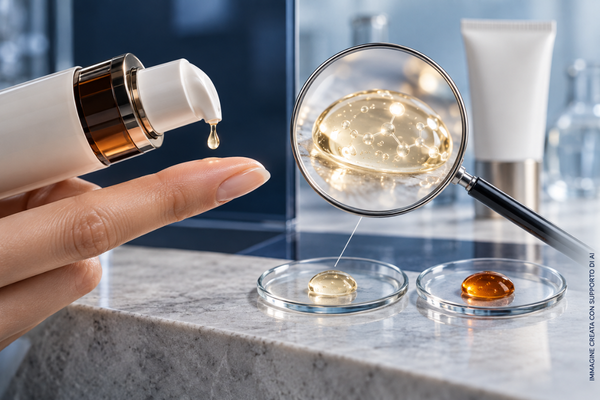



Toner is the product in a skincare routine surrounded by the most contradictory opinions: for some, it is indispensable; for others, it is scented water to skip. They are both right and wrong, because products that do completely different things are sold today under the same name.
In brief
- Toner originated to correct residue from alkaline soaps and limescale. With a gentle cleanser, that function matters much less.
- Today there are three families: exfoliating, hydrating, and soothing toners. Asking "is toner necessary?" only makes sense after choosing which type.
- Alcohol-rich astringent toners are the ones to avoid on dry, sensitive, or redness-prone skin.
- If your cleanser leaves your skin feeling tight, toner does not solve the problem: it hides it.
Article written by Elisa Avalle, founder of LeLang Skin Care and dermocosmetics specialist. Cover image generated with the support of artificial intelligence.
[INDICE:h2]
What toner was used for, and why it has changed today
The surface of the skin is slightly acidic, with a pH below 5 in healthy adults. Traditional soaps, on the other hand, are alkaline, and after washing they leave the skin at a higher-than-physiological pH for a certain period of time. Tap water adds to this: where it is hard, limescale leaves residue on the skin that binds to surfactants and makes the barrier more vulnerable.
Traditional toner was used for this purpose: to remove the final residue and bring the surface back toward its natural acidity. The mechanism is explained in the article on skin pH.
The point is that today almost no one washes their face with laundry soap. A good facial cleanser is already formulated at a skin-compatible pH, and toner’s “rebalancing” function has therefore become much less important. This is why toner has changed: from a corrective step, it has become a vehicle for specific active ingredients.
The three families of toner
Exfoliating toners
They contain acids: glycolic, lactic, mandelic, salicylic, or polyhydroxy acids. They work by loosening surface cells and are, in effect, a treatment. They should be treated as such: not every day at first, never together with another exfoliant on the same evening, and always with sun protection in the morning. How to choose the right acid is explained in the guide to acids in skincare.
Hydrating toners
These are water-based solutions with humectants such as glycerin, hyaluronic acid, or panthenol. They give the skin an initial layer of water over which serum spreads more easily. They are useful for dehydrated skin and in winter, but less necessary if the serum that follows already has a rich hydrating base.
Soothing toners
Floral waters, thermal waters, and calming extracts. There are very different products in this category: Damask rose water and witch hazel are the classics, but with witch hazel, the form matters greatly, because distilled water and extract do not contain the same substances.
The toner to avoid
It is the alcohol-based astringent toner, often sold for oily skin. The feeling of freshness and “degreased” skin is immediate, and that is precisely the problem: high concentrations of denatured alcohol strip away surface lipids, and a skin barrier deprived of its lipids tends to react with more redness and, in oily skin, more sebum.
Not every alcohol in an INCI is a problem: fatty alcohols, such as cetyl alcohol, are emollients and have nothing to do with denatured alcohol. The one to look for is Alcohol Denat. near the top of the list.
How to apply it
After cleansing and before serum. How you apply it depends on the family.
- Hydrating and soothing toners: apply with your hands, patting gently. A cotton pad absorbs some of the product and adds unnecessary rubbing.
- Exfoliating toners: a cotton pad makes sense because it allows you to measure and distribute the acid evenly. Glide it lightly over the skin, without insisting on areas that are already sensitive.
- Sprays: mist from about twenty centimeters away, then let the product dry for a few seconds or pat it in before continuing.
The order of the rest of the routine is the one described in serum or cream first: from the most fluid product to the richest.
Who can skip it
Anyone who uses a gentle cleanser, has balanced skin, and a serum that already provides hydration: in this case, toner does not add much, and removing one step is not a sacrifice. On the other hand, people who live in an area with very hard water, have dehydrated skin, or want to introduce an acid gradually may find a tangible benefit in using one.
A practical alternative, especially away from home, is a thermal water spray: it does the job of a soothing toner and can also be used throughout the day, as explained in thermal water spray.

MULTI VIT THERMAL WATER Multivitamin thermal water face mist Balancing toner with Valdieri Thermal Water, stabilized Vitamin C, Niacinamide a... Discover MULTI VIT THERMAL WATER
Frequently asked questions
Does toner tighten pores?
No. Pores do not have muscles that open and close, as explained in do pores really open and close?. The feeling of firmer skin after a cold or astringent toner is temporary and superficial.
Can toner be used instead of cleanser?
No. Toner does not contain enough surfactants to remove sebum, sunscreen, and makeup. It comes after cleansing, not instead of it.
Can an exfoliating toner be used every day?
It depends on the acid and its concentration. Start with two or three evenings a week and increase only if your skin tolerates it, without combining it with other exfoliants.
Are toner and micellar water the same thing?
No. Micellar water contains surfactants and is used for removal; toner comes afterward, on already clean skin.
The next step
Before adding a toner, it is worth looking at your cleanser: that is what determines the condition in which your skin reaches everything else. If you are unsure which of the two to change, at LeLang partner pharmacies and parapharmacies you can assess it with someone who looks at your skin, not just the label.
Sources for this article
- Lambers H., Piessens S., Bloem A., Pronk H., Finkel P. (2006). "Natural skin surface pH is on average below 5, which is beneficial for its resident flora". International Journal of Cosmetic Science, vol. 28, no. 5, pp. 359-370.
- Danby S.G. et al. (2018). "The effect of water hardness on surfactant deposition after washing and subsequent skin irritation in atopic dermatitis patients and healthy control subjects". Journal of Investigative Dermatology, vol. 138, no. 1, pp. 68-77.
- Draelos Z.D. (2018). "The science behind skin care: Cleansers". Journal of Cosmetic Dermatology, vol. 17, no. 1, pp. 8-14.
Where to continue: how to choose a facial cleanser · the morning and evening routine · skin pH
Discover the products: facial cleansers · soothing treatments for sensitive skin · skincare for oily skin