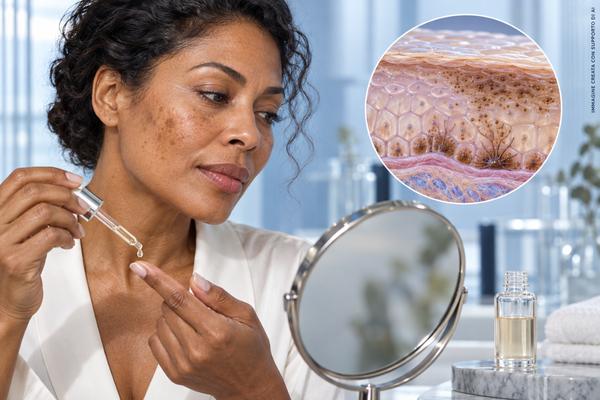



An under-the-skin pimple does not have a whitehead because there is nothing to bring out. The follicle becomes clogged deep down, the wall gives way inward rather than toward the surface, and the contents end up in the surrounding dermis, where they trigger inflammation. What you feel under your fingers is precisely that: a swollen, warm, painful area with no opening.
This is why squeezing it never works. There is no plug to remove: pressure pushes the contents deeper and spreads the inflammation.
Article written by Elisa Avalle, founder of LeLang Skin Care and dermocosmetics specialist. Cover image generated with the support of artificial intelligence.
Why they always appear in the same places
The jawline, chin, neck and perioral area are the typical locations. These are the areas where the sebaceous glands respond most strongly to hormonal stimuli, which is why this type of lesion appears or worsens during certain phases of the month and is often seen in adult acne. This is not a diagnosis you make by looking in the mirror: it is an indication of where to look.
Unlike blackheads, which are open, superficial blockages, this is something different: deeper, more inflammatory and much slower to resolve. A comedone clears up in days, while an under-the-skin nodule can remain for two weeks even when you do everything right. Anyone who promises to make it disappear overnight is not describing this type of lesion.
What to do when you have one
- Warm compress, for five minutes, two or three times a day. Heat increases local blood flow and helps it resolve. It is the most useful and most underestimated measure.
- Spot treatment with salicylic acid or azelaic acid, applied only to the lesion and not all over the face.
- No harsh exfoliants on top. Skin that is already inflamed responds worse, not better, when it is further irritated.
- Ice wrapped in a cloth if the pain is bothersome: it reduces swelling for a few hours. It does not resolve the problem, but it makes the day more bearable.
- Wait. This is the step nobody wants to hear about, and it is the one that prevents permanent damage.

ACNEREBAL SERUM Serum with salicylic acid and niacinamide For oily skin and enlarged pores, with Zincidone®, Burdock and Provitamin B... Discover ACNEREBAL SERUM
What never to do
Do not squeeze it or use needles or tools at home: breaking the follicular wall deep down is exactly the mechanism that leads to post-acne marks and, in the worst cases, indented scarring. A lesion that would have lasted ten days can leave a mark that lasts six months.
Do not apply toothpaste, alcohol or disinfectants: they dry out the surface layer of the skin without reaching the source of the inflammation, leaving an irritated area over an intact nodule. And do not change your entire routine because of one pimple: your skin does not need to be punished; it needs consistency.
How to reduce how often they appear
Prevention matters more here than managing an individual episode, because once an episode has started, it will run its course. You need a consistent routine with a chemical exfoliant twice a week, daily niacinamide to help regulate sebum production, cleansing after physical activity and lightweight but adequate hydration.
The same applies here as with visible pores: dehydrated skin produces more sebum, not less, and routines designed to dry it out thoroughly tend to worsen the situation within a few weeks.
When it is no longer a matter of cosmetics
If deep lesions recur, appear in clusters, leave marks or last longer than two or three weeks, it is time to see a dermatologist. Nodular and cystic forms have effective medical treatments, and the factor that determines the outcome is time: the earlier you intervene, the less likely scarring becomes. A cosmetic product can support and maintain the skin, but it cannot address deep inflammation. For the bigger picture, it is still useful to understand how acne works.
Frequently asked questions
How long does an under-the-skin pimple last?
Usually between one and two weeks. Local heat and not touching it are the two factors that genuinely shorten the healing time.
Do hydrocolloid patches work?
They do on open, oozing lesions, because they absorb fluid and protect the area. On a closed nodule, there is nothing for them to absorb: at most, they help stop you from touching it, which is still no small benefit.
Does it depend on what I eat?
Diet is one of the factors studied, but it is not the main factor, and the relationship varies from person to person. Before reorganizing your diet, it is worth getting your routine in order and discussing it with a doctor.
Sources for this article
- Dermatological literature on the pathogenesis of deep inflammatory lesions: follicular blockage, wall rupture and perifollicular inflammation.
- Studies on the distribution of lesions along the jawline and chin and on the sensitivity of the sebaceous glands to hormonal stimuli.
- Clinical literature on the topical use of salicylic acid and azelaic acid on acne-prone skin.
- Reviews on the risk of scarring and post-inflammatory hyperpigmentation in relation to manipulating lesions and delaying treatment.
There is only one rule, and it applies to everyone: the more you touch it, the longer it stays. Heat, one targeted active applied to the area, keep your hands off and leave the rest of your routine unchanged. If the same pattern repeats every month, the problem is not the individual pimple, and it is time to see a specialist.