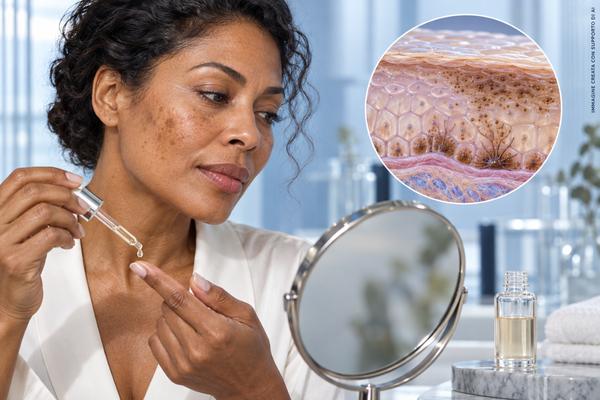



In 2017, a group of dermatologists borrowed a word from epidemiology to describe everything that ages the skin from the outside: exposome. It is not a marketing term; it is a list, and it serves to organize factors that are usually mentioned at random.
The skin exposome is the set of environmental exposures that skin accumulates over a lifetime. The point is not to list them. The point is that they do not all carry the same weight and that each requires a different approach: here you will find the hierarchy, while the overall picture is in the article on skin aging.
Article written by Elisa Avalle, founder of LeLang Skin Care and dermocosmetics specialist. Cover image generated with the support of artificial intelligence.
[INDICE:h2]
Why a new word was needed
For decades, skin aging was divided into two categories: chronological aging, written into DNA, and sun-induced aging. It was a convenient simplification that left out too many things, from smoking to sleep quality.
The exposome is what brings these things together. The recurring estimate in the literature is that environmental factors account for around 80% of visible signs on the face, compared with 20% for genetics. This ratio should be taken as an order of magnitude, not as a precise measurement, but the direction is clear: almost everything visible in the mirror depends on exposures, not heredity.
The eight factors, one by one
- Solar radiation. Not just UVB and UVA: visible light and infrared also contribute, and on darker skin, visible light affects pigmentation more than previously believed.
- Air pollution. Fine particulate matter, polycyclic aromatic hydrocarbons, and ozone. The smallest particles settle on the surface and generate oxidative stress; ozone, which does not penetrate, oxidizes the barrier lipids from the outside.
- Tobacco smoke. The factor with the worst harm-to-habit ratio on the entire list. It affects oxygenation, collagen degradation, and tissue repair.
- Nutrition. Not in the sense of miracle foods. Rather, in terms of sugar load, which fuels the glycation of support fibers, and dietary antioxidant intake.
- Temperature. Heat, even without UV rays, activates enzymes that degrade collagen; cold and temperature fluctuations put pressure on the lipid barrier. People who work in front of an oven or another heat source can see it on their faces.
- Sleep. It is the factor mentioned last and has more studies behind it than you might think: sleep quality is associated with poorer barrier function and slower recovery after damage.
- Psychological stress. It acts through cortisol and inflammatory mediators, with measurable effects on redness, sebum, and repair. I wrote about it in stress-dulled skin.
- Cosmetics and cleansers. Yes, them too. Aggressive cleansing repeated twice a day for twenty years is environmental exposure in every sense, and this is the only item on the list that you control 100%.
The hierarchy: they do not carry the same weight
We need to distinguish between them; otherwise, we end up buying an anti-pollution serum and continuing to go outside without sun protection.
- First level: sun and smoking. They are the only two factors for which the evidence is massive, consistent, and quantified. Everything else comes later, at a distance.
- Second level: pollution and nutrition. Real effects, documented in populations, but smaller in scale and slower to appear.
- Third level: temperature, sleep, stress, cosmetics. They matter, especially for people who already have reactive skin or a fragile barrier, where they become the factor that determines whether the day goes well or badly.
People who live in cities and worry about pollution usually underestimate the first level. It is the same mistake I see, in reverse, made by those who protect themselves only at the seaside.
What a cosmetic product can do, factor by factor
| Factor | What a cosmetic product does |
| Solar radiation | A lot: it is the only case in which a product blocks the factor before it reaches the skin |
| Pollution | Somewhat: cleansing removes deposits, while antioxidants limit downstream damage |
| Smoking | Nothing for the factor, little for the damage. Here, cream is not the tool |
| Nutrition | Nothing on the factor; downstream, you can work on glycation products |
| Temperature and cold | A great deal on the consequence: protect and rebuild the lipid barrier |
| Sleep and stress | On the signs, yes; on the cause, no. No cream can replace seven hours of sleep |
| Cosmetics and cleansers | Everything: here, the cosmetic is the factor, so you just need to choose it better |
A cosmetic acts on the surface and superficial layers of the skin and does not treat any clinical condition, under Regulation (EC) 1223/2009 and Regulation (EU) 655/2013. To stop smoking, address a sleep disorder, or treat a skin condition that does not improve, the right path is to see a doctor, not to reach for a product on the shelf.
Where to really start
In order, and without shortcuts: daily sun protection all year round, not just in summer; gentle cleansing; antioxidant defence in the morning, which is how a cosmetic works on factors it cannot block.
The first two points cannot be bought: they have to be done. The third is where a well-formulated product makes a difference, and it is also the only one worth spending money on.

FERULIC + HA SERUM Vitamin C and ferulic acid face serum Antioxidant and tone-evening, with dual hyaluronic acid. Helps prevent dark sp... Discover FERULIC + HA SERUM
If you want to understand which factors have the greatest impact on your skin, LeLang partner pharmacists carry out this type of assessment at the pharmacy counter, looking at your skin and not just the label.
Want to understand where to start?
Book a free virtual consultation: together, we assess your skin and create a tailored protocol.
Sources for this article
- Krutmann J., Bouloc A., Sore G., Bernard B.A., Passeron T. (2017). "The skin aging exposome". Journal of Dermatological Science, vol. 85, no. 3, pp. 152-161.
- Vierkötter A. et al. (2010). "Airborne particle exposure and extrinsic skin aging". Journal of Investigative Dermatology, vol. 130, no. 12, pp. 2719-2726. Cohort study of a female population.
- Oyetakin-White P. et al. (2015). "Does poor sleep quality affect skin ageing?". Clinical and Experimental Dermatology, vol. 40, no. 1, pp. 17-22.
- Regulation (EC) No 1223/2009 of the European Parliament and of the Council on cosmetic products.
- Commission Regulation (EU) No 655/2013, common criteria for the justification of claims used in relation to cosmetic products.
On the website: Skin aging · Glycation · Facial sun protection