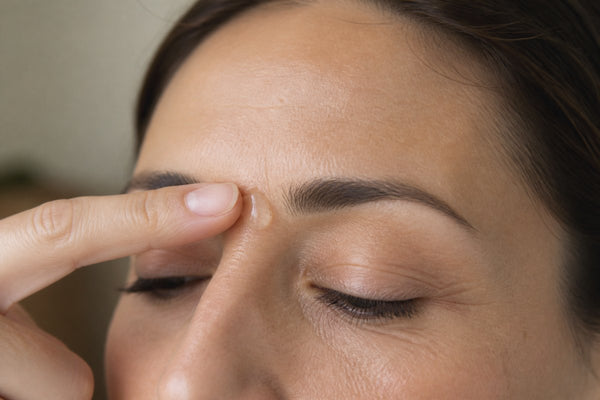


Cream, serum, gel, roll-on, patches: when choosing an eye contour product from the shelf, the first decision isn’t about the active ingredient, but the texture. And rightly so, because on the thinnest skin on the face, texture determines how much product reaches the skin, how long it stays there, and how likely it is to migrate into the eye. The point is, there’s no single best texture: there’s the right one for your concern and the time of day.
In brief: eye contour serum is lightweight and concentrated, suitable for eye bags, dark circles, and expression lines, even on young or sensitive skin; cream is richer and protective, suited to dry and mature skin; gel feels refreshing and absorbs quickly, making it useful in the morning for eye bags. Often, the solution is to use two: serum first, then cream. In the LeLang Skin Care range, available at pharmacies and drugstores, the serum is Formula Eyes Duo Peptide and the cream is Vitis Eyes Contour.
Article written by Elisa Avalle, founder of LeLang Skin Care and dermocosmetics specialist. Cover image generated with the support of artificial intelligence.
[INDICE:h2]
Cream, serum, or gel: what’s the real difference?
The difference lies in the ratio of water, oils, and active ingredients. A serum is usually water-based, with few or no lipids: it spreads in a thin layer and delivers active ingredients at high concentrations. A cream is an emulsion of water and oils: it nourishes, softens, and forms a protective layer on the surface that limits water loss. A gel is a thickened water-based formula, with little or no oil: it feels fresh and lightweight, but on its own provides little long-term hydration.
| Texture | What it’s made of | Who it’s for | When to use it |
|---|---|---|---|
| Serum | Water-based formula, concentrated active ingredients, few lipids | Eye bags, dark circles, expression lines; young, combination, or sensitive skin | Morning and evening, as the first step |
| Cream | Water-and-oil emulsion, more nourishing | Dry, mature skin, fine lines caused by dryness | After serum, especially in the evening and in winter |
| Gel | Thickened water-based formula, oil-free | Morning puffiness, oily skin, or anyone who can’t tolerate rich textures | In the morning, even under makeup |
| Patches | Pre-soaked applicator, leave on for 10-20 minutes | Tired-looking eyes before an event | Occasional use, does not replace your routine |
The skin on the lower eyelid is much thinner than the rest of the face: an ultrasound measurement found the dermis under the eye to be about 0.53 mm thick, compared with 1.18 mm at the temple and cheek. This skin absorbs more and is less able to tolerate too much product. That’s why eye contour products are a category of their own, not just a face cream in a smaller package, as explained in the guide to eye contour care by age.
How to choose the right texture for your concern?
Under-eye bags and puffiness
Puffiness caused by fluid retention is most noticeable in the morning. You need ingredients that promote drainage, such as caffeine and Acetyl Tetrapeptide-5, in a lightweight texture that won’t weigh down the eyelid. Here, serum and gel work better than a rich cream, which can even worsen puffiness if you use too much. If the bags are caused by fat rather than fluid, no texture will reduce them: we explain this in our guide to vascular, pigmented, or hollow dark circles.
Dark circles
Pigmented dark circles respond to active ingredients such as niacinamide, while vascular dark circles respond to ingredients that target microcirculation and drainage. Here, too, it’s important that the active ingredients are present in an effective concentration: serum is the most logical choice, followed by a lightweight cream.
Expression lines and crow’s feet
Peptides that target facial muscle contractions, such as Acetyl Hexapeptide-8, work best in a lightweight formula that brings them into contact with the skin. If your lines are also caused by dryness, applying cream after serum completes the job by locking in moisture.
Dry and mature skin
When the skin around the eyes feels tight, looks creased and appears dull, it needs nourishment: that’s where cream comes in, with lightweight oils, hyaluronic acid, and antioxidants. Serum alone isn’t enough to protect skin that’s losing moisture.
The rule of thumb: the serum delivers the active ingredients, while the cream locks them in. If you have just one concern and young skin, the serum is enough. If your skin is also dry or mature, you need both.
Serum and eye cream together: which order?
Serum first, then cream. It’s the same rule as for the face: go from the lightest texture to the heaviest. A watery serum applied over a cream largely stays on the surface, while the reverse works. Just wait about thirty seconds between steps.
In the LeLang Skin Care protocol, the first step is Formula Eyes Duo Peptide, a fragrance-free serum with a watery texture containing Acetyl Tetrapeptide-5, Acetyl Hexapeptide-8, caffeine, bromelain, niacinamide, and hyaluronic acid. It targets under-eye bags, dark circles, and expression lines, and is dermatologically tested on sensitive skin and nickel tested.

FORMULA EYES DUO PEPTIDE Anti-wrinkle eye contour serum for puffiness and dark circles Fragrance-free peptide booster: apply first, before you... Discover FORMULA EYES DUO PEPTIDE
The second step is Vitis Eyes Contour, a lifting cream from the Uvè Biotech® line with grape leaf extract, resveratrol, grapeseed oil, peptides, and hyaluronic acid, designed for mature skin around the eyes. It contains fragrance: those with very reactive eyelids can use only the serum.

VITIS EYES CONTOUR Lifting eye contour cream for wrinkles, puffiness and dark circles Moisturizes and nourishes the delicate skin aroun... Discover VITIS EYES CONTOUR
For a complete routine, including cleansing, there’s a dedicated skincare set.

Eye Protocol: Bags • Dark Circles • Wrinkles PROTOCOL CONTENTS: 1X Cleansing Detox Mousse 1X Gentle Oil 1X Formula Eyes Duo Peptide 1X Vitis Eyes Contour Discover Eye Protocol: Bags • Dark Circles • Wrinkles
How do you apply eye cream, step by step?
- Clean, makeup-free skin. Apply eye cream after cleansing and before your face serum and moisturizer.
- Use a small amount. For serum, a couple of drops are enough for both eyes; for cream, use an amount about the size of a grain of rice. More won’t increase the effect and may cause the product to migrate into the eye.
- LUse your ring finger, not your index finger. It applies the least pressure: distribute small dots along the orbital bone.
- Pat, don’t rub. From the inner corner outward, using light taps. Rubbing pulls on thin, less elastic skin.
- Keep your distance from the lashes. Apply along the orbital bone: the product will spread inward on its own. A watery serum like Formula Eyes can also be applied to the mobile eyelid, avoiding direct contact with the eye.
- Morning and evening. In the morning, sunscreen should be applied right up to the under-eye area, where wrinkles appear first.
Is cooling eye gel good for tired eyes?
It provides relief, and that’s no small thing: the cooling sensation and lower temperature help reduce eyelid puffiness a little in the morning. A simple trick is to store the product somewhere cool. But if the gel contains no active ingredients, the benefit lasts only as long as the cooling effect. For results that build over time, you need a formula with decongesting and brightening active ingredients, used every day.
Eye cream with hyaluronic acid: what are the benefits?
LHyaluronic acid retains water in the upper layers of the skin and immediately smooths fine lines caused by dehydration. It is particularly useful around the eyes, as this area dries out easily. However, it does not work on puffiness or dark circles: those require other active ingredients, which is why it is a supporting ingredient, not the star, in well-formulated eye creams.
Frequently asked questions
Is eye cream or eye serum better?
It depends on the concern and your skin. Serum is lighter and more concentrated, making it the best choice for puffiness, dark circles, and expression lines, including for young or sensitive skin. Cream is more nourishing and suits dry, mature skin. Often, the most effective solution is to use both: serum first, then cream.
How should I apply eye cream correctly to see results?
Apply a small amount to clean skin morning and evening: a couple of drops of serum or a rice-grain-sized amount of cream for both eyes. Use your ring finger to gently pat it along the orbital bone, moving from the inner corner outward without rubbing, and wait for it to absorb before applying face cream. Assess results for puffiness and wrinkles after at least four weeks of consistent use.
Is eye gel suitable for tired eyes?
Yes, its refreshing texture soothes and helps reduce eyelid puffiness in the morning, and it works well under makeup. For the effect to go beyond feeling refreshed, the gel should contain decongesting active ingredients such as caffeine or peptides and be used every day.
What are the benefits of an eye cream with hyaluronic acid?
It hydrates the surface layers and smooths fine dehydration lines within a few hours, one of the most common causes of small wrinkles under the eyes. However, it doesn’t address puffiness or dark circles: those call for active ingredients such as caffeine, Acetyl Tetrapeptide-5, and niacinamide.
Should I apply eye serum before or after face cream?
The eye area comes first. L's order is cleanser, eye serum, optional eye cream, then face serum and cream, and sunscreen in the morning. LeLang Skin Care’s Formula Eyes Duo Peptide is designed specifically as the first step in your routine.
Which texture is best for sensitive skin?
A lightweight, fragrance-free texture with just a few ingredients: usually a watery serum. Very rich creams tend to migrate toward the eye and cause irritation. You’ll find all the criteria in the guide to eye care for sensitive skin.
Not sure which eye cream is right for you?
In fifteen minutes, we’ll look at your eye area together and work out whether you need a serum, a cream, or both. You can also ask for advice at LeLang Skin Care partner pharmacies and drugstores.
Sources for this article
- Kim J.S., Atchima S. (2025). “Analysis of Dermal Thickness Across 10 Areas and Injection Depth After Polynucleotide Injection Using Rejumate Automatic 0.8-mm 9-pin Injector on the Face Using 33-MHz Sonography.” Plastic and Reconstructive Surgery Global Open, vol. 13, no. 9, e7121.
- Pissaridou M.K., Ghanem A., Lowe N. (2021). “Periorbital Discolouration Diagnosis and Treatment: Evidence-Based Review.” Journal of Cosmetic and Laser Therapy, vol. 22, no. 6-8, pp. 217-225.
- Warshaw E.M., Voller L.M., Maibach H.I. et al. (2021). “Eyelid dermatitis in patients referred for patch testing: Retrospective analysis of North American Contact Dermatitis Group data, 1994-2016.” Journal of the American Academy of Dermatology, vol. 84, no. 4, pp. 953-964.
- Wang Y., Wang M., Xiao S., Pan P., Li P., Huo J. (2013). “The anti-wrinkle efficacy of argireline, a synthetic hexapeptide, in Chinese subjects: a randomized, placebo-controlled study.” American Journal of Clinical Dermatology, vol. 14, no. 2, pp. 147-153.
- Pavicic T., Gauglitz G.G., Lersch P. et al. (2011). “Efficacy of cream-based novel formulations of hyaluronic acid of different molecular weights in anti-wrinkle treatment.” Journal of Drugs in Dermatology, vol. 10, no. 9, pp. 990-1000.
- Regulation (EC) No. 1223/2009 on cosmetic products and Regulation (EU) No. 655/2013 on common criteria for claims relating to cosmetic products.
On the site: Best eye cream · Eye cream for sensitive skin · Eye cream guide by age · Acetyl Tetrapeptide-5 · Eye cream collection