


The skin around the eyes is the thinnest on the body and the first area of the face to show signs of fatigue, age, and lifestyle. It is also the area for which people tend to shop most randomly: nearly all disappointments stem from choosing a product without knowing which concern it was intended to address.
Dark circles, bags, and wrinkles have different causes and respond to different active ingredients. This guide will help you identify which of these concerns you actually have, understand what changes with age, and know in advance where the capabilities of a cosmetic product end.
What is eye cream for?
It is designed to protect and support the most fragile skin on the body, helping to reduce the main concerns in this area for a more open, vibrant, and naturally expressive look.
[INDICE:h2]
The uniqueness of the eye area (and why face cream is not enough)
The area around the eyes is not simply “another area of the face”: it differs from the rest in three key ways, which is why it requires dedicated formulations. These three factors are thickness, microcirculation, and elasticity.
1. Thickness and fragility
Eyelid skin is the thinnest skin on the human body, almost transparent. This explains why blood vessels are more visible and makes the tissues more sensitive. As we age, its thickness may decrease further, while support tissues such as elastic fibers and collagen deteriorate. Its natural thinness also makes the area more permeable: an advantage for the effectiveness of well-designed active ingredients, but also a risk of irritation if ingredients and concentrations are not properly balanced.

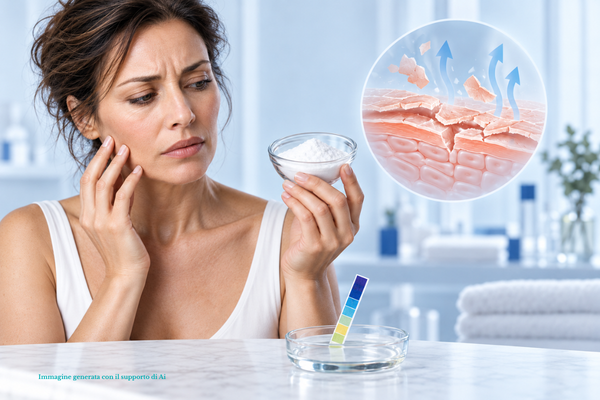
The skin around the eyes is much thinner than the rest of the face, making it extremely fragile and sensitive.
2. Microcirculation and lymphatic drainage
This area is rich in small blood vessels, such as capillaries and venules. Changes in vascular permeability can promote fluid accumulation, causing puffiness and bags. Lymphatic drainage is essential: if it is slow or impaired, edema forms. The area under the eyes also contains small fat pockets that, with age and loss of support, contribute to the appearance of bags.
3. Elasticity and structural support
The periorbital dermis has a lower density of elastic fibers and a more fragile structural organization. Fibroblasts, the cells that produce collagen and elastin, become less active with age and exposure to UV rays and oxidation. This accelerates the deterioration of the extracellular matrix and makes the area more prone to loss of firmness and the formation of fine lines. The continuous movement of the eyes and facial expressions adds to this.
Why the eye contour area requires dedicated formulations
Given the fragility and thinness of the skin, eye contour products require special formulations designed to be gentle, well tolerated, and truly effective.
Ophthalmological testing
A dedicated product undergoes ophthalmological testing: its safety is verified to ensure that it does not cause irritation or stinging if it accidentally comes close to the eye. This is no small detail, because overly rich textures or aggressive ingredients can easily migrate and cause discomfort.
Calibrated pH
The pH is also carefully calibrated. While facial creams have a physiological pH between 4.5 and 5.5, eye contour products are formulated with reference to the isotearmal pH, which is much closer to that of tears—around 7. This minimizes the risk of stinging or redness. There is a dedicated article exploring the role of skin pH.
Essential active ingredients
Eye contour products are formulated with active ingredients that have specific effects: peptides, draining molecules, low-molecular-weight moisturizers, antioxidants, brightening and firming ingredients. They often include Retinol and Vitamin C, together with soothing substances such as chamomile or bisabolol. The texture is specifically designed not to migrate into the eyelid margin.
When to start using eye contour care
There is no single “right age” that applies to everyone, because everyone has a different skin history shaped by genetics, lifestyle, and sleep. However, introducing the product into your routine before more pronounced signs appear can help prevent them and maintain the skin’s natural elasticity.
| Age | Primary objective | Recommended product type and active ingredients |
|---|---|---|
| 20+ years | Prevention and hydration | Lightweight and hydrating eye contour care that strengthens the skin barrier and combats the first signs of fatigue. Nothing complex is needed. |
| 30+ years | Slowing expression lines | More complete formulas: biomimetic peptides, hyaluronic acid with different molecular weights, antioxidants, and vitamins. |
| 40+ years | Counteracting loss of firmness and volume | More targeted functional formulas: Retinol, firming complexes, and lifting or brightening active ingredients. |
| 50+ years | Static wrinkles and loss of density | Richer, multifunctional products, with a pro-aging approach: enhancing the beauty that evolves with us. |
In short: the sooner you start, the better, but with the right gradual approach. There is no need to overload young skin with complex formulas, just as you cannot settle for simple moisturizers when age calls for more effective active ingredients.
Identifying and treating the main concerns
Precisely because of this area's characteristics, many people develop specific concerns. It is essential to recognize them in order to choose the right treatment.

Identifying the right concern is the first step toward effective treatment.
1. Dark circles: vascular, pigmented, or structural?
- Vascular dark circles: bluish-purple or reddish tones caused by visible blood vessels beneath thin skin. They worsen with fatigue, allergies, or water retention. They are treated with ingredients that improve circulation and micro-drainage, such as Caffeine.
- Pigmented dark circles: darker, brown, and linked to melanin overproduction. You can recognize them because the discoloration remains even when the skin is gently pulled. They are treated with topical brightening agents such as Niacinamide, Vitamin C, and retinoids.
- Structural dark circles: they are not discolored, but represent a loss of volume caused by the gradual descent of the tissues. Products that provide filling are needed here.
Most people actually have a combination of types, which is why a product may seem to work only halfway. The complete method for identifying your type — including what the different colors, from purple to brown, indicate — can be found in the in-depth guide on vascular, pigmented, or sunken dark circles.
2. Under-eye bags: edema and morning puffiness
Under-eye bags are mainly caused by edema or fluid retention. They appear as the classic morning puffiness that varies throughout the day and may be linked to water retention, allergies, insufficient sleep, or an unhealthy diet. If they improve in the evening and worsen in the morning, they are most likely due to fluid retention.
They can be reduced with lymphatic drainage massages, local cryotherapy, and specific non-invasive cosmetic ingredients.
3. Wrinkles and crepey skin
Wrinkles are divided into dynamic wrinkles — “crow’s feet” that appear with facial expressions — and static wrinkles, which remain when the face is relaxed. Crepey skin under the eyes is the result of collagen and elastin loss, reduced hyaluronic acid, and photoaging.
They are treated with retinoids or active ingredients that stimulate cell turnover, peptides, and hyaluronic acid. Sun protection is highly recommended, especially in this area.
LeLang products for the eye contour
In the LeLang protocol, the central treatment is Formula Eyes Duo Peptide: a serum designed to address uneven pigmentation, persistent dark circles, and a dull-looking gaze. It contains draining caffeine, bromelain, which stimulates cell renewal, Hyaluronic Acid, and Acetyl Tetrapeptide-5, the peptide that acts on eye bags and dark circles by improving lymphatic drainage.

FORMULA EYES DUO PEPTIDE Anti-wrinkle eye contour serum for puffiness and dark circles Fragrance-free peptide booster: apply first, before you... Discover FORMULA EYES DUO PEPTIDE
Vitis Eyes Contour is instead the cream designed primarily for mature skin, when the eye contour becomes thinner and loses density. It combines biomimetic peptides, polyphenol-rich resveratrol, and grapeseed oil with omega-6 and Vitamin E.

VITIS EYES CONTOUR Lifting eye contour cream for wrinkles, puffiness and dark circles Moisturizes and nourishes the delicate skin aroun... Discover VITIS EYES CONTOUR
For those who prefer the complete routine in a single purchase, the two treatments are available together in the Eye Protocol, with dedicated cleansing and step-by-step instructions.

Eye Protocol: Bags • Dark Circles • Wrinkles PROTOCOL CONTENTS: 1X Cleansing Detox Mousse 1X Gentle Oil 1X Formula Eyes Duo Peptide 1X Vitis Eyes Contour Discover Eye Protocol: Bags • Dark Circles • Wrinkles
If, before choosing, it is helpful to have someone examine the area in person — the taut skin test reveals a lot, but with the right lighting it reveals even more — this assessment is carried out at the counter in LeLang partner pharmacies.
The correct application method
Another factor that affects the product's effectiveness is how it is applied. Following the correct application method is essential:
- Quantity: only a minimal amount is needed; the equivalent of a grain of rice for both eyes is generally sufficient. An excessive amount does not increase effectiveness; it only causes discomfort.
- Technique: massage with extreme gentleness, tapping with the ring finger — one of the least strong fingers, which naturally applies little pressure. Apply it to the orbital bone, not too close to the lash line, moving from the inside outward.
- Absorption: allow the product to be fully absorbed before applying makeup.
What to avoid:
• Non-specific face masks should be applied away from the eye area.
• The area should not be treated with exfoliants.
• Sunscreens should also be suitable for the eye area, as they often cause discomfort and itching.
What if the product migrates into the eye?
It can happen, especially at first. Nothing serious occurs, but it may cause stinging, redness, or a foreign-body sensation. In that case, do not rub: rinse gently with cool water and wait a few minutes. If the discomfort persists for a long time, stop using the product and ask a dermatologist for advice.
Frequently asked questions about the eye contour
When should it be applied: morning, evening, or both?
It should be applied morning and evening. Evening application allows the active ingredients to work during rest, while morning application hydrates, protects against external agents, and helps reduce morning puffiness.
What is the best eye contour product for expression lines?
The best one is the one tailored to your needs. For expression lines, the most effective formulas contain biomimetic peptides, which help relax the muscles, and low-molecular-weight hyaluronic acid to hydrate and add volume from within.
Can face cream be used around the eyes?
Generally, no. The skin is the thinnest on the body and requires formulations that have undergone ophthalmological testing. In addition, the eye contour has a pH close to that of tears, near 7, to prevent stinging or irritation.
Which active ingredients help reduce bags?
Bags are often linked to water retention and sluggish microcirculation. The most suitable active ingredients have draining and vasoprotective properties: Caffeine, specific plant extracts, and peptide complexes that act on puffiness. However, be aware of a distinction that changes expectations: bags caused by fluid retention respond to cosmetics, while those caused by protrusion of periorbital fat do not, because this is an anatomical issue.
How long does it take to see results?
With suitable products and a consistent routine, you can start to see a more rested-looking appearance in 4–8 weeks. After 3–4 months, more stable differences in tone and elasticity can be assessed. A practical tip: take a photo before you start, because the brain gets used to small changes and eventually stops noticing them.
Would you like to always have the complete guide with you?
To consult all the scientific details and professional advice at any time, we have prepared the Complete Eye Contour Guide in PDF format.
Conclusions: a conscious act of care
There is no one perfect eye contour solution for everyone, because there is not just one concern. Addressing what makes you feel uncomfortable is legitimate, and cosmetic science offers practical tools to do so gently — provided you first know what you are addressing.
The key is an integrated approach, where skincare is combined with targeted, consistent practices. The goal is pro-aging: not denying time, but experiencing it consciously. For the men's perspective on this topic, see the men's eye contour guide.
15-Minute Free Consultation with the Founder
If, despite this guide, you would like direct support and advice based on your skin's specific needs, Elisa Avalle, founder of LeLang, is available for a personalized, free 15-minute consultation.
Sources for this article
01 Huang Y.L., Chang S.L., Ma L., Lee M.C., Hu S., "Clinical analysis and classification of dark eye circle", International Journal of Dermatology, vol. 53 no. 2, 2014, pp. 164-170 — study of 65 cases assessed using a Wood's lamp and skin ultrasound, from which the classification into pigmented, vascular, structural, and mixed forms was derived.
02 Sarkar R., Ranjan R., Garg S. et al., "Periorbital Hyperpigmentation: A Comprehensive Review", Journal of Clinical and Aesthetic Dermatology, vol. 9 no. 1, 2016, pp. 49-55 — review of the causes, aggravating factors, and mixed subtypes of periorbital hyperpigmentation.
03 Echeverri D., Montes F.R., Cabrera M., Galan A., Prieto A., "Caffeine's Vascular Mechanisms of Action", International Journal of Vascular Medicine, vol. 2010, 2010, article 834060 — review of caffeine's vascular mechanisms.
04 Efficacy data for cosmetic peptides from raw material manufacturers' tests, not independent clinical studies: they should be interpreted as an indication of the active ingredient's activity, not as a result of the finished product.
05 Regulation (EC) No. 1223/2009 on cosmetic products and Regulation (EU) No. 655/2013 on common criteria for claims: a cosmetic product can improve the appearance of the skin, but cannot treat clinical conditions or replace a medical evaluation.
On the website: Dark circles: vascular, pigmented, or hollow · Under-eye bags: causes and how to reduce them · Men's eye contour · Caffeine in cosmetics · Acetyl Tetrapeptide-5 (Eyeseryl) · Eye contour collection