


[INDICE:h2]
Exfoliation is an important part of a skincare routine: it allows the skin to renew its surface layer and better prepare to absorb the active ingredients in serums and creams. Removing impurities, makeup, and dead skin cells is something we do every day through cleansing, but sometimes the skin needs deeper renewal.
In this article, we look at the different exfoliation methods, which one best suits your skin type, and the benefits and contraindications of scrubs and peels.
What is skin exfoliation
It is the process of removing dead cells from the outermost layer of the skin, to make the surface more even and radiant. It is a widespread practice but not mandatory and not suitable for everyone: if done incorrectly or too often, it can sensitize the skin and worsen redness and blemishes.
There are two types of exfoliation: mechanical, using scrubs, brushes, or gloves, and chemical, which uses acids or enzymes to promote the detachment of cells.
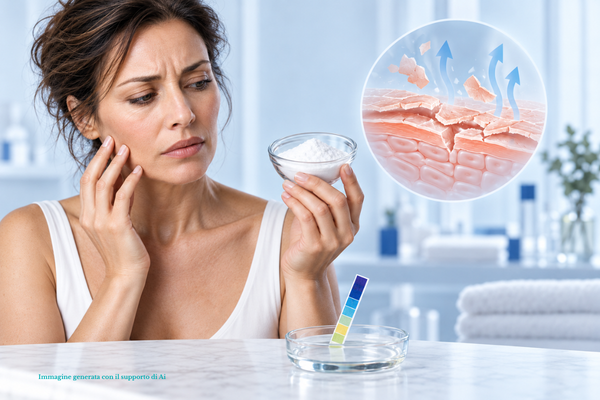
One clarification worth keeping in mind: the stratum corneum is not dirt to be removed. It is a protective barrier whose corneocytes actively regulate water flow and retention, protecting the skin from dehydration and external aggressors. The goal of exfoliation is to remove the excess of horny cells, not to thin the barrier. That is the difference between radiant skin and irritated skin.
The goal of an exfoliating treatment is to support the skin’s natural renewal process, or cell turnover. The complexion immediately looks more even and, over time, the appearance of fine lines and dark spots improves.
Why exfoliate
Over time, cell turnover slows down — due to hormonal factors, the use of unsuitable cosmetics, or simply age — and dead cells remain on the surface for longer. The result is a less even texture and a less radiant complexion.
In mature skin, renewal is physiologically slower, and exfoliation can be helpful, provided you choose formulas compatible with skin that is often thinner and more fragile. Here, “more often” does not mean “more aggressively”: overly intense exfoliation stresses the barrier and has the opposite effect.
Which type of exfoliation to choose
There is no single best method: scrubs and peels are both effective, and the choice depends on sensitivity, goals, and consistency. The practical rule is to choose the most effective approach with the least impact on the skin barrier.
The scrub, or mechanical exfoliation
It is achieved with a product containing microbeads or with sponges and brushes. This is the best-known method, especially for the body. It is popular because it gives the skin an immediate smooth feel, but on very sensitive skin or skin with inflamed acne, it may be too stimulating.
Apply it with your fingertips, using circular motions on cleansed, slightly damp skin and applying very light pressure.

RELAX BODY SCRUB Gentle salt body scrub With essential oils and neurocosmetics, for a relaxing exfoliation. Exfoliates and smooths th... Discover RELAX BODY SCRUB
In the Relax body scrub, salt crystals smooth the skin, while shea butter, hazelnut oil, and essential oils soften and nourish it. It also contains Tephrosia purpurea extract, a neurocosmetic ingredient that, according to the manufacturer's tests, modulates skin cortisol production.
For the face, lighter textures are available, with small, uniform particles. A gentle mechanical scrub suits many skin types, provided you do not apply too much pressure or use it more than once or twice a week.
Ultrasonic skin scrubbers
These devices have a thin blade that vibrates at high frequency and is placed on damp skin. Removal occurs through vibration, which detaches residue from dead skin cells, oxidized sebum, and impurities.
They remain a form of mechanical exfoliation, but are gentler than traditional granules because there is no rubbing.
The peel
Uses substances that induce the controlled removal of layers of skin, with varying depth depending on the type of substance, its concentration, and how it is used. In dermatology, peels are classified as superficial, medium-depth, and deep, and are based on AHA, BHA, and PHA exfoliating acids.
Be careful to distinguish between them: at home, use gentle, gradual exfoliants. Professional peels are medical procedures that work by controlled ablation of tissue to a set depth, with specific protocols and possible side effects — including post-inflammatory hyperpigmentation, which is more common in darker skin tones. They are not the "stronger" version of an over-the-counter product.
For gentler exfoliation, there is the enzymatic peel: it uses neither acids nor granules, but proteolytic enzymes, often of plant origin, that weaken the bonds between superficial dead skin cells, mimicking the natural exfoliation process and making them easier to shed without rubbing. It is the approach with the lowest mechanical impact, and therefore the most suitable for those with sensitive or reactive skin.
However, it is worth stating this precisely: the gentleness of enzymatic exfoliation depends on its mechanism, not on a large body of clinical studies. A 2022 literature review found just eleven studies on the subject, and very few clinical trials: papain and bromelain exfoliate, but the authors conclude that more robust in vivo studies are needed. This distinction matters when evaluating a claim of efficacy.
Mandelic Enzimatic Soft Peel is based on mandelic acid, derived from almonds and enriched with bromelain and papain.

MANDELIC ENZYMATIC SOFT PEEL Mandelic Acid and Enzymatic Facial Peel Highly tolerated, gentle exfoliant that stimulates cell turnover. Removes de... Discover MANDELIC ENZYMATIC SOFT PEEL
The benefits of exfoliation
A well-chosen exfoliation improves texture and radiance because it reduces the buildup of surface dead skin cells. When the surface is less thickened, light reflects more evenly and the complexion appears more uniform.
It also helps keep pores clearer — useful for those with oily skin — and makes the skin more receptive to the active ingredients applied afterward.
How to do it properly
The difference between radiant and irritated skin lies almost entirely in technique and frequency. The goal is not to feel burning, but to achieve gradual improvement while respecting the skin barrier.
- Use light, small movements for about 30 seconds.
- Rinse with lukewarm water, never hot.
- Never exfoliate sunburned skin or skin with wounds or active irritation.
- Moisturize immediately afterward to reduce dryness and support the skin barrier.
- Sun protection the following day: freshly exfoliated skin is more exposed and may develop spots more easily.
In the presence of active acne, especially with papules and pustules, it is best to choose less traumatic methods and consider how they interact with the other active ingredients in your routine.
Exfoliating the body: legs, elbows, and knees
The skin on the body has a thicker stratum corneum than facial skin and tolerates more intensive exfoliation, but not equally everywhere.
On the elbows and knees, where the skin is thickened and tends to darken, a salt- or sugar-based scrub works well once or twice a week, followed by a nourishing body butter or oil. On the legs, it is best to exfoliate before hair removal, not immediately afterward: freshly depilated skin has micro-injuries and reacts poorly to rubbing. Exfoliating two or three days later, however, helps prevent ingrown hairs.
However, there is one thing that matters more than weekly scrubbing: the daily habit. A cleanser that is too harsh or water that is too hot removes every day what a scrub removes once a week, and no exfoliation can make up for an unsuitable shower routine. For advice on choosing a body cleanser and what really differs between products, see the article on shower gel, bubble bath, and shower foam.
Areas to treat with greater caution: inner thighs, décolleté, and neck, where the skin is as thin as facial skin. On varicose veins, visible capillaries, or very dry and cracked skin, mechanical scrubs should be avoided in favor of enzyme formulas or gentle acids.
Frequently asked questions about exfoliation
How do you exfoliate your skin?
Apply the product to cleansed, slightly damp skin using your fingertips, with small circular motions and very light pressure, for about 30 seconds. Rinse with lukewarm water, moisturize immediately afterward, and apply sunscreen the following day. A sensible frequency for the face is once or twice a week; you can increase this slightly for the body, but not on all areas.
What is the difference between a scrub and an exfoliant?
"Exfoliant" is the general category: it includes anything that promotes the removal of dead skin cells. A scrub is a subcategory, specifically the mechanical type, which works through friction from granules, salts, or sugars. Other exfoliants are chemical (AHA, BHA, and PHA acids) or enzymatic, and work by weakening the bonds between cells without friction. In practice: every scrub is an exfoliant, but not every exfoliant is a scrub.
Which scrubs are recommended during pregnancy?
During pregnancy, gentle mechanical scrubs are generally the safest choice, because they act only on the surface and do not involve active ingredients being absorbed. Chemical peels, especially those based on vitamin A derivatives and high concentrations of salicylic acid, should instead be evaluated with a doctor. There is also a practical reason to take it easy: during pregnancy, the skin is more prone to melasma, and overly intense exfoliation without sun protection can make it worse. The rule remains to confirm any treatment with your gynecologist or dermatologist.
How do you exfoliate skin with rosacea?
With great caution and never during active flare-ups. On skin with rosacea and couperose, mechanical scrubs and brushes should be avoided, because friction increases redness and reactivity. If the dermatologist considers it appropriate, an enzymatic peel or a low-concentration PHA can be considered, no more than once every ten to fifteen days, always followed by a soothing product. In this condition, the goal is barrier stability, not rapid renewal.
Can you exfoliate your skin naturally or with a DIY treatment?
For the body, homemade preparations based on sugar or salt with a vegetable oil work well and are harmless, provided they are used gently. For the face, it is a different story: baking soda, coarse salt, crushed shells, and lemon juice have irregular particle sizes or a pH far from that of the skin, and are among the most common causes of micro-injuries and sensitization. If the goal is facial exfoliation, a formulated enzyme exfoliant costs little more and works in a much more predictable way.
How often should you exfoliate your skin?
For most skin types, once or twice a week. Oily, thickened skin can tolerate the upper limit, while dry or sensitive skin does better with once every seven to ten days. The signs of overdoing it are clear: skin that feels tight, stings slightly when cream is applied, looks red, or suddenly appears shinier. In that case, stop for two weeks and start again at a reduced frequency.
Sources for this article
01 Soleymani T., Lanoue J., Rahman Z., A Practical Approach to Chemical Peels: A Review of Fundamentals and Step-by-step Algorithmic Protocol for Treatment, The Journal of Clinical and Aesthetic Dermatology, 2018; 11(8): 21-28.
02 Trevisol T.C., Henriques R.O., Souza A.J.A., Furigo A. Jr, An overview of the use of proteolytic enzymes as exfoliating agents, Journal of Cosmetic Dermatology, 2022; 21(8): 3300-3307.
03 Rawlings A.V., Harding C.R., Moisturization and skin barrier function, Dermatologic Therapy, 2004; 17(Suppl 1): 43-48.
15-minute free consultation with the founder
Not sure whether your skin can tolerate a scrub or whether you need an enzyme exfoliant? Book a free virtual skincare consultation with Elisa Avalle, founder of LeLang.
On the website: acids in skincare: AHA, BHA and PHA · mandelic acid · skin barrier · facial hyperpigmentation