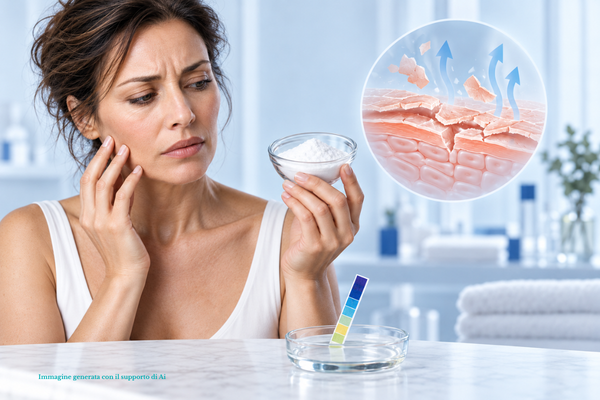



Exfoliation is an important part of a skincare routine: it helps the skin renew itself, prepares it to receive subsequent treatments, and contributes to a more even complexion.
However, the differences between the various exfoliating acids are not always well known, and uninformed use can create more problems than it solves. Let’s take a detailed look at the characteristics of each one and which skin types they are suited to.
[INDICE:h2]
What are exfoliating acids?
AHA, BHA, and PHA are ingredients capable of removing dead cells from the skin’s surface and promoting renewal. They work through a chemical rather than physical process: they dissolve the bonds between horny cells and support cell turnover.
Some penetrate more deeply, while others have a more superficial action that brightens the complexion and smooths the texture.
Chemical exfoliation and mechanical exfoliation
The two approaches are often confused. Mechanical exfoliation is used in scrubs with microbeads and works through friction. It is often more suitable for the body than the face, where circular massage also has a stimulating effect on circulation.

RELAX BODY SCRUB Gentle salt body scrub With essential oils and neurocosmetics, for a relaxing exfoliation. Exfoliates and smooths th... Discover RELAX BODY SCRUB
The Relax line’s body scrub is based on salt crystals, with shea butter and hazelnut oil to nourish the skin.
Abrasive sponges also fall into this category: if used too roughly, they can remove more than necessary and irritate sensitive skin.
Chemical exfoliation, on the other hand, works in a more controlled way. No rubbing, no abrasions.
Acids dissolve the bonds that hold dead skin cells together, allowing them to detach naturally. The result is more even, without micro-injuries, and above all more predictable: you can adjust the intensity by choosing the type of acid, concentration, and frequency. With a scrub, the intensity depends on how hard you press.
There are three main benefits:
- It is even, because it acts across the entire surface without depending on finger pressure.
- It is customizable, allowing you to choose the acid suited to your skin type.
- It is also suitable for sensitive skin: many PHA formulas or formulas based on mandelic acid are less aggressive than traditional scrubs.
Why acids matter in your routine
They are not an extra for those seeking perfect skin: they support a process that the skin already carries out on its own. With age, as well as due to stress, pollution, and sun exposure, cell turnover slows down, and the skin appears duller and more uneven.
Regular exfoliation helps improve radiance, refine skin texture, reduce mild dark spots and small superficial wrinkles, and make the skin more receptive to subsequent treatments.
AHA, alpha hydroxy acids
They are water-soluble acids, often called fruit acids because of their origin. They act on the skin's surface, improving evenness, cell turnover, and radiance. They are suitable for those with dull, rough, or lackluster skin.
- Glycolic acid has the smallest molecule, penetrates easily, and visibly smooths the skin. It is also the most potent and the least tolerated by reactive skin.
- Lactic acid is gentler and has a moisturizing action: suitable for dry or dehydrated skin.
- Mandelic acid has a larger molecule and therefore penetrates more slowly: it is the best tolerated and is suitable for combination and sensitive skin.
The complete comparison of all AHAs — including their molecular weights, why citric and tartaric acids almost never truly exfoliate, and the forms in which they are commercially available — can be found in the in-depth guide dedicated to alpha hydroxy acids.

MANDELIC ENZYMATIC SOFT PEEL Mandelic Acid and Enzymatic Facial Peel Highly tolerated, gentle exfoliant that stimulates cell turnover. Removes de... Discover MANDELIC ENZYMATIC SOFT PEEL
Mandelic Enzimatic Soft Peel combines mandelic acid with bromelain and papain, along with chamomile extract and aloe vera: it removes superficial dead skin cells without irritation.
BHA, beta-hydroxy acids
They are oil-soluble acids, so they can dissolve sebum and impurities inside the pore. The best known, and practically the only one used in cosmetics, is salicylic acid.
They are the best choice for those with oily or combination skin, enlarged pores, blackheads, or an acne-prone complexion. Salicylic acid unclogs sebum plugs, reduces the appearance of comedones, and also has a soothing effect that is helpful for inflamed blemishes.
It may be too intense for very dry or reactive skin, but in formulations it is adjusted to remain effective without being harsh.

CLEANSING ACTIVE MOUSSE Facial cleanser with salicylic acid Purifying mousse with Tea Tree Oil, Burdock and Betaine Reduces the appearance o... Discover CLEANSING ACTIVE MOUSSE

ACNEREBAL SERUM Serum with salicylic acid and niacinamide For oily skin and enlarged pores, with Zincidone®, Burdock and Provitamin B... Discover ACNEREBAL SERUM
PHAs, the gentlest generation
PHAs — gluconolactone, lactobionic acid — offer superficial exfoliation with a hydrating, barrier-protective action. They also have antioxidant properties.
The technical difference lies in the molecule size: much larger than that of AHAs, it penetrates more slowly and gradually. This results in better tolerance.
They are perfect for anyone who reddens easily or cannot tolerate the tingling sensation of AHAs. In short: they gently boost radiance, smooth fine lines, strengthen the barrier, and work well alongside other active ingredients.
How much acid can a cosmetic contain
This is where communication and legislation tell two different stories, and it is worth distinguishing between them.
Salicylic acid has a binding limit. Regulation (EC) 1223/2009 lists it in Annex III, among the substances subject to restrictions: a maximum of 3% in rinse-off hair products, 2% in other products, and 0.5% in body lotions, eyeshadows, mascaras, eyeliners, lipsticks, and roll-on deodorants. It is also excluded from products for children under three, except shampoos. That percentage is not a company choice: it is a legal threshold.
For AHAs, the picture is different, and this is the part that almost no one explains. Glycolic and lactic acid do not have a limit set out in the annexes to the Regulation. There is an opinion from the European scientific committee that, as a precaution, suggests not exceeding 4% for glycolic acid at pH ≥ 3.8 and 2.5% for lactic acid at pH ≥ 5, with a warning about sun protection. It is a recommendation, not a ban: that is why much more concentrated and perfectly legal formulas are available on the market.
The practical takeaway is just one: when it comes to an AHA percentage, you cannot rely on the idea that “there is a legal limit anyway”. The stated concentration, the pH of the finished formula, and frequency of use all matter. On reactive skin, a 10% product at a low pH is completely different from a buffered 5% product, even if the same ingredient appears on the label.
Professional peeling concentrations, those measured in tens of percentage points, fall outside the scope of cosmetics: they are medical procedures, performed by a dermatologist, and the choice of acid depends on phototype and the risk of post-inflammatory hyperpigmentation.
How to choose based on your skin type
Skin that feels tight, marks easily, and tends to become dull needs exfoliation that does not deplete it further: this is where PHAs and gentle AHAs such as lactic or mandelic acid come in. Once or twice a week, in the evening, followed by a lipid-rich cream.
When pores are visible and shine reliably appears halfway through the day, BHAs become essential. Pairing them with a gentle AHA can improve overall radiance, but proceed with caution: overdoing it leads to more fragile, reactive skin.
If you are prone to redness, stinging, occasional dermatitis, or a compromised skin barrier, it is better to avoid aggressive approaches. PHAs are the safest choice: they exfoliate slowly, hydrate, and improve barrier function rather than weakening it. If redness is persistent rather than temporary, assessment should be left to a dermatologist: an exfoliant is not the answer to active dermatitis.
If it is still unclear from these lines which category your skin falls into — that happens often, because oily and dehydrated skin at the same time is more common than you might think — that is exactly the question to ask at the pharmacy counter: LeLang partner pharmacies are trained to assess your skin in person before recommending an exfoliant.
How to incorporate them into your routine
Introduce acids as you would a new ingredient in your diet: little by little, consistently. The practical rule is simple: once or twice a week, with moderate concentrations and only in the evening.
Within ten days or two weeks, your skin gets used to them and you start to see improvements in radiance and smoothness. And one recommendation always applies: the day after exfoliation, sunscreen is non-negotiable, because freshly renewed skin is more exposed and can become discolored more easily.

SPOT DEFENCE 50 SPF SPF 50 anti-dark-spot facial sunscreen serum With encapsulated vitamin C, plant glycogen and postbiotic ferments, for... Discover SPOT DEFENCE 50 SPF
Which actives to combine with acids and which to keep separate
It is the question that comes up most often, and also the one surrounded by the most inaccurate information. There is only one principle to keep in mind: the problem is almost never the "chemical reaction" between two ingredients, but rather the combined effect of multiple stimuli on the same skin on the same evening.
| Combination | Can they be combined? | How to manage it |
|---|---|---|
| Acids + niacinamide | Yes | They coexist without problems in modern cosmetic formulas. If your skin is very reactive, simply wait a few minutes between the two steps. |
| Acids + hyaluronic acid, ceramides, panthenol | Yes | It is the most sensible pairing overall: exfoliate, then immediately restore the skin barrier. |
| AHA + BHA | Yes, in moderation | It is better to use them in an already balanced formula or alternate them on different evenings. Combining two strong products on the same evening is the most common cause of over-exfoliation. |
| Acids + retinol or retinoids | Better to separate them | Both accelerate cell turnover: using them together multiplies flaking and redness. Alternate them on different evenings. |
| Acids + pure vitamin C | Better to separate them | Not because they are incompatible, but for better tolerability: the practical solution is vitamin C in the morning and acids in the evening. |
| Acids + benzoyl peroxide | Better to separate them | The combination is often too irritating. If the peroxide has been prescribed by a doctor, the specialist's instructions come first. |
| Acids + physical scrub | No | It is the combination to avoid: two exfoliating treatments layered on the same skin. Choose one or the other. |
The signs that you are overdoing it are always the same: skin that feels tight, stings when you apply cream, becomes red, and looks strangely shiny. It is not "the skin renewing itself": it is a weakened barrier. Stop everything for two weeks, go back to a gentle cleanser and cream, then start again at half the frequency.
Frequently asked questions about exfoliating acids
What are AHA and BHA acids?
AHAs (alpha hydroxy acids) are water-soluble and act on the surface: the main ones are glycolic, lactic, mandelic, citric, and tartaric acids. The BHA used in cosmetics is essentially just one, salicylic acid, which is oil-soluble and therefore able to work inside the pore. Put simply: AHAs work on texture and complexion, while BHA works on sebum and pores.
Can I use AHA and BHA together?
Yes, and it is actually a combination found in many professional formulations, where the concentrations are already calibrated to work together. What is best avoided is layering two different products on the same evening: in that case, you do not get twice the result—you get a stressed skin barrier. If you use them separately, alternate them on different evenings and still keep the total to two or three applications per week.
What should not be used with AHA and BHA?
In the same application, it is best not to combine them with retinol and retinoids, benzoyl peroxide, or a physical scrub: these all act on the same front and their effects add up. Pure vitamin C is better used in the morning instead. The old rule about niacinamide should be dispelled, as it is perfectly compatible with acids in modern cosmetic formulations.
Which acids can be used during pregnancy?
During pregnancy, it is best to stick to gentler molecules at low concentrations: PHA, lactic acid, and mandelic acid are the most frequently chosen, once a week. Azelaic acid is also considered a well-tolerated active ingredient and is often used during this phase for melasma-related discoloration. Professional peels, high concentrations, and retinoids should instead be postponed. Since this is a particular phase, it is worth confirming your routine with your gynecologist or dermatologist.
What is the best acid for a peel?
It depends on who is using them and on which skin. At home, the most sensible acid to start with is mandelic acid, because the large molecule penetrates slowly and is more forgiving of mistakes; for very reactive skin, move down to PHAs, while for oily skin, move up to salicylic acid. Glycolic acid delivers the fastest results but is also the least forgiving. High-concentration peels, on the other hand, are medical procedures: in that case, the choice of acid is up to the dermatologist, who assesses skin type and the risk of post-inflammatory hyperpigmentation.
Can exfoliating acids be used in summer?
Yes, under two conditions: reduce the frequency and apply sunscreen every morning, without skipping days. Newly exfoliated skin is more exposed to UV rays and, without photoprotection, there is a real risk of achieving the opposite effect to the one sought for dark spots.
How do you read the percentage of acid on the label?
In most cases, it isn’t stated at all: the INCI lists ingredients in descending order of quantity, but does not show the percentages. If a brand does not disclose the concentration, the only clue is the acid’s position in the list — being above preservatives and fragrances means it is present in a significant amount. When the percentage is disclosed, it should always be read together with the pH: these are two numbers that only make sense as a pair.
The sources for this article
01 Regulation (EC) No 1223/2009 of the European Parliament and of the Council on cosmetic products, Annex III — list of substances that cosmetic products must not contain outside the restrictions specified, entry concerning salicylic acid.
02 European Scientific Committee on Cosmetic Products and Non-Food Products Intended for Consumers (SCCNFP), Position paper concerning consumer safety of alpha-hydroxy acids, document SCCNFP/0370/00, 2000: precautionary recommendation on glycolic acid (up to 4%, pH ≥ 3.8) and lactic acid (up to 2.5%, pH ≥ 5), with warnings about eye contact and photoprotection.
On the website: how to exfoliate the skin · alpha hydroxy acids · salicylic acid · mandelic acid · the skin barrier
Free 15-minute consultation with the founder
Not sure which acid is right for your skin, or suspect you may have over-exfoliated? Book a free virtual skincare consultation with Elisa Avalle, founder of LeLang: together, we’ll assess the situation and rebuild your routine with the right frequency.