


Kudzu is an Asian climbing plant, Pueraria lobata, whose root has been used for centuries in cooking and herbal medicine and is now also used in cosmetics for its antioxidant profile.
Let’s clear up a common misunderstanding: kuzu with a single “d,” the product sold as a thickener in macrobiotic cooking, is the starch extracted from the same root. Same plant, two different products: on one hand, a flour used to thicken soups and puddings; on the other, an extract standardized for isoflavones, used in facial formulas. Here we are talking about the latter.
[INDICE:h2]
What is kudzu?
Kudzu, also known as Pueraria lobata or Pueraria montana, is a climbing vine native to Japan, China, and Korea, belonging to the Fabaceae family and now widespread throughout the world.
The plant grows by winding around other trees and is considered invasive in many countries, with very deep roots. In traditional Chinese medicine, kudzu powder has been used for centuries. The name Pueraria derives from the botanist Marc Nicolas Puerari.

The extract is rich in isoflavones, which are responsible for most of its biological activity. The main compounds in the root are quercetin, genistein, tectorigenin, daidzein, and puerarin: all antioxidants capable of counteracting oxidative stress in the skin.
Kuzu in cooking and kudzu in cosmetics: the difference
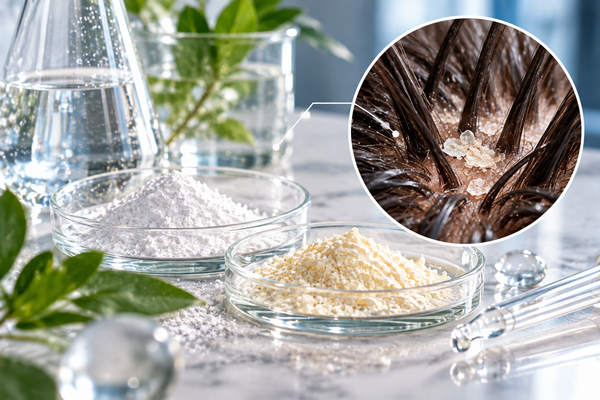
Kuzu starch is obtained by grinding and decanting the root until its starchy fraction is isolated: it is a food product used as a thickener and valued in macrobiotic cooking for its digestibility. Very little of the root’s active component remains in that starch.
The cosmetic extract takes the opposite approach: it concentrates precisely the fraction left behind by the starch, namely the isoflavones. This is the form that appears in INCI and is worth considering when choosing a cream or serum.
How kudzu works on the skin
The factors that cause skin aging are numerous: diet, lifestyle, sun exposure, or simply chronological aging. Cellular senescence is linked to oxidation caused by free radicals generated by endogenous and exogenous stress. That is why antioxidants are useful for slowing the process.
Fibroblasts play a central role in maintaining tissue structure, enabling the synthesis of extracellular matrix proteins, including collagen and elastin. The dermis is divided into two portions: the papillary dermis, which is more superficial and has a high cell density, and the deeper reticular dermis. Aging processes primarily affect papillary fibroblasts, slowing their proliferation.
Puerarin is the characteristic isoflavone of Pueraria lobata. In cultures of human dermal fibroblasts aged in the laboratory, treatment with it increased cell proliferation and reduced the proportion of senescent cells, while also limiting the shift toward the reticular fibroblast profile observed with age.
Here is a detail that matters more than anything else and is usually omitted. In the same study, free radicals did not decrease: in fact, they increased in the treated cells. In other words, the effect on senescence is real, but it does not result from simple antioxidant action, as is stated almost everywhere. It is a good reminder of how easy it is to describe an ingredient using the explanation that sounds good rather than the one supported by the data.
On another front, the data are more consistent: in fibroblasts exposed to UVA rays, puerarin increases the expression of the cell's antioxidant enzymes through a specific signaling pathway, reducing markers of oxidative damage. In that context, its antioxidant activity is documented.
The main benefits of kudzu for the skin
- Antioxidant, thanks to puerarin, the plant's main bioactive glycoside;
- Anti-glycation: glycation is the process through which excess sugars bind to structural proteins, making them stiffer. Kudzu contains molecules that counteract the formation of advanced glycation end products, or AGEs;
- Support for skin renewal, through the stimulation of epidermal keratinocytes;
- Support for fibroblast vitality, documented in laboratory-aged cell cultures.
What about dark spots?
It is the question that always comes up, because isoflavones are often presented as brightening agents. The honest answer is that the evidence is not clear-cut. Tyrosinase, the key enzyme in melanin production, works in two successive steps: in the first, puerarin acts as an inhibitor; in the second, as an activator. Some plant extracts show clear anti-melanogenic activity, but this depends on the fraction used and the experimental model.
In other words: kudzu should not be chosen as a dark-spot treatment. If your goal is to address facial hyperpigmentation, other active ingredients have more solid data behind them. Kudzu makes sense for what it does well: antioxidant protection and structural support.
A general clarification: much of this data comes from in vitro studies, meaning studies on cell cultures, not human clinical trials. They provide indications about the mechanism of action, not proof of effectiveness on the face.
Kudzu and menopausal skin
This is the context in which this active ingredient is mentioned most often, and it is worth explaining why without promising what a cosmetic product cannot do.
The root’s isoflavones belong to the phytoestrogen family, plant molecules with a structure reminiscent of estrogen. This is why they attract interest during the phase when estrogen levels decline and the skin becomes thinner, drier, and less firm. However, an extract applied to the face does not affect hormonal balance: what it offers is antioxidant support and help with hydration, addressing the two areas in which the skin suffers most during this phase.
For a complete overview of how the skin changes during this period and which active ingredients to focus on, see the guide to facial skin during menopause and the article on targeted active ingredients after age 50.
Where to find kudzu in LeLang formulas
Kudzu extract is one of the active ingredients in Hyaluronic Advance, where it complements hyaluronic acid with different molecular weights: one works on the skin’s ability to retain water, while the other provides antioxidant protection for the structure that must retain it.

HYALURONIC ADVANCE Plumping face cream with hyaluronic acid, filler effect Multiple hyaluronic acid: hydrates from deep within to the s... Discover HYALURONIC ADVANCE
In the kudzu ingredient page, you will find the complete list of LeLang formulas that contain it, while the other anti-aging facial treatments feature formulas that address the same goal with different active ingredients.
Frequently asked questions
Are kuzu and kudzu the same thing?
They come from the same plant, Pueraria lobata, but they are two different products. Kuzu is the starch from the root, used in cooking as a thickener; the kudzu used in cosmetics is an extract concentrated in isoflavones. The spelling with two “d”s is the most common in botanical and cosmetic contexts.
What does kudzu do for the skin?
It acts as an antioxidant: it counteracts free radicals generated by sunlight, pollution, and stress, helps limit the glycation of structural proteins, and supports hydration. The result is a more even complexion and more comfortable skin—not a dramatic overnight effect.
Should kudzu be taken or applied?
These are two distinct approaches. Oral isoflavone supplementation should be discussed with a doctor or pharmacist, especially for anyone undergoing hormone therapy or with a history of hormone-sensitive conditions. Topical use in a cosmetic acts where it is applied and remains focused on the appearance of the skin.
Is it suitable for sensitive skin?
Yes, at cosmetic concentrations it is generally well tolerated, and its flavonoid component has a soothing profile. As with any new product, for very reactive skin it is best to introduce it on its own, without adding other new products at the same time.
Does kudzu lighten dark spots?
It is not the right active for that goal. Puerarin behaves in opposite ways during the two steps of the enzyme that produces melanin, and the results vary depending on the extract studied. Those looking for an effect on discoloration should look elsewhere; kudzu remains a good antioxidant.
If you want to understand whether this active makes sense for your routine, at LeLang partner pharmacies you can find someone who can assess your skin in person and tell you whether the issue you have calls for an antioxidant or something else.
15-minute free consultation with the founder
Want to understand which antioxidant actives are best suited to your skin? Book a free virtual skincare consultation with Elisa Avalle, founder of LeLang.
Sources for this article
01 "Puerarin blocks the aging phenotype in human dermal fibroblasts", PLOS ONE, 2021 — a study on normal human dermal fibroblasts aged in culture: treatment with puerarin increased cell proliferation and reduced the proportion of cells positive for senescence-associated beta-galactosidase, while the production of reactive oxygen species did not decrease.
02 "Puerarin Reduces Oxidative Damage and Photoaging Caused by UVA Radiation in Human Fibroblasts by Regulating Nrf2 and MAPK Signaling Pathways", Nutrients, vol. 14 no. 22, 2022 — a study on human skin fibroblasts exposed to UVA: puerarin increases the expression of antioxidant enzymes through the KEAP1-Nrf2/ARE pathway, reducing ROS and malondialdehyde.
03 Qu L., Song K., Zhang Q., Guo J., Huang J., "Simultaneous Determination of Six Isoflavones from Puerariae Lobatae Radix by CPE-HPLC and Effect of Puerarin on Tyrosinase Activity", Molecules, vol. 25 no. 2, 2020 — puerarin inhibits the monophenolase activity of tyrosinase and activates its diphenolase activity: it therefore acts as both an inhibitor and an activator, depending on the enzymatic step.
04 Regulation (EC) No. 1223/2009 on cosmetic products and Regulation (EU) No. 655/2013 on common criteria for claims: a cosmetic product may improve the appearance of the skin, but it cannot affect hormonal balance or replace a medical assessment.
On the website: Isoflavones and puerarin · Skin glycation · Free radicals and antioxidants · Skincare during menopause · Ingredient profile: kudzu · Anti-aging facial treatments