


In cosmetics, beeswax is used to protect and provide structure: it forms a thin film on the skin that slows water evaporation, and in formulas it works as a natural thickener and emulsifier, keeping the oily and aqueous phases together. On the label, it appears as Cera Alba.
The useful thing to know is that it is not an active ingredient that "treats" anything. It is a structural and protective ingredient, and that is precisely where it excels — it makes a cream more comfortable, a lip balm more durable, and dry skin less exposed to the cold. Anyone looking for an anti-wrinkle effect will be disappointed; anyone looking for protection for skin that becomes chapped will not.
[INDICE:h2]
What beeswax is used for in cosmetics
Three functions, all practical.
Retaining moisture
It works as an occlusive: it creates a film on the skin's surface that slows water evaporation and reduces transepidermal water loss (TEWL), supporting the skin barrier. Unlike other heavier occlusives, it has low comedogenic potential and is not irritating, making it suitable for sensitive skin as well.
Giving formulas structure
It is an excellent co-emulsifier and thickener: it gives creams, lip balms, and sticks plasticity and consistency, and works well with all oils and oil-soluble ingredients. Without an ingredient of this kind, a lip balm would be liquid and a cream would separate.
Protecting against external agents
The same film that retains water also limits contact with cold, wind, and particulate matter. This is why beeswax appears so often in winter products, hand creams, and balms for chapped lips.
What it is and where it comes from
Beeswax is a natural wax produced by honeybees to build honeycombs. In its original state, it is colorless: pollen and propolis residues give it its familiar yellow or amber color. When beekeepers harvest honey, they also remove the honeycombs, and the wax is then clarified to remove impurities.
Natural beeswax also contains minor components such as carotenoids and flavonoids, with antioxidant and antimicrobial properties, along with squalene and 10-hydroxy-trans-2-decenoic acid.
It should be noted, however, that these components are present in very small quantities, and that the available evidence of their antimicrobial activity comes from in vitro studies, not clinical studies on skin: the main cosmetic value of beeswax remains structural and protective, not that of a biological active ingredient. This is an honest distinction that helps prevent attributing more to the ingredient than it actually does.
Is beeswax useful for wrinkles?
It is one of the most frequently asked questions, and it deserves a precise answer because you can read all sorts of things about it.
Beeswax does not stimulate collagen or act on the mechanisms that cause wrinkles. It is not a retinoid or a peptide: those work on the structure, while beeswax works on the surface.
That said, it does have a real effect on the appearance of wrinkles. Dehydration lines - the fine lines that appear when the skin loses water - visibly soften when hydration is retained, and the smoothing film makes the surface more even to the touch and in the light. It is an immediate, noticeable improvement, but it lasts only as long as the product remains on the skin.
In practice: if your wrinkles are fine and your skin is dry, a formula with beeswax really improves the appearance of your face. If, on the other hand, they are pronounced furrows linked to the loss of collagen, something else is needed - and beeswax remains an excellent complement, not the treatment.
How to use it
In everyday use, beeswax is almost never applied pure: you encounter it already formulated, which is how it delivers the best results.
- In face and body creams: as a co-emulsifier and protective agent, especially in winter formulas or for dry skin.
- In lip balms and sticks: it is what gives them solid consistency and resistance, while protecting an area without sebaceous glands.
- In hand creams and restorative products: wherever a film that withstands frequent washing is needed.
- In homemade preparations: it is melted in a bain-marie and combined with a plant oil, generally in a ratio of one part wax to four or five parts oil. It should be noted that a homemade preparation contains no preservatives and should be used within a short time.
Beeswax cream: when to choose it
Anyone looking for a beeswax cream almost always has a specific concern: skin that feels tight, reddens in the cold, or becomes chapped. This is exactly when this ingredient is most effective, because its job is to retain the water already present and protect from external factors.
It makes more sense:
- on dry skin and skin that becomes dehydrated with the change of season;
- in winter, on the hands and lips exposed to cold and wind;
- as the final step of your evening routine, over a moisturizing serum, when your skin needs to be sealed in.
It is less suitable for oily or acne-prone skin during the warmer months: not because the wax clogs pores, but because formulas containing it are generally rich.
How to recognize it on the label
In INCI, beeswax is called Cera Alba, sometimes accompanied by Beeswax. Its position in the list says a lot: ingredients present above 1% are listed in descending order of concentration, so if Cera Alba appears among the first ingredients, the cream will be more protective and rich; if it appears toward the bottom, it mainly serves a texturizing function. How to read the list as a whole is explained in the article on how to read INCI.
Beeswax creams can also be found in pharmacies and para-pharmacies. More than the sales channel, however, what matters is the formula: what is combined with the wax, which plant oils and moisturizing actives are included, because that is what determines how much the cream nourishes as well as protects.
The evolution: emulsifiers derived from beeswax
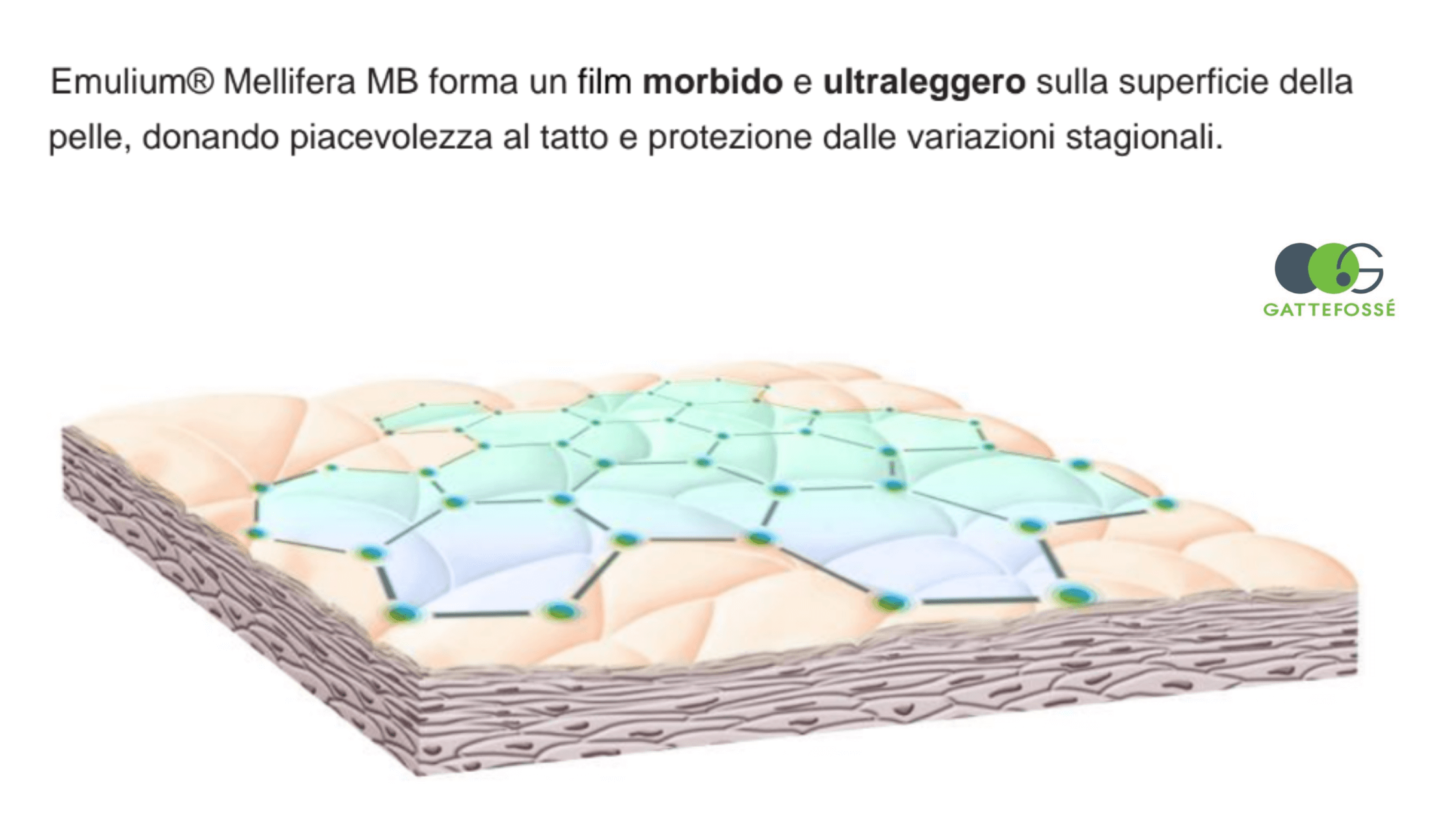
Natural cosmetics have used beeswax as a starting point for developing more advanced ingredients. One of these is an emulsifier that combines beeswax, jojoba wax, and vegetable polyglycerol, which react to produce a soft, uniform butter that respects the skin microbiome.
Its most interesting characteristic is its ability to self-adapt to temperature and humidity:
- in dry and cold conditions, it creates a soft, comfortable protective film on the skin;
- in hot and humid conditions, it stabilizes the sensory properties, leaving the skin feeling less heavy and making the film less noticeable.
In practice, the same cream feels richer in winter and lighter in summer, without changing the formula.
Formulations containing it showed an increase in:
- +77% in skin radiance;
- +68% in the fineness of the skin's texture;
- +58% in smoothness;
- +35% in the appearance of firmness.
These values come from the ingredient manufacturer's tests, not from independent clinical studies published in peer-reviewed journals. They also express a relative improvement compared with the control, not an absolute change in the skin: they should be read as indications of efficacy in the formula.
Where we use it at LeLang
We chose this emulsifier for the Elyx Performance face cream, where it enhances the absorption and properties of the other active ingredients, creating a cream that feels soft and fresh and is easy to apply.

ELYX PERFORMANCE Snail slime face cream, anti-wrinkle and regenerating Organic Snail Slime: regenerates and promotes cell renewal. Re... Discover ELYX PERFORMANCE
The formula therefore better meets the needs of modern life, addressing skin imperfections while also protecting the skin barrier from factors such as pollution and climate fluctuations.
The ingredient sheet for the beeswax and jojoba emulsifier contains the complete list of LeLang formulas that include it.
You can also find LeLang products at partner pharmacies throughout Italy.
Frequently asked questions
What is beeswax used for on the skin?
To protect it and retain moisture. It forms a thin film that slows water evaporation and protects against cold and wind, without being as occlusive as other similar ingredients. In formulations, it also serves a technical function by providing consistency and stability.
Does beeswax clog pores?
It has a low comedogenic potential, much lower than is often attributed to it. For very oily or acne-prone skin, it is still advisable to choose lighter textures, not because the wax itself is problematic but because formulas containing it are generally richer.
Is it suitable for sensitive skin?
Yes, it is one of the best-tolerated ingredients and does not appear to be irritating. The only precaution concerns people with a confirmed allergy to hive products — propolis, honey, pollen: in that case, since the wax may contain traces of them, a preliminary test is advisable.
What is the difference between beeswax and plant-based waxes?
Plant-based waxes such as candelilla or carnauba wax perform a similar function but have a higher melting point and produce a firmer texture: they are used when a more solid structure is needed. Beeswax remains more pliable and soft on the skin, which is why it is preferred in balms. Plant-based waxes are, however, the alternative when the formula must be vegan.
Is it vegan?
No: since it is produced by bees, it is of animal origin and therefore does not appear in certified vegan formulations, where it is replaced by plant-based waxes.
Sources for this article
01 Fratini F., Cilia G., Turchi B., Felicioli A., "Beeswax: A minireview of its antimicrobial activity and its application in medicine", Asian Pacific Journal of Tropical Medicine, vol. 9 no. 9, 2016, pp. 839-843. Review of the composition and antimicrobial activity of beeswax, with the authors themselves noting that studies dedicated solely to beeswax are still limited.
02 Sensory and instrumental efficacy data on the beeswax, jojoba wax, and polyglycerol emulsifier: ingredient manufacturer's tests, not published in a peer-reviewed journal.
03 Regulation (EC) No. 1223/2009 on cosmetic products, Articles 2 and 20, and Regulation (EU) No. 655/2013 on common criteria for claims relating to cosmetic products.
On the website: The skin barrier · Skin microbiome · Peptides in cosmetics · Collagen · Beeswax and jojoba emulsifier fact sheet
15-Minute Free Consultation with the Founder
Would you like to understand which texture and formula are best suited to your skin? Book a free virtual skincare consultation with Elisa Avalle, founder of LeLang.

