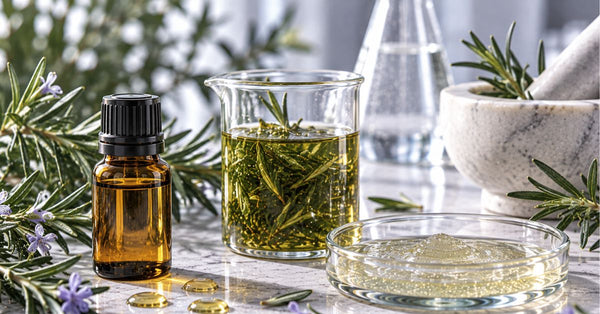



Jojoba oil, listed in the INCI as Simmondsia Chinensis Seed Oil, is obtained from the seeds of a shrub that grows in the deserts of North America. The interesting thing is not where it comes from: it is that, chemically, it is not an oil. Unlike all other plant oils, it does not contain triglycerides, but esters of long-chain alcohols and fatty acids. It is a liquid wax, and this explains all of its behavior on the skin.
It almost never goes rancid, remains lightweight, and does not clog pores. In return, it does not nourish like an oil rich in essential fatty acids: it is a trade-off, not a flaw.
Article written by Elisa Avalle, founder of LeLang Skin Care and dermocosmetics specialist. Cover image generated with the support of artificial intelligence.
What being a wax rather than an oil means
The first two consequences are practical. Its ester structure is highly resistant to oxidation, so jojoba lasts over time without developing the typical rancid odor of oils rich in unsaturated fatty acids. This also makes it a reliable ingredient in formulas without powerful antioxidants. The second is its skin feel: it absorbs quickly and leaves the skin soft but dry, not shiny.
The third is the most frequently mentioned and needs to be explained precisely. Human sebum also contains a significant proportion of wax esters, so jojoba has a genuine affinity with the hydrolipidic film and spreads well. This does not mean that it regulates sebum production: this is a widespread claim that studies do not support. Jojoba feels lightweight on oily skin, which is different from reducing sebaceous activity.
What it really does on the skin
It works as an emollient and a lightweight occlusive: it fills the spaces between cells in the stratum corneum, makes the surface feel smooth, and reduces transepidermal water loss without the heaviness of a classic occlusive. It is also an excellent carrier, meaning a base that delivers and stabilizes other oil-soluble actives.
What it does not do is provide useful amounts of essential fatty acids, because it contains very little of them. If the goal is to support the synthesis of barrier lipids on dry, cracked skin, oils rich in linoleic acid are needed, such as grapeseed oil. Jojoba is the right choice for another purpose: protecting and softening while remaining imperceptible.
Which skin types it makes sense for
- Oily and combination skin. It is one of the few oils that can be used without feeling heavy, and it fits well into a routine for oily skin as a lightweight evening step.
- Reactive skin. Its composition is simple, with very few potentially sensitizing components and no strong inherent fragrance.
- After shaving. It reduces friction and does not clog follicles that have just been irritated by the razor: useful when managing sensitive skin after shaving.
- In oil cleansing. It dissolves sebum and long-wearing makeup through affinity, and is one of the classic ingredients in the first step of double cleansing.
- On hair and the scalp. It is also well tolerated by scalps that tend to become oily, precisely because of its dry finish.
In our oil cleanser, the base is made with lightweight plant oils from sunflower, sweet almond, hazelnut, and grapeseed, following the same principle: dissolve without leaving residue.

CLEANSING GENTLE OIL Rich cleansing and makeup removing gel oil for a deep cleansing, protects the hydrolipidic barrier Protects the skin... Discover CLEANSING GENTLE OIL
How to read it on the label
It appears as Simmondsia Chinensis Seed Oil, sometimes accompanied by Hydrogenated Jojoba Oil, the solid version used to give structure to balms and sticks. Its position in the INCI indicates how much is present: in the first three entries, it is a key ingredient; at the end of the list, it is little more than a label presence. For pure products, a dark, tightly closed container is advisable, even though its stability is high.
Frequently asked questions
Is it comedogenic?
It is considered one of the least comedogenic oils in its category, which is why it is chosen for skin that develops imperfections with other oils. Individual responses still vary: on very reactive skin, it is best to test it on a limited area.
Can it replace moisturizer?
No. An oil contains no water and does not hydrate: it holds on to the water that is already there. Applied to dry skin after aggressive cleansing, it will leave the skin soft to the touch but still dehydrated.
Is jojoba or almond oil better?
It depends on the goal. Almond oil for dry skin that needs nourishment, jojoba for skin that does not want to feel anything on it.
Sources for this article
- Literature on the composition of jojoba oil: esters of long-chain alcohols and fatty acids, with a substantial absence of triglycerides.
- Studies on the oxidative stability of liquid waxes compared with plant oils rich in unsaturated fatty acids.
- Literature on the composition of human sebum and its proportion of wax esters.
- Studies on topical emollients and occlusives and their effect on transepidermal water loss.
Jojoba is the ingredient you notice for what it does not do: it does not feel greasy, go rancid, or clog pores. On skin that has rejected all other oils, it is almost always the first one worth trying.