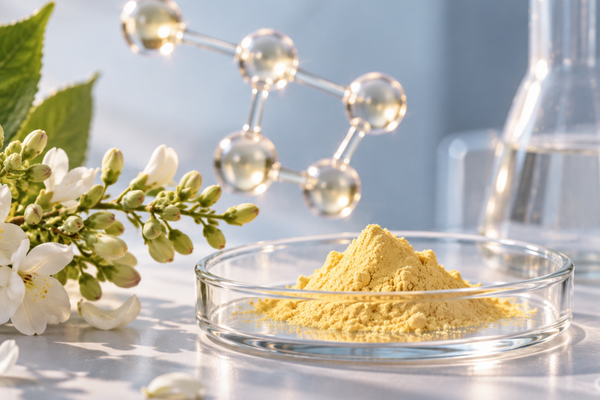



Witch hazel bought as "water" and witch hazel found in a dermocosmetic formula are often not the same thing. A distillate carries only the plant's volatile components, and tannins - the molecules responsible for much of its activity - are not volatile. The name on the label is identical; the contents are not.
Article written by Elisa Avalle, founder of LeLang Skin Care and dermocosmetics specialist. Cover image generated with the support of artificial intelligence.
[INDICE:h2]What is witch hazel?
Hamamelis virginiana is a shrub native to North America, similar to a hazel tree, with oval leaves that are toothed along the edges. In cosmetics, extracts obtained from the leaves are used most often, and sometimes from the bark.
On the label, it appears as Hamamelis Virginiana Leaf Extract, Hamamelis Virginiana Bark Extract or Hamamelis Virginiana Water. The three designations are not interchangeable, and this is the central point of this article.
What it really contains
Analysis of the 60% ethanolic extract shows three families of compounds:
- gallic acid;
- quercetin, a flavonol;
- tannins, including hamamelitannin, which is characteristic of the plant.
Tannins are large, non-volatile molecules. This means that a steam-distillation process - the one that produces "waters" - by its nature does not carry them into the final product. They remain in the residue. What passes through are the volatile compounds, in modest quantities.
This is not a defect of the distillate: it is how distillation works. The problem arises when the properties documented for the extract are attributed to witch hazel water, because the two are different things.
The second problem: alcohol
Many witch hazel distillates on the market contain alcohol as a preservative, often in significant percentages. On already reactive skin, the effect may be the opposite of what is intended: stinging, dryness and redness after application. If your skin is sensitive, it is worth checking where Alcohol or Alcohol Denat. appears in the INCI list.
The extract's dual action
Witch hazel is recognized as having a twofold action on the venous system, due to two different groups of molecules.
- Increased venous tone, attributed to catechin tannins composed of leucoanthocyanins. This is the strictly venotonic action.
- Vitamin P activity, due to flavonoids: reduced capillary permeability and increased venous resistance. This is the same family of effects discussed in connection with rutin and horse chestnut.
On the skin, in cosmetics, this translates into an astringent effect and a contribution to the comfort of areas prone to redness.
Astringent does not mean drying
"Astringent" is one of the most misunderstood words in cosmetics. It describes a temporary contraction of the superficial tissues caused by tannins, which precipitate surface proteins. It does not describe the removal of water or lipids.
The confusion stems from the fact that traditional astringent toners were almost all alcohol-based, while alcohol causes dehydration. The drying effect many people remember came from the alcohol, not the tannins. A well-formulated witch hazel extract in an alcohol-free vehicle should not leave the skin feeling tight.
If the issue is skin that reddens easily, it is also worth reading red skin: causes, prevention and remedies.

NUTRALIGHT SENSITIVE Soothing and repairing face cream with thermal water from the Piedmont Alps – ideal for sensitive and reactive skin ... Discover NUTRALIGHT SENSITIVE
The limitation
Regulatory note. Witch hazel is recognized for traditional medical uses in varicose veins, hemorrhoids, phlebitis and venous insufficiency. These indications belong to medicines, not cosmetics: a cosmetic product does not treat them and cannot claim to do so, under Regulation (EC) 1223/2009 and Regulation (EU) 655/2013. For stable dilated capillaries, persistent swelling or pain, consult a doctor.
There is also a lesser-known limitation. Tannins interact with other molecules: they can precipitate proteins and bind metal ions, which means that their compatibility must be verified in a complex formula. This is not an ingredient to add lightly to just any base.
How to choose it
Three practical criteria, in order of importance:
- Look at the exact INCI designation. Leaf Extract or Bark Extract indicate an extract; Water indicates a distillate or an aqueous solution, with low or no tannin content.
- Check for alcohol and its position in the list. If it is among the first ingredients in a product intended for sensitive skin, that is a contradiction.
- Consider the formula's overall context. An astringent makes sense as part of a routine that hydrates and protects, not on its own.
If you would prefer an opinion on a specific product you already have at home, the LeLang partner pharmacists are trained to read the INCI with you and distinguish an extract from a fragranced water.
Not sure if it is the right product for you?
Book a free virtual consultation: together, we will assess your skin and create a customized protocol.
Book your consultationSources for this article
- Caballero Gobern F. (2023). Cosmetici per le gambe. Fundació IL3 - Universitat de Barcelona.
- Lintner K. (1998). "Purified plant extracts". Cosmetic & Toiletries, vol. 113, pp. 67-73.
- Nees S., Weiss D.R., Reichenbach-Klinke E. et al. (2003). "Protective effects of flavonoids contained in the red vine leaf on venular endothelium against the attack of activated blood components in vitro". Arzneimittel-Forschung / Drug Research, vol. 53, no. 5, pp. 330-341.
- Regulation (EC) No. 1223/2009 of the European Parliament and of the Council on cosmetic products.
- Commission Regulation (EU) No. 655/2013, common criteria for the justification of claims relating to cosmetic products.
On the site: Rutin in cosmetics: what it does and why it is called vitamin P · Skin pH: what it is and how it affects cosmetics · What sensitive skin is and how to treat it