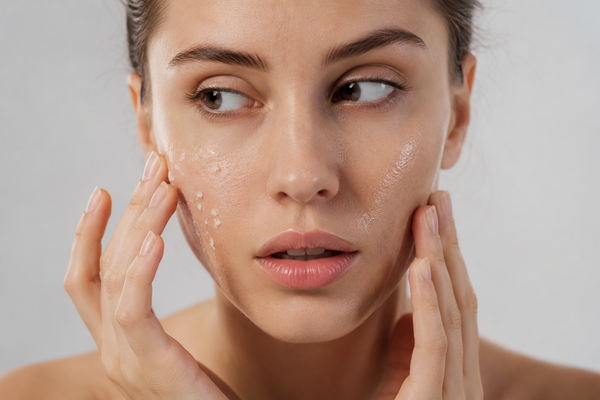



Hypochlorous acid, often referred to as HOCl, is an oxidizing substance that our immune system produces during its response to microorganisms. In stabilized form, it has long been used for cleansing and wound management.
The word “acid” may make it seem like an exfoliant, but it does not belong to the same category as alpha or beta hydroxy acids. Its appeal comes from its antimicrobial activity and the good tolerability of properly prepared formulations. The issue is something else: it is becoming a universal step, and it is not one.
[INDICE:h2]

Elisa Avalle · Founder and dermocosmetics specialist
This is an interesting case because the truth is not found at either extreme. Hypochlorous acid is not just a trend, but neither is it miracle water that replaces cleanser, treatment, and barrier repair.
Langhe, September 9, 2026
Why it went viral
The spray format is perfect for social media: quick, refreshing, and easy to use after the gym, while traveling, or on a hot day. This has led to increasingly broad claims — acne, rosacea, eczema, a damaged barrier, and even replacing cleansing.
Its success is understandable. It is rare to find an ingredient perceived as gentle while also being associated with antimicrobial action: usually, the two qualities point in opposite directions. But versatility does not mean universality.
Where the evidence is most convincing
Dermatological reviews describe applications in infection prevention, wound management, itch relief, and certain inflammatory conditions. There is also emerging data on acne, seborrheic dermatitis, and other dermatoses.
However, this evidence does not justify turning every cosmetic spray into a treatment. Concentration, pH, stability, container, and method of use all affect how the product behaves, and hypochlorous acid is notably sensitive to light, heat, and interactions with other ingredients. This is one of those cases where the difference between two formulations with the same name on the label can be enormous.
Can it replace cleanser and acne treatment?
I would not consider it a replacement for cleansing. A spray can be practical when it is not possible to wash your face immediately after sweating, but it does not remove sebum, particulate matter, makeup, and sunscreen the way an appropriate cleanser does.
Likewise, acne does not depend solely on bacteria present on the skin’s surface: sebum production, keratinization, inflammation, and individual characteristics are all involved. HOCl may play a supporting role, but it is not equivalent to a complete treatment.
“Not everything that is well tolerated needs to become mandatory.”
Do you need to use it every day?
In August 2026, a counterdebate also emerged: some dermatologists drew attention to the repeated and indiscriminate use of an antimicrobial on healthy skin, especially given the growing interest in the skin microbiome.
This does not mean the ingredient is inherently harmful. It means that balanced skin, without a specific need, may have no reason to be misted several times a day.
My take
I see it as a targeted product, useful at certain times and for certain skin types. It has a history of use and documented properties: it is not a gimmick.
Before permanently adding it to a routine, however, I would always ask one question: what problem are we trying to solve? If we cannot answer, perhaps we are adding a step because it is viral, not because we need it. That is the same criterion I use when looking at any routine that keeps getting longer without a stated reason.

Elisa Avalle is the founder of LeLang Skin Care, specializing in dermocosmetics at the University of Barcelona. Formulated in the Langhe for Italian pharmacies.
Sources for this article
01 Natarelli et al., dermatological applications of hypochlorous acid, Journal of Integrative Dermatology, 2024
02 Haralović et al., “Clinical insights on hypochlorous acid,” 2025
03 Marie Claire UK, debate on daily HOCl use, August 2026
On the site: the skin microbiome · double cleansing