

For a few months now, beta-glucan has been presented as the new hyaluronic acid. The same claim keeps circulating: it would hydrate many times more and penetrate more deeply. It is a polysaccharide, a long chain of sugars, and on labels you will find it as Beta-Glucan, or within oat or yeast extracts.
The comparison is misguided, and it does neither ingredient any favors. Beta-glucan is not a more powerful hyaluronic acid: it is a molecule that does a different job. One draws in and retains water; the other works mainly on the surface and on skin reactivity. People with dehydrated skin need the former. People whose skin reacts to everything have more to gain from the latter.
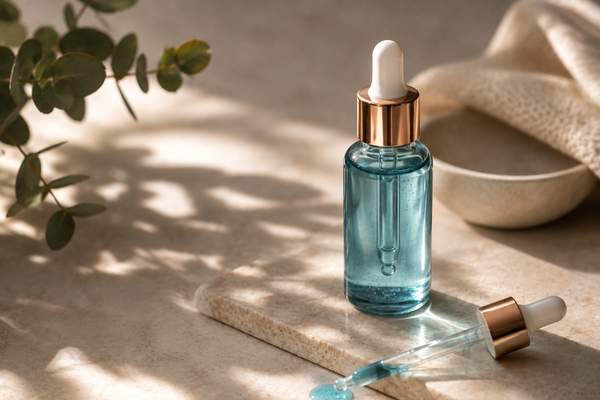
Cover image generated with the support of artificial intelligence.
[INDICE:h2]

Elisa Avalle · Founder and dermocosmetics specialist
Whenever an ingredient is sold as a substitute for another, the ingredient loses out. Because it is judged on ground that is not its own.
Langhe, October 18, 2026
What beta-glucan is, in two lines
It is a chain of glucose molecules joined by beta-type bonds. The structure changes depending on its source, and this is the first thing marketing oversimplifies: there is no such thing as "the" beta-glucan.
- Oat beta-glucan is linear and is most closely associated with the soothing and film-forming effect we have long known from colloidal oatmeal baths.
- Yeast beta-glucan is branched, and it is the form on which the literature concerning interaction with immune cells focuses.
- Mushroom beta-glucans have yet other structures, with data mostly studied for oral rather than topical use.
When a label says only "beta-glucan" without saying where it comes from, the useful information is missing. It's like writing "vegetable oil."
Why "hydrates many times more than hyaluronic acid" doesn't hold up
Numbers such as "holds X times its weight in water" come from laboratory measurements taken on a solution. They compare molecules in a test tube and do not describe what happens on skin.
On the skin, the limiting factor is not how much water a molecule could theoretically bind: it is how much water it finds, where it finds it, and how much it can retain. A pure humectant, in a dry environment, may draw water from the underlying layers rather than from the air, which is why hyaluronic acid needs to be sealed in with something on top.
Beta-glucan isn’t playing the same game. It has a high molecular weight and remains largely on the surface, where it forms a film that reduces evaporation. Functionally, it is closer to a light occlusive than to a humectant. Comparing it with hyaluronic acid for hydration is like comparing a coat with a glass of water.
“There’s no competition between the two. There’s skin that needs water and skin that needs to be left alone.”
Where it does have a real advantage
For skin that reacts to everything. This is the situation I see most often: someone who has tried six products in two months, has a barrier in disarray, and gets worse with every new attempt. In that situation, the goal isn’t to add a more powerful active ingredient: it’s to turn down the noise.
A film that reduces water loss and very high tolerability are exactly what is needed there. In this respect, beta-glucan is an excellent ingredient, and it was one even before someone decided to sell it as a substitute for something else.
The biology that interests me, and its limitation
The skin’s immune cells possess a receptor that specifically recognizes beta-glucans, called dectin-1. It is a well-described pathway in immunology and explains why this family of molecules is being studied for modulating the inflammatory response.
That said, I need to add the part that disappears from promotional content: the existence of a receptor does not prove that a cream activates it in a clinically useful way. Between an experiment on cell cultures and a jar lie penetration, the actual concentration in the formula, the vehicle, and contact time. Much of the data circulating is either in vitro or produced by those who sell the raw material. It isn’t false data: it answers a different question from “does it work on my face?”
It’s the same distinction I wrote about when discussing what “clinically tested” really means.
The molecular weight trade-off
This is the technical point that determines almost everything. The molecule is large, so it penetrates very little. That's why some suppliers propose low-molecular-weight fractions, presenting them as improved versions.
But the more the molecular weight is reduced, the more the film-forming effect that made the ingredient interesting is lost. It's not an improvement: it's a trade-off. You gain depth at the expense of the surface, and which of the two you need depends on your skin, not on which version is newer.
It's exactly the kind of choice we make at LeLang when developing a formula, and I wrote about it in how I choose active ingredients: almost never is the question "is this ingredient good?" The question is "which version, at what concentration, in what texture, for which skin?"
What I do with skin that reacts to everything
The sequence is always the same, and it doesn't start with a new ingredient; it starts by taking something away. Two weeks with the bare minimum: gentle cleansing, a cream that rebuilds the lipid barrier, and sun protection. Nothing else.

NUTRALIGHT SENSITIVE Soothing face cream for sensitive, redness-prone skin With thermal water from the Piedmont Alps, for sensitive and re... Discover NUTRALIGHT SENSITIVE
Only once the skin has become tolerant again does it make sense to restore true hydration, the kind that works with water rather than only on the surface. This is when hyaluronic acid becomes genuinely useful again, and when applying it to calm skin makes it clear that it wasn't the problem.

HYALURONIC ADVANCE Plumping face cream with hyaluronic acid, filler effect Multiple hyaluronic acid: hydrates from deep within to the s... Discover HYALURONIC ADVANCE
In this sequence, beta-glucan would be a good supporting ingredient in the first phase. We didn't choose it for LeLang formulas because we achieve the same goal with a combination we've tested more thoroughly, but if you find it in a product you're already using and it works well for you, there's no reason to switch.
How to read a label that contains it
- Look at where it comes from: oats, yeast, and fungi are not the same thing. If it's not stated, the information is missing.
- Look at where it appears in the INCI. A beta-glucan at the bottom of the list, after the preservatives, risks being an ingredient for a press release.
- Be wary of numerical comparisons with other ingredients. Under common European criteria for cosmetic claims, a comparative claim must be supported by verifiable evidence: it's legitimate to ask what that evidence is.
- Don't expect an immediately visible effect. Its job is to make fewer things happen, and things that don't happen can't be photographed.
If this kind of reading seems complicated to do on your own, that's because it is: at the pharmacies and parapharmacies that distribute LeLang, it's a two-minute job at the counter, with the product in hand and your skin in front of us. That's why we chose pharmacies and parapharmacies as our channel.
What I really think
That it is a serious ingredient, with one of the best tolerability profiles available, and that it never needed to be sold as a substitute for something else.
The "new X" mechanism is a convenient narrative shortcut: it makes a novelty immediately understandable. But every time, it causes the same damage. Buyers expect the original's result, don't get it because the molecule does something else, and conclude that the ingredient doesn't work. Within two seasons, an honest raw material has been burned through, and in the meantime the next substitute is already ready.
It's better to say what it does. Even if it's a less spectacular phrase.

Elisa Avalle is the founder of LeLang Skin Care, specializing in dermocosmetics at the University of Barcelona. She founded the brand in the Langhe, for Italian pharmacies and parapharmacies.
Sources for this article
01 Regulation (EC) No. 1223/2009 on cosmetic products
02 Regulation (EU) No. 655/2013 on common criteria for claims relating to cosmetic products
03 INCI nomenclature for sources used in cosmetics: Beta-Glucan, Avena Sativa (Oat) Kernel Extract, and extracts and ferments of Saccharomyces cerevisiae
04 Dectin-1 as a beta-glucan recognition receptor: a pathway described in the immunological literature, with data primarily from in vitro studies
05 Observations collected during skincare consultations conducted by the author
On the website: hyaluronic acid in cosmetics · oats for the skin · the skin barrier · what clinically tested means