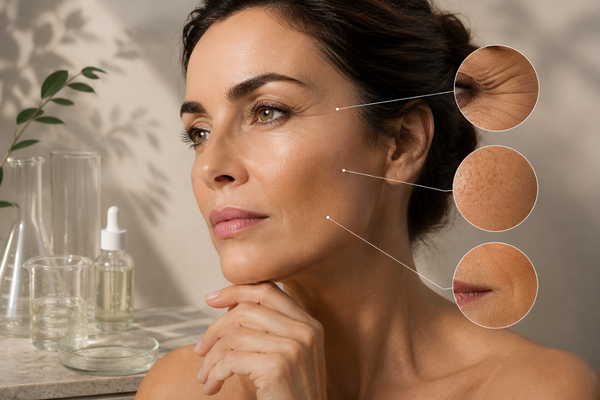



In September, the skin doesn’t change because the season changes. It changes because it suddenly stops receiving what it had adapted to over three months: humidity, heat, and consistent sunlight. And almost always, at the same time, we also change all our products.
Seasonal-transition mistakes all have the same root: too many things are done together and too quickly. Skin takes about four weeks to complete a renewal cycle: changing your routine in three days means not giving anything enough time to work, and then not knowing what caused what.
[INDICE:h2]
Mistake 1: restarting acids too soon and all at once
This is the most common mistake. In August, exfoliating acids and retinoids are paused; in September, they are restarted — often on the first available day, and often at the same frequency used in June.
The problem is that September skin is not June skin. After months of exposure, the stratum corneum is thicker and the skin barrier may be more fragile than it appears: a tan masks redness and dehydration, and when it fades, you discover its real condition.
What to do instead: reintroduce one active ingredient at a time, starting with the lowest frequency and waiting at least two weeks before adding the next one. If you start with the exfoliant, let the retinoid wait. If you introduce them together and your skin reacts, you will never know which one was responsible.
Mistake 2: switching immediately to rich textures
On the first cool day, the winter cream comes out. But in September, the skin’s problem is not a lack of lipids: it is the dehydration left behind by summer.
These are two different things, yet they are constantly confused. Dry skin lacks sebum, while dehydrated skin lacks water — and oily skin can be perfectly dehydrated. Applying an occlusive texture to dehydrated skin provides an immediate feeling of comfort but does not solve the problem; on oily or blemish-prone skin, it can make things worse. The complete distinction is explained in the guide to dry and dehydrated skin.
What to do instead: in September, you need hydration, not nourishment. Humectants such as hyaluronic acid and glycerin, along with a texture that gradually becomes richer from October onward, when the cold and heating really come into play.
“In September, skin doesn’t ask for more products. It asks us to stop changing them every three days.”
Mistake 3: stopping sunscreen
When the holidays end, sunscreen goes back in the drawer. It is the costliest mistake, and its consequences are delayed: the spots that appear in October are often summer’s bill, and without protection they get worse just as you are trying to lighten them.
September and October still have days with a high UV index, and visible light — which no filter can block completely — contributes to hyperpigmentation all year round. Anyone with sunspots or using brightening actives cannot afford to stop.
What to do instead: sunscreen stays in your morning routine. If anything, change the format: a lighter texture for the city, or a pocket-sized single-use sachet for days when you do not think about it.

Face Sunscreen SPF 50 Pocket Size, Travel Size (5 pcs) The problem isn’t applying sunscreen. It’s reapplying it. Smaller than a credit card, fits in your wallet and... Discover Face Sunscreen SPF 50 Pocket Size, Travel Size (5 pcs)
Mistake 4: changing your entire routine at once
Cleanser, serum, cream, eye contour: everything new on the same day. It is understandable — returning to your routine is when you reorganize — but it makes it impossible to understand anything.
If your skin reacts badly, with five new products there is no way to know which one is responsible. And if it reacts well, you do not know what to attribute it to, so you cannot repeat the result.
What to do instead: change one product at a time, every two weeks. Start with the cleanser, which is the most underestimated step and the one that affects all the others: if cleansing is too harsh, no serum can repair the damage.
Mistake 5: treating hair shedding as an emergency
Hair shedding increases between September and November. It is not a symptom: a larger proportion of follicles simultaneously enters the resting phase, and it is a documented seasonal phenomenon.
The mistake is reacting with aggressive treatments and constantly switching products. However, if shedding is heavy, lasts more than three months, or is accompanied by visible thinning, it is no longer a cosmetic matter and should be assessed by a dermatologist.
Mistake 6: expecting results within a week
Complete skin renewal takes about twenty-eight days in young adults and slows with age. Hydration and comfort can be noticed within a few days; texture, evenness, and firmness take two or three months.
Anyone who changes products after two weeks because “it doesn’t work” is not evaluating the product: they are evaluating a timeframe that is not long enough for anyone. This is also why a three-step routine followed consistently delivers more than a ten-step routine that is constantly changed, as I explain in the guide to a minimalist routine.

Elisa’s note
September is the month when I receive the most consultation requests, and almost always the person has already bought three new products the week before. The first advice I give is almost always the same: set them aside, let’s start again with what you were using and add one thing at a time.
A sensible seasonal-transition schedule
If I had to reduce everything to an order of operations, it would be this.
First two weeks of September: change nothing. Increase hydration and continue using sunscreen. Observe how your skin is doing as your tan fades.
Third and fourth weeks: reintroduce exfoliation, starting once a week. If there are dark spots, begin with a brightening active.
October: reintroduce retinoids, always at a low frequency, and switch to slightly richer textures.
November: this is when the real cold-weather problem begins, and it is another season with different rules — I discuss it in the guide to preparing your skin for winter.
Six weeks to do what many people try to do in three days. It is slow, but it is the only way to know what is working.
Frequently asked questions about seasonal changes
Does skin really change with the seasons?
Yes. Ambient humidity, temperature, and sun exposure influence surface hydration, sebum production, and reactivity. Your skin type does not change; its condition at that particular moment does.
Do I need to buy different products for autumn?
Not necessarily. Often, it is enough to change the frequency of what you already use and add hydration. New products should be evaluated after understanding how your skin is doing, not before.
Why does acne come back in September?
Sun exposure has a temporary anti-inflammatory effect that masks lesions; when exposure ends, the thickening of the stratum corneum accumulated over the summer clogs pores. This is the so-called rebound effect, which I discuss in the acne guide.
How long should I give a new routine?
At least two renewal cycles, so about two months, before deciding that it does not work.
Sources for this article
01 Dermatological literature on skin cell turnover and its variation with age
02 Studies on the seasonal nature of the hair cycle and the increase in the telogen phase in autumn
03 Regulation (EC) No. 1223/2009 on cosmetic products
On the site: dry or dehydrated skin · skin barrier · preparing your skin for winter