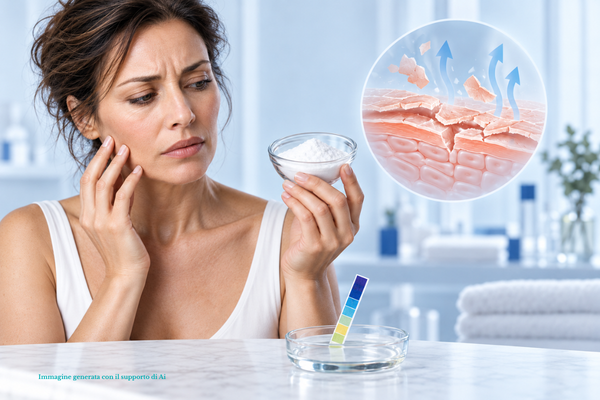



With the change of season, the skin undergoes various effects. In some cases, it becomes dry and tight because it depletes its own resources to defend itself; in others, the complexion looks dull and the skin becomes thicker and less radiant.
Achieving the glass skin effect is not a matter of makeup: if your complexion struggles to find its natural radiance, targeted skincare solutions are needed.
Article written by Elisa Avalle, founder of LeLang Skin Care and dermocosmetics specialist. Cover image generated with the support of artificial intelligence.
[INDICE:h2]
What is a facial brightening product in skincare?
When we talk about a brightening product in a skincare routine, we are not referring to glittery powders or pearly drops to blend onto the cheekbones, but to real treatments — serums and creams formulated to improve the quality of the epidermis.
There are cosmetics that work synergistically to support cell renewal, even out skin texture and reduce the appearance of discoloration.
True glow does not depend on an artificial optical effect, but on skin that is healthier: when the surface is more even, less dry and less stressed, it reflects light more evenly. It is the same physical principle that makes dehydrated skin look gray: light is scattered instead of reflected.
Why skin becomes dull: the five causes
"Dull complexion" is a symptom, not a diagnosis. There are different causes behind it, and understanding which one is affecting you determines which treatment makes sense.
Here we look at them from a product perspective: which treatment is needed for each one. If, instead, you are looking for the underlying biological mechanisms and how to identify your own, the complete picture is in dull skin: causes and remedies.
- Slowed cellular turnover. Dead cells accumulate on the surface and form an uneven layer that scatters light instead of reflecting it. It is by far the most common cause, and also the one that responds fastest.
- Dehydration. Skin lacking water has a less taut surface and reflects light less effectively. This is why the complexion appears grayish even without dark spots or wrinkles: the distinction between dry and dehydrated skin matters here too.
- Oxidative stress. Free radicals generated by the sun, pollution, and smoking damage lipids and proteins, and the skin loses its visual firmness.
- Chronic stress and insufficient sleep. Microcirculation slows down and delivers less oxygen to the superficial layers: the complexion turns grayish or yellowish. We discuss this in more detail in the article on stress-related tired skin.
- Accumulated sun damage. Hyperpigmentation makes the complexion uneven, and the eye interprets this unevenness as dullness.
There is an interesting point on this last aspect: research into facial perception indicates that the uniformity of color distribution affects age estimation, regardless of wrinkles. It is not only a matter of how much light the skin reflects, but also of how uniformly it does so.
Why antioxidants help
Skin loses its radiance when exposed to oxidative stress, linked to the action of free radicals: unstable molecules promoted by sun exposure and pollution.
Antioxidants do not brighten the skin like a highlighter would: they support it in defending itself against factors that make it appear dull.
Ingredients to know
The most interesting active is vitamin C, an ideal antioxidant for reviving a dull complexion. It is often combined with ferulic acid, which stabilizes its action and helps prevent dark spots.
- Lycopene: an antioxidant carotenoid that counteracts UV damage and a dull complexion.
- Mullein: a botanical ingredient that, according to the manufacturer's tests, absorbs part of UV radiation and returns it as visible light.
- Hyaluronic acid: retains water and keeps the skin plump; hydrated skin appears more radiant.
- Niacinamide: refines skin texture and evens out the complexion, counteracting the marks left by blemishes.
How and where to apply it
The product should be applied after cleansing and toner. The right technique is to pat it in with light movements instead of rubbing, to ensure even application without stressing the tissues.
Radiant does not mean shiny. If you have combination skin, apply the brightening serum to the cheekbones and alternate it with a mattifying treatment on the T-zone.
Products for radiance
Lycoglow Serum
Brightening serum based on mullein and lycopene, to smooth the surface and revive a dull complexion.

LYCOGLOW SERUM Anti-pollution brightening face serum Brightens dull skin with mullein extract. Lycopene and algae extract: an antio... Discover LYCOGLOW SERUM
Ferulic + HA Serum
With ferulic acid and stabilized vitamin C, it combats oxidative stress and supports collagen.

FERULIC + HA SERUM Vitamin C and ferulic acid face serum Antioxidant and tone-evening, with dual hyaluronic acid. Helps prevent dark sp... Discover FERULIC + HA SERUM
Mandelic Enzimatic Soft Peel
Once or twice a week. Enzymatic peeling promotes cell turnover by renewing the surface: it is based on mandelic acid, one of the gentlest AHAs. Exfoliation is one of the treatments with the most immediate effect on radiance.

MANDELIC ENZYMATIC SOFT PEEL Mandelic Acid and Enzymatic Facial Peel Highly tolerated, gentle exfoliant that stimulates cell turnover. Removes de... Discover MANDELIC ENZYMATIC SOFT PEEL
Hyaluronic Advance
Face cream with hyaluronic acid in different molecular weights, niacinamide, and Kudzu.

HYALURONIC ADVANCE Plumping face cream with hyaluronic acid, filler effect Multiple hyaluronic acid: hydrates from deep within to the s... Discover HYALURONIC ADVANCE
You can find the full range in the LeLang radiance collection.
Frequently asked questions
How long does it take to see a change?
It depends on the cause. If the problem is slowed cell turnover, gentle exfoliation produces a visible effect within a few days. Antioxidants take two or three weeks; accumulated discoloration takes months. That is why it is worth understanding where the dullness comes from before choosing a product.
Does frequent exfoliation make the skin more radiant?
Up to a point, then the effect reverses. Exfoliating too often thins the skin barrier, and a compromised barrier leaves the skin inflamed and less radiant. Once or twice a week is a reasonable limit for most skin types.
Can oily skin be dull?
Yes, and it is a common case: shiny in the T-zone and dull on the cheeks. Sebum-related shine is not radiance - in fact, it often occurs alongside a grayish complexion caused by dehydration and irregular cell turnover.
Do I need a brightening product if I already use vitamin C?
Probably not. Vitamin C is already one of the most effective ingredients for improving the complexion: adding a second "brightening" product with the same function will not double the result. It is better to add what is missing, namely exfoliation or hydration.
Could a dull complexion be caused by a medical condition?
It can. Anemia, thyroid disorders, and nutritional deficiencies can affect the appearance of the skin. If the pallor is pronounced and accompanied by persistent fatigue, the question is for a doctor, not a cosmetic product.
In conclusion
To protect your renewed radiance, daily sun protection is essential. It shields the skin from oxidative damage and prevents new discoloration.

SPOT DEFENCE 50 SPF SPF 50 anti-dark-spot facial sunscreen serum With encapsulated vitamin C, plant glycogen and postbiotic ferments, for... Discover SPOT DEFENCE 50 SPF
Build your routine with a few targeted products and the difference will become visible over time. Understanding which of the five causes has the greatest impact on your skin is not always obvious in the mirror: at partner pharmacies, you can find a pharmacist who can help you tell them apart.
Sources for this article
01 Pullar J.M., Carr A.C., Vissers M.C.M., The Roles of Vitamin C in Skin Health, Nutrients, 2017; 9(8): 866.
02 Lin F.H., Lin J.Y., Gupta R.D. et al., Ferulic acid stabilizes a solution of vitamins C and E and doubles its photoprotection of skin, Journal of Investigative Dermatology, 2005; 125(4): 826-832.
03 Fink B., Grammer K., Matts P.J., Visible skin color distribution plays a role in the perception of age, attractiveness, and health in female faces, Evolution and Human Behavior, 2006; 27(6): 433-442.
04 Bissett D.L., Oblong J.E., Berge C.A., Niacinamide: a B vitamin that improves aging facial skin appearance, Dermatologic Surgery, 2005; 31(7 Pt 2): 860-865.
05 Manufacturer test data on mullein extract concerning the absorption of UV radiation and re-emission in the visible spectrum.
15-minute free consultation with the founder
Not sure which brightening treatment is best suited to your complexion? Book a free virtual skincare consultation with Elisa Avalle, founder of LeLang.
On the website: dull skin: causes and remedies · stress-related tired skin · facial dyschromia · exfoliating the skin · lycopene · radiance treatments