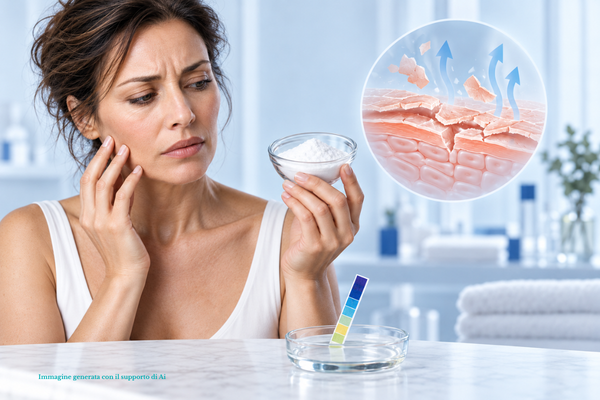



The spot goes away and leaves behind a reminder: a halo that lingers for weeks, sometimes months. Red for some people, brown for others, and the first reaction is almost always the same: to treat it as if it were a scar. But in the vast majority of cases, it isn’t, and that’s where everything else begins.
The distinction matters because the two types of marks have different origins, different timelines, and respond to different active ingredients. Using a product designed for brown spots on vascular redness means waiting for months without seeing any results. It’s worth spending thirty seconds to figure out which one you’re dealing with.
Article written by Elisa Avalle, founder of LeLang Skin Care and dermocosmetics specialist. Cover image generated with the support of artificial intelligence.
They aren’t scars: the distinction that changes everything
A true scar is a structural change in the skin. The tissue was damaged deep down and repaired imperfectly, so the surface changes shape: a depression forms (so-called atrophic, ice-pick, or boxcar scars) or a raised area develops. If you run your finger over it and feel a difference in level, it’s a scar.
A post-inflammatory mark, on the other hand, is simply a change in color. The skin is smooth and intact, and feels no different from the rest of your face: only the tone changes. It’s the color residue of inflammation that has subsided, and in most cases it resolves on its own. Slowly, but it resolves.
Quick test: close your eyes and run your fingertip over the mark. If the surface is perfectly smooth, you’re looking at post-inflammatory discoloration, not a scar. If you feel a depression or a bump, the situation is different and you should seek medical advice.
Red or brown? The finger test
Once you’ve established that it isn’t a scar, you still need to determine what kind of mark it is. The method dermatologists use in the clinic is called diascopy, but the at-home version is simple: press one finger on the mark for two seconds and observe what happens when you lift it.
If the mark blanches under pressure: post-inflammatory erythema
It’s called PIE, from the English post-inflammatory erythema. It has nothing to do with melanin: it’s a vascular issue. Inflammation has dilated and partially damaged the superficial capillaries in the dermis, which remain visible even after the spot has cleared. Under finger pressure, the blood is pushed away and the mark disappears for an instant, then returns.
It is more common in fair complexions and in sensitive or redness-prone skin. Those who already live with erythrosis or couperose tend to develop it more easily, because their microcirculation is already reactive.
If the mark stays the same: post-inflammatory hyperpigmentation
This is PIH, post-inflammatory hyperpigmentation. Melanin is the culprit here: the inflammation activated the melanocytes, which produced excess pigment precisely where the lesion had been. The result is a halo ranging from beige to dark brown, which does not change under pressure because the pigment is deposited in the tissue, not in the blood.
It is much more common in medium and dark skin tones: according to the dermatological literature, among people with darker complexions who suffer from acne, the incidence can reach up to 65%. But no skin tone is immune, and in Italy it affects a significant proportion of people who have had inflammatory acne.
How long do they really last
Here, we need to be honest, because the promise of “gone in two weeks” is the most widespread lie in this product category.
Post-inflammatory erythema is usually the fastest to fade: when the microcirculation returns to normal, the redness diminishes over the course of a few weeks or a few months. Hyperpigmentation follows a different timeline depending on where the pigment is located. If it is deposited in the epidermis, the spontaneous improvement timeline reported in the literature is around six to twelve months. If, instead, the pigment has moved into the dermis and been captured by macrophages, the mark takes on a more grayish-blue hue and is much more resistant: it may improve extremely slowly and in some cases remain.
The good news is that the right cosmetic treatment noticeably shortens this timeline. The bad news is that no cream can eliminate it entirely, and anyone promising otherwise is selling an expectation, not a result.
What works on redness
With PIE, the goal is not to lighten the skin, but to put out the residual inflammation and avoid irritating an already stressed microcirculation. This means, first and foremost, stopping aggravating the area: persistent mechanical scrubs, alcohol, heavily fragranced “astringent” products, and layering acids make the condition worse instead of resolving it.
- Soothing and vasoprotective active ingredients: peptides targeting redness, thermal water, and calming extracts. They work on the vascular component and reactivity.
- Niacinamide: useful on both fronts, because it reduces inflammation while also interfering with pigment transfer. It is one of the few active ingredients that makes sense in any case.
- Azelaic acid: in controlled studies, 15% gel reduced both the erythematous and pigmented components of acne marks. It is one of the few actives documented for both types of mark, which is why it appears in both strategies.
- Barrier repair: skin with a compromised barrier remains inflamed for longer. Rebuilding it is part of the treatment, not an optional extra.
Within the LeLang range, the serum designed for the vascular component and persistent redness is this one, formulated with peptides tested on couperose, thermal water, and ceramides.

COUPER RELIEF Serum for couperose and redness, for sensitive skin With Telangyn™, ActiSoothe® complex, thermal spring water and cer... Discover COUPER RELIEF
What works on brown marks
For PIH, the strategy is twofold: slow melanin production and speed up the renewal of the most superficial layer, so that the pigment already formed is eliminated more quickly. Both approaches must be pursued together, because acting only on turnover without slowing melanocytes means seeing the mark return.
- Vitamin C and ferulic acid: antioxidant and brightening action, with ferulic acid stabilizing vitamin C and prolonging its activity.
- Niacinamide: it acts downstream by hindering the transfer of melanosomes from melanocytes to keratinocytes.
- Gentle exfoliants: low-strength alpha hydroxy acids, such as mandelic acid, have a large molecule that penetrates slowly and are better tolerated by skin prone to redness.
- Azelaic acid: here it is again, for the reasons explained above. Full details in the dedicated azelaic acid guide.
The most common mistake: exfoliating every day in the belief that you can "wear away" the spot faster. Excessive exfoliation reignites inflammation, and inflammation is exactly what created the pigment.

FERULIC + HA SERUM Vitamin C and ferulic acid face serum Antioxidant and tone-evening, with dual hyaluronic acid. Helps prevent dark sp... Discover FERULIC + HA SERUM

MANDELIC ENZYMATIC SOFT PEEL Mandelic Acid and Enzymatic Facial Peel Highly tolerated, gentle exfoliant that stimulates cell turnover. Removes de... Discover MANDELIC ENZYMATIC SOFT PEEL
The step that matters more than all the others
If you were to take away just one thing from this article, it would be this: daily sun protection. This is not generic advice. On post-inflammatory marks, exposure to ultraviolet rays reactivates melanocytes precisely where they are already overactive, selectively darkening the spot while the rest of the face tans. The contrast increases instead of decreasing.
Without consistent sun protection, any brightening treatment is working against something that undoes it every day. That is why many people conclude that "dark spot creams do not work": in reality, they have never stopped recreating the problem.

SPOT DEFENCE 50 SPF SPF 50 anti-dark-spot facial sunscreen serum With encapsulated vitamin C, plant glycogen and postbiotic ferments, for... Discover SPOT DEFENCE 50 SPF
Why marks are more noticeable in September
There is a specific reason why this problem becomes more noticeable right now. During the summer, the sun has a temporary anti-inflammatory effect and tanning evens out the complexion, so the marks seem less visible. Then the tan fades, the contrast with the surrounding skin becomes sharper, and everything that seemed to have disappeared reappears.
At the same time, many people experience the so-called acne rebound effect, with a flare-up of lesions between late August and October: new pimples on skin that still bears the marks of previous breakouts. We discussed this extensively in the article on sun and acne. So the right time to establish a protocol for marks is now: before the cycle starts again.
A starter routine, in order
Those who still have active acne must treat it first; otherwise, they will continue to develop new marks while trying to erase the old ones. Those who only have residual marks, on the other hand, can focus on discoloration. In both cases, the application order is as follows:
- Gentle cleansing, morning and evening. No harsh soaps or mechanical brushes.
- Targeted serum, with an antioxidant in the morning and a cell-renewing or soothing product in the evening, depending on the type of mark.
- Moisturizing or repairing cream, to support the skin barrier.
- SPF 50 sunscreen every morning, reapplied when spending time outdoors.
- Gentle exfoliation two or three times a week, in the evening, never combined with other acids.
For those who still have active inflammation, the protocol is built around sebum-regulating products.

ACNEREBAL SERUM Serum with salicylic acid and niacinamide For oily skin and enlarged pores, with Zincidone®, Burdock and Provitamin B... Discover ACNEREBAL SERUM

ACNEREBAL CREAM Cream for hormonal acne and oily skin, mattifying effect Sebum-regulating cream with Azeloglycine, Zincidone® and Nia... Discover ACNEREBAL CREAM
The two strategies also have two different sections: the selection for acne-prone skin for those who still have active acne, and the anti-blemish selection for those who only have brown marks.
The finger test provides an indication, not a diagnosis: when the mark is mixed, or when old marks coexist with active acne, the order in which the two issues are addressed changes the outcome. At LeLang partner pharmacies, you can find a pharmacist who can examine your skin before recommending a protocol.
If you are looking for a more general introduction to how acne works, you can find everything in the guide to the causes and types of pimples, while the general overview of color changes is covered in the article about facial skin discoloration.
When to see a dermatologist
- when you feel depressions or raised areas to the touch, meaning true scars
- when the acne is nodular-cystic or deep, because the risk of scarring is high and must be addressed immediately
- when the mark has a grayish-blue tone, indicating dermal pigment
- when absolutely nothing has changed after six months of following a proper routine
- when spots appear in areas not affected by pimples, because the cause could be something else
Functional skincare products can effectively cover post-inflammatory discoloration, but acne is a dermatological condition: a cosmetic product can improve the appearance and comfort of the skin, but it cannot treat a disease or replace medical therapy.
Frequently asked questions about post-acne marks
Do post-acne marks go away on their own?
In most cases, yes, but it takes time. Post-inflammatory erythema tends to resolve within weeks or a few months; superficial hyperpigmentation generally takes six to twelve months. Appropriate cosmetic treatment and daily sun protection significantly shorten this timeframe.
How can I tell whether it is a dark spot or a scar?
By touch. Post-inflammatory discoloration leaves the skin's surface perfectly smooth: only the color changes. A scar alters the skin's texture, so you can feel a depression or raised area when running your fingertip over it.
Can I use vitamin C on red marks?
Yes, but it is not the most targeted choice. Vitamin C works mainly on pigment, so it is most effective on brown marks. For red marks, it is better to focus on soothing ingredients, anti-redness peptides, and niacinamide, which act on the inflammatory and vascular components.
Does squeezing pimples leave more marks?
Yes. Picking increases and prolongs inflammation, and inflammation is the factor that triggers both vasodilation and melanocyte overactivation. It is the single behavior that, more than any other, turns a three-day pimple into a six-month mark.
Do I also need sun protection in winter if I have marks?
Yes. Ultraviolet radiation is present all year round and continues to stimulate melanocytes even when the sky is overcast. Stopping sun protection in October effectively means undoing the results achieved in the previous months.
In summary
The marks left by acne are not scars, and they are not all the same. A two-second test with your fingertip tells you whether you are dealing with vascular redness or a buildup of melanin, and from there the entire strategy changes: soothing ingredients and anti-redness peptides on one hand, brightening ingredients and cellular turnover on the other, with niacinamide and azelaic acid as useful active ingredients in both cases. Daily sun protection is not a minor detail: it is the variable that determines whether the work you put in over the coming months will produce results or remain stagnant.
Sources for this article
01 Davis E.C., Callender V.D., Postinflammatory hyperpigmentation: a review of the epidemiology, clinical features, and treatment options in skin of color, Journal of Clinical and Aesthetic Dermatology, 2010; 3(7): 20-31.
02 Bae-Harboe Y.C., Graber E.M., Easy as PIE (Postinflammatory Erythema), Journal of Clinical and Aesthetic Dermatology, 2013; 6(9): 46-47.
03 Fitton A., Goa K.L., Azelaic acid. A review of its pharmacological properties and therapeutic efficacy in acne and hyperpigmentary skin disorders, Drugs, 1991; 41(5): 780-798.
04 Draelos Z.D., The effect of niacinamide on facial skin, Cutis, 2006.
Who wrote this article. Elisa Avalle is the founder of LeLang Skin Care, specializing in dermocosmetics at the Universitat de Barcelona. She works closely with pharmacists and dermatologists to develop the brand’s cosmetic protocols. The content of this article is for informational purposes and does not replace a doctor’s diagnosis or prescription.
15-Minute Free Consultation with the Founder
Not sure whether your marks are red or pigmented, or which protocol makes sense for your skin? Let’s talk it through together: fifteen minutes by video call, with no obligation, to build a personalized routine.
On the website: understanding acne · facial hyperpigmentation · skin discoloration · azelaic acid · dark spot collection