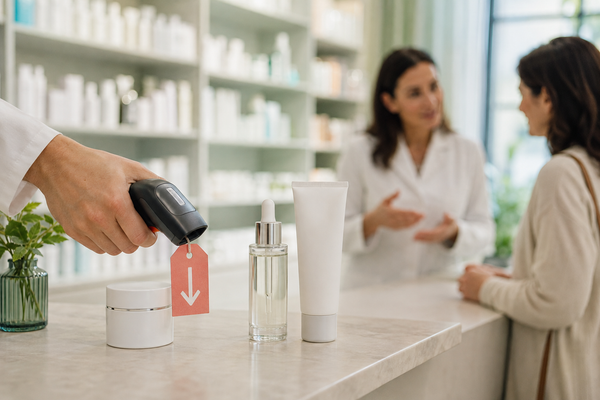



The customer arrives with a screenshot and a direct question: I read that eyelash serums have been banned—is that true? The correct answer is neither yes nor no, and that is exactly why the conversation almost always ends badly.
The European scientific committee did not declare three prostaglandin analogues dangerous: it said that the data submitted are not sufficient to declare them safe. This is a substantial difference, and throughout the supply chain there is only one person who can explain it to the person standing in front of them in thirty seconds. That person is behind the counter.
[INDICE:h2]
The facts in four lines
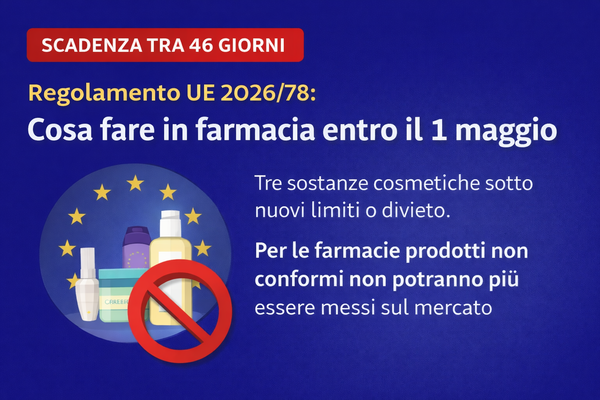
On February 2, 2026, the Scientific Committee on Consumer Safety adopted its final opinion SCCS/1680/25 on three prostaglandin analogues used in eyelash and eyebrow products, published on February 10. The substances assessed were Ethyl Tafluprostamide up to 0.018%, Methylamido-Dihydro-Noralfaprostal up to 0.03%, and Isopropyl Cloprostenate up to 0.005%.
For none of the three substances was the committee able to conclude that the proposed cosmetic use is safe, for two reasons: their powerful pharmacological activity even at very low concentrations, and the lack of sufficient data on reproductive and developmental toxicity, in a category of users who are largely of childbearing age.
The opinion is a scientific risk assessment. Regulatory decisions are the responsibility of the European Commission at a later stage. The full picture, including the cosmetovigilance case recorded in France, is reconstructed in what the European opinion on prostaglandins really says.
The three wrong answers
Three stock phrases circulate at the counter, and all three create a problem.
“Yes, they banned them.” This is false, and the customer discovers it as soon as she finds those products still on sale elsewhere. At that point, she loses trust in all the rest of the advice.
“It’s a cosmetic, so don’t worry.” This is the oversimplification that the European opinion explicitly calls into question. A substance can be contained in a cosmetic and have a powerful biological activity at very low doses.
“I wouldn’t know—look it up online.” This is the worst of the three, because it sends the customer back to the online channel for the one thing the online channel cannot provide.
The answer that works lies somewhere in between, and it is simpler than it seems: they are not banned, but for three specific ingredients the European authority has not found a concentration it could define as safe, so it is worth checking whether the product contains them.
How to distinguish a conditioning product from a prostaglandin analogue
This is the technical part, and it can be resolved by reading the INCI. There are three names to know, but with one catch.
- Isopropyl Cloprostenate
- Methylamido-Dihydro-Noralfaprostal, also listed as Norbimatoprost
- Ethyl Tafluprostamide, also listed as Dechloro Dihydroxy Difluoro Ethylcloprostenolamide, abbreviated as DDDE
The dual nomenclature is what can mislead even people searching in good faith: the name on the label and the name under which the substance was assessed may not match. It is worth keeping the list close at hand, even in printed form.
A purely conditioning product, on the other hand, contains panthenol, peptides, biotin, plant oils, and humectants. It acts on the hair shaft, making it softer, shinier, and less prone to breakage. The visual result is real, but it depends on fewer lost lashes, not on a modified growth cycle.
Finally, be careful with the wording prostaglandin free. It excludes a category of ingredients; it does not prove that the product makes eyelashes grow. It is the same “free from” mechanism used as a sales argument, and it should be treated with the same caution.
“Not banned does not mean safe. Translating this sentence for someone reading it on social media is exactly the job.”
How to say it without causing alarm
The opposite risk is just as real: turning technical information into an alarm, and ending up with a frightened customer who buys nothing and never comes back. The formula we recommend consists of three sentences.
- Acknowledge the question. “That’s a fair question. It’s been discussed a lot, and the news was reported in a confusing way.”
- State the facts, without adjectives. “It isn’t banned. For three specific ingredients, the European body said that the data are not sufficient to declare them safe, especially for people of childbearing age.”
- Focus on the concrete action. “If you like, we can look at the INCI of the product you’re using together.”
The third step is what brings the conversation to a good close, because it turns an anxiety-provoking piece of news into a practical check carried out together with someone who knows how to interpret it.
Questions to ask before giving any advice
Four, and they’re quick.
- Pregnancy, breastfeeding, or trying to conceive. This comes first because the concern raised by the committee specifically relates to reproductive and developmental toxicity.
- Ongoing eye treatments, particularly glaucoma treatment. Independently combining a product containing prostaglandin analogues with an eye drop from the same family is not a decision to make at the counter.
- Contact lenses and known eye sensitivity.
- Effects that have already appeared: persistent redness, itching, changes in iris color, eyes that appear more sunken. If any of these occur, discontinue use and refer the person to a doctor, without suggesting alternatives in the same conversation.

Elisa's note
We have been asked several times whether we would make an eyelash serum, because the category is popular. The answer is no, and not because of commercial caution: without an active ingredient with that type of activity, the result is modest, and with that type of activity we are no longer within the scope of a cosmetic. I would rather say so than build a launch around it.
What keeping it in stock entails
The most practical question is also the least discussed: if a product of this kind is already on the shelves, what changes.
Formally, until the annexes to Regulation (EC) No 1223/2009 are amended, the product remains marketable. But the Regulation also provides that serious undesirable effects be reported to the competent authority, and the obligation applies to the responsible person and distributors. An incident reported at the counter is not gossip: it is a cosmetovigilance report and must be treated as such.
At a substantive level, there is a positioning question every owner can ask themselves. If people come to a pharmacy for professional advice, keeping a category on the shelves about which the European scientific body has expressed itself in that way requires at least that those who sell it know how to explain it. This is not an invitation to remove it; it is an invitation not to sell it the way one sells mascara.
The minimum check to carry out today is simple: review the INCI lists of the eyelash products in stock and know which of the three names appear in them, before a customer asks about them.
What to propose instead
If the initial request is for a more defined look, the honest alternative is not another serum promising the same thing with different ingredients.
It is about caring for the eye area: hydrating the thinnest skin on the face, using actives with documented effects on the microcirculation and edema, and providing sun protection. And, for the lashes, a product explicitly described as conditioning, with expectations clearly presented as such. Well-managed expectations are worth more than a promise that cannot be kept.

FORMULA EYES DUO PEPTIDE Eye contour serum Peptide booster: apply first, before the cream. Reduces expression lines Targets pigmented and vas... Discover FORMULA EYES DUO PEPTIDE
Why this is a conversation worth having
A customer who comes in with an alarming screenshot and leaves with precise information, verified together on the label of the product in her bag, has just had an experience that no online platform can replicate.
This is why we insist that a pharmacy’s advantage in cosmetics has never been price, as we wrote in why the average 13% discount is a problem. When regulatory news is reported inaccurately, that advantage becomes clearer than with any promotion.
LeLang is an Italian cosmetics company founded in the Langhe and distributing exclusively through pharmacies. On regulatory matters, we provide our partner pharmacies with summaries of opinions, lists of ingredients to know, and response scripts for the counter. The network of partner pharmacies can be viewed on the website; the terms are available on the become a partner pharmacist page.
The sources for this article
01 Scientific Committee on Consumer Safety, final opinion on the prostaglandin analogues Methylamido-Dihydro-Noralfaprostal, Isopropyl Cloprostenate and Dechloro Dihydroxy Difluoro Ethylcloprostenolamide, SCCS/1680/25, adopted on February 2, 2026 and published on February 10, 2026
02 SCCS, preliminary opinion SCCS/1635/21 on prostaglandins and their analogues in cosmetic products
03 ANSES, Vigil'Anses No 27, cosmetovigilance bulletin, December 2025
04 Regulation (EC) No 1223/2009 on cosmetic products, particularly the obligations concerning serious undesirable effects
05 Regulation (EU) No 655/2013 on common criteria for claims relating to cosmetic products
On the website: the European opinion on prostaglandins · LeLang partner pharmacies · become a partner pharmacist