


In Consumer Health, dermocosmetics is the segment hit hardest by discounting. The average discount is around 13%, with the facial care segment at about 11%: much higher than supplements and over-the-counter medicines. On an average theoretical margin of 42%, only 35% remains at sell-out.
Those are seven margin points that disappear from the pharmacy's income statement. And the question we ask ourselves, as a company that sells exclusively through this channel, is whether that is the right price to pay: because price has never been the pharmacy's competitive advantage in cosmetics.
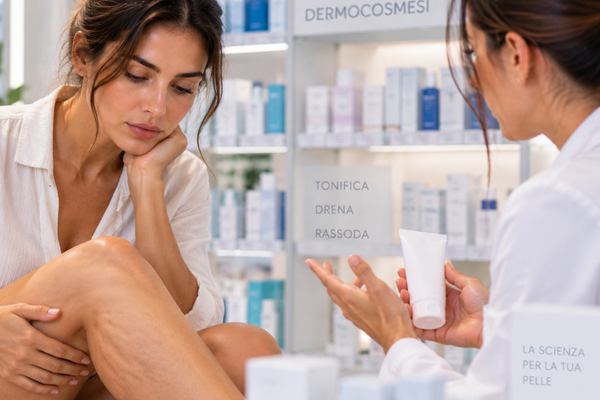
Cover image generated with the support of artificial intelligence.
[INDICE:h2]
The numbers first
The data comes from the Cosmetic Summit at Cosmofarma 2026, where Cosmetica Italia presented a snapshot of cosmetics in pharmacies. They are worth reading in the right order, because taken together they tell a different story from the one usually told.
The Italian beauty market is worth €12.8 billion. Of this, €2.22 billion goes through pharmacies, representing 17.4% of the total. This is the figure usually cited to define pharmacies as « the second channel », and on its own it sounds modest.
But skincare paints a completely different picture. Of a €4.3 billion skincare segment, pharmacies account for €1.48 billion: 34.5% of the category. Almost one in three skincare products bought in Italy is purchased at a pharmacy.
Across the beauty market as a whole, pharmacies are one channel among many. In skincare, they are almost the leading channel. This difference changes the conclusions drawn from the data.
Why dermocosmetics are discounted more than anything else
The same data also reveals the most uncomfortable detail. Dermocosmetics have one of the highest average discount rates in all of Consumer Health: around 13%, with facial care at around 11%. Segments such as food supplements and over-the-counter medicines are significantly lower.
The usual interpretation is that this promotion is necessary to support sales and compete with competitors that are more aggressive commercially. It is a reasonable interpretation, but it describes the symptom, not the cause.
There is a second figure that needs to be read alongside the first. In facial care, 63% of purchases are made directly from manufacturers and only 36% through wholesalers, down three percentage points. The explanation is margin: buying directly is more profitable. The average theoretical margin is 42%, but at sell-out it becomes 35%, precisely because of the discount applied to the end customer.
Taken together, the two figures say this: the pharmacy is working on procurement to recover the margin it then gives up at the counter. It takes seven points from the supplier and returns them to the customer.
«Discounting a dermocosmetic means competing on the ground of whoever has more volume than you. It is the only ground on which the pharmacy cannot win.»
The strategic problem, not the accounting one
Seven margin points are an income-statement problem, and that would already be enough. But the real problem is something else: positioning.
When a dermocosmetic is offered at a discount, the implicit message is that the reason to buy it there is the price. And that is exactly the comparison the pharmacy loses: when it comes to price, mass retailers and online platforms have incomparable cost structures and no obligation to provide professional advice.
The 34.5% share of skincare was not built on price. It was built on something no other channel has: someone behind the counter who looks at the skin of the person in front of them and knows what to recommend. That 34.5% measures how much trust has been accumulated, not how much has been discounted.
A discount is the quickest response to a price objection. But it is also the quickest way to teach customers that the product is not worth its full price.
What works instead of discounting
This is not an abstract criticism: if the discount is removed, something has to take its place. Based on the data and our work with pharmacies that distribute our lines, three levers support full-price sales.
The protocol instead of the individual product. A customer who buys a cream compares the price of that cream. A customer who is given a three-month plan compares a result. The unit of measurement changes, and the average basket value rises instead of falling.
The trial size. The barrier to entry for a little-known brand is not lowered by discounting the full-size product, which permanently damages its positioning. It is lowered with a single-use sachet or travel size: the customer risks just a few euros, and if the product works, they come back and pay full price.
Demonstrated expertise. Advice that explains why an active ingredient works, at what concentration, and how long it will take to deliver results justifies a price difference. Generic advice does not. That is why we invest more in training our pharmacy partners than in promotions.

Elisa's note
When I present a line in a pharmacy, the question that comes up almost every time concerns the margin. It is the right question, but it is the second one. The first is whether the pharmacist feels able to explain the product to a customer who has just read something incorrect online. If the answer is yes, the margin defends itself.
What this means for those choosing which lines to stock
The one criterion we suggest applying to any supplier, including ourselves, is this: how much of what you are sold is product, and how much puts you in a position to sell it.
A line that arrives with a good theoretical margin and nothing else will leave all the positioning work to the pharmacy, and will end up being discounted. A line that arrives with carefully designed protocols, technical materials, training on active ingredients, and trial sizes puts the pharmacist in a position to sell at full price. The real margin is the second one, not the first.
This is how we built our network: LeLang is an Italian cosmetics company born in the Langhe region and distributed exclusively through pharmacies, with dermocosmetic protocols, training on active ingredients, and single-use formats designed as an entry point. The network of partner pharmacies can be found on the website, and anyone wishing to evaluate the line can find the terms and conditions on the become a partner pharmacist page.
We have also written about the channel and its figures in the cosmetics sector and in pharmacy purchasing trends.
The conclusion, which is also a question
The figure we started with remains unchanged: almost one in three skincare products in Italy is purchased at a pharmacy. It is a position that no other channel has managed to build, and it was not built by offering the lowest price.
The question we leave with those behind the counter is this: is that 13% discount protecting revenue, or eroding the reason people come into a pharmacy to buy a cream instead of going to the supermarket?
We have an answer, and it is the reason we have never built our commercial offering around promotions.
Sources for this article
01 Cosmetica Italia, data presented at the Cosmetic Summit at Cosmofarma Exhibition 2026
02 Cosmetica Italia, 48th report of the economic survey of the cosmetics sector
03 Gruppo Cosmetici in Farmacia, presentation conference at Cosmofarma 2026, Milan, March 31, 2026
On the website: LeLang partner pharmacies · become a partner pharmacist