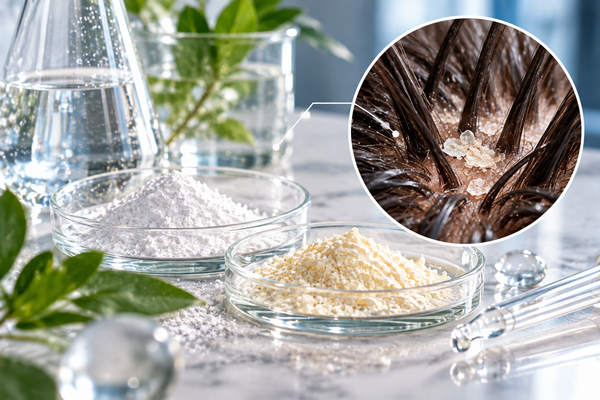



Salicylic acid is the most widely used beta hydroxy acid in skincare, and the one most sought after by people with oily skin, clogged pores, and blemishes.
[INDICE:h2]
What is salicylic acid used for?
Salicylic acid helps clear pores from within. Unlike other exfoliants, it is oil-soluble: it enters the pore, mixes with sebum, and dissolves the buildup. On the surface, it promotes the shedding of dead skin cells, making the skin texture more even. It is therefore especially useful for blackheads, enlarged pores, shiny skin, and recurring blemishes, and also plays a role in addressing the dark marks left after a blemish.
This is the characteristic that distinguishes it from all other acids: the others work on the surface, while salicylic acid reaches where the problem originates.
It is often combined with niacinamide, which supports the function of skin cells. Since salicylic acid is effective but can be drying, using the two active ingredients together is often the best approach: we discuss this in the article dedicated to niacinamide and salicylic acid for acne-prone skin.
What is salicylic acid?
Salicylic acid is an organic compound belonging to the carboxylic acid family, originally isolated from willow bark — hence its name, from the Latin Salix. It is used in several sectors, and in cosmetics it is one of the most widely used active ingredients in products for blemish-prone skin.
Its key property is that of being keratolytic: it promotes the shedding of cells from the stratum corneum, helping to keep pores clear.
It can be found in many different forms: cleansers, toners, serums, and peels, with concentrations that vary greatly depending on the type of product.
A useful clarification: salicylic acid is also found in pharmaceutical preparations, at much higher concentrations and for medical purposes. In cosmetics, lower percentages are used with the aim of improving the appearance of the skin. For moderate or severe acne, the dermatologist remains the point of reference.
Difference between BHAs and AHAs
When it comes to chemical exfoliants, there are two major families: beta hydroxy acids (BHAs) and alpha hydroxy acids (AHAs).
Salicylic acid is a beta hydroxy acid: this means that the hydroxyl group of the molecule is separated from the acid group by two carbon atoms, whereas in an alpha hydroxy acid — such as mandelic acid — it is separated by only one.
The practical consequence is this: AHAs are water-soluble and work mainly on the surface, while salicylic acid is oil-soluble and can therefore enter the pore, where it mixes with sebum and dissolves blockages. This is why it is the active ingredient of choice for blackheads and clogged pores.
The BHA family also includes betaine salicylate and willow bark extract, which are gentler alternatives. The complete overview of chemical exfoliants can be found in the guide to AHA, BHA, and PHA.
The main benefits of salicylic acid
Salicylic acid works by exfoliating the skin, which accounts for its effects:
- Deeply cleanses pores: being oil-soluble, it penetrates the pore to exfoliate its lining, remove excess sebum, and dissolve blockages.
- Helps prevent new blemishes: by keeping pores free of sebum and dead skin cells, it counteracts the formation of comedones.
- Exfoliates and smooths: on the surface, it promotes the removal of dead skin cells, improving texture and smoothness.
- Makes pores less noticeable: its ability to deeply cleanse pores helps them appear smaller.
- Helps control excess sebum: it helps rebalance the skin’s shiny appearance.
- Reduces the appearance of redness: it helps make the redness that accompanies blemishes less noticeable.
- Reduces the appearance of post-blemish marks: it helps lighten the red and brown marks left after breakouts, and is also used for hyperpigmentation and photodamage.

What concentration is salicylic acid used at?
It is the question almost no one answers with numbers, yet in Europe percentages are not left to the discretion of those who formulate products: they are set by law.
Regulation (EC) 1223/2009 on cosmetic products lists salicylic acid in Annex III, entry 98, meaning among substances subject to restrictions. The maximum limits are as follows.
| Product type | Maximum concentration |
|---|---|
| Rinse-off hair products | 3% |
| Other products (face, serums, peels) | 2% |
| Body lotions, eye and lip products | 0,5% |
| As a preservative (Annex V) | 0,5% |
There is also a restriction worth knowing if there are young children at home: salicylic acid cannot be used in products intended for children under three years of age.
When you read “2% salicylic acid” on a facial serum, you are reading the maximum permitted limit, not an exceptional percentage. And a higher concentration is not legally permitted in a cosmetic product: if a product claims otherwise, it is either not a cosmetic or it is non-compliant.
Why pH matters as much as the percentage
Two products with the same percentage of salicylic acid can perform very differently, and the reason is the formula’s pH.
Salicylic acid works in its free acid form. In an overly alkaline environment, the molecule is predominantly present in salt form, which does not pass through the pore’s sebum in the same way. This is why exfoliating formulas have a controlled, slightly acidic pH, and why a very alkaline cleanser reduces the effectiveness of the acid it contains.
It is not information that appears on the label, but it explains why it is worth choosing products formulated by people who understand the issue, rather than looking only at the stated percentage. We have a dedicated article on how the skin’s pH works.
Does salicylic acid help with wrinkles?
It is a question I get often, and the honest answer is that this is not what it does, but it does do something.
For true wrinkles—those caused by collagen loss and repeated facial movements—salicylic acid has no effect: it does not stimulate collagen synthesis and does not work in the dermis. Its field of action is the stratum corneum and inside the pore.
What changes is the appearance of the surface. Regular exfoliation makes the texture more even and the skin better able to reflect light, and on thick or uneven skin this translates into less noticeable fine lines. They have not disappeared: they are simply less visible, and that is a distinction worth keeping in mind.
The misunderstanding stems from professional peels. In a clinic, salicylic acid is used at concentrations far higher than those permitted in a cosmetic product, and in that context its effects on skin texture are documented. These results do not carry over to an over-the-counter serum or cleanser.
If the goal is to address signs of aging, other tools are more suitable: retinoids, peptides, vitamin C, and above all daily sun protection, as explained in the article on skin aging. Salicylic acid fits into this picture when the skin is also oily or blemish-prone, that is, in cases where classic anti-aging treatments are too rich: this is the reasoning behind the article on first wrinkles on combination or oily skin.
One practical warning: if you are already using a retinoid, salicylic acid and retinoids should not be applied on the same evening. The reason is explained a little further on.
How to use salicylic acid
The most suitable concentration varies from person to person, and it is best to consult a dermatologist or your trusted pharmacist before starting, especially in the presence of significant acne.
In general, it should be used moderately but consistently. The key is to listen to your skin: if mild irritation appears, it is best to stop for a day or two and moisturize well. Always follow the product instructions.
The main undesirable effect of salicylic acid is its ability to irritate and dry out the skin of those who are particularly sensitive or use it excessively: peeling, dryness, and redness may occur. When starting, it is best to use it every other day to assess how the skin reacts. It is also not recommended during pregnancy and breastfeeding without medical advice.
As an active ingredient that acts on skin renewal, it is important not to overlook daily sun protection during treatment.
What not to combine with salicylic acid
Salicylic acid works well with almost everything, but there are three situations in which alternating is preferable to layering.
With retinol: both accelerate skin renewal, and using them on the same evening increases the risk of irritation without multiplying the results. It is better to use them on alternate evenings. With other exfoliating acids, AHA or PHA: the same logic applies—choose which one to use that evening. With pure, highly concentrated vitamin C, due to pH and tolerability concerns: if both are needed, use vitamin C in the morning and salicylic acid in the evening.
Salicylic acid cleansing mousse: Cleansing Active
At LeLang, we specialize in creating products that meet the needs of every skin type, also ideal for sensitive skin and efficacy-tested. Cleansing Active Mousse is the purifying, blemish-fighting mousse that respects the skin's balance.
It contains 0.5% Salicylic Acid, which deeply cleanses the skin by removing impurities and dead skin cells. Thanks to ingredients such as Burdock, Tea Tree Oil, and Betaine, which enhance its purifying power, Cleansing Active remains gentle and soothing at the same time.

CLEANSING ACTIVE MOUSSE Facial cleanser with salicylic acid Purifying mousse with Tea Tree Oil, Burdock and Betaine Reduces the appearance o... Discover CLEANSING ACTIVE MOUSSE
The synergistic action of the ingredients exfoliates and purifies without compromising the skin's health. It is the ideal solution for adding a salicylic acid cleanser to your routine: effective yet gentle. Suitable for those with acne-prone, oily, or combination skin, especially if you want to brighten dull, lackluster skin and stimulate cell turnover. Prolonged use is not recommended for dry or very dry skin.
In the salicylic acid ingredient page, you will find the complete list of LeLang formulas that contain it, while the dedicated collection includes other products designed for blemish-prone skin.
Frequently asked questions about salicylic acid
What is salicylic acid used for on the face?
It helps keep pores clear. Since it is oil-soluble, it penetrates the pore, dissolves sebum buildup, and helps loosen the dead skin cells that clog it. On the face, this translates into fewer blackheads, less visible pores, less shine, and a more even texture. It also helps reduce the dark marks left by blemishes that have already cleared.
How often should salicylic acid be used?
It depends on the format. In a cleanser, which remains on the skin for only a few seconds, it can be used every day. In a serum or toner, which remain on the skin, it is best to start every other day and increase frequency only if your skin responds well. With a higher-concentration peel, use it once or twice a week.
What percentage of salicylic acid should you choose?
In cosmetics, typical concentrations range from 0.5% to 2%, which is also the legal maximum for facial products. Lower concentrations, around 0.5%, are used in daily cleansers and for more reactive skin; 2% is the upper limit for leave-on products. A higher percentage does not mean better results: it only means a greater risk of irritation, and on a stressed skin barrier, the effect is counterproductive.
Can salicylic acid be used every day?
Yes, if it is in a low-concentration cleanser and your skin tolerates it. No, if it is a serum or peel: in that case, daily use quickly leads to dryness and redness. The warning sign is always the same: skin that feels tight, stings when you apply moisturizer, or suddenly becomes shinier.
Does salicylic acid remove wrinkles?
No. It does not act on collagen or work deep within the skin: it makes the surface more even, and on uneven skin, fine lines appear less noticeable. This is an effect on appearance, not structure. Other active ingredients are needed to address signs of aging, while daily sun protection remains the most important factor.
Should I stop if I get more pimples at first?
This is the most frequently asked question during the first few weeks. An active ingredient that accelerates skin cell turnover can bring blockages already present in the pore but not yet visible to the surface: the phenomenon tends to subside within four to six weeks and affects the areas where blemishes usually appear. If lesions appear in new areas, or if two months pass without improvement, then it is not an adjustment period: it is best to stop and review your routine.
Can salicylic acid and niacinamide be used together?
Yes, and it is actually one of the most sensible combinations for blemish-prone skin: salicylic acid works on the pore, niacinamide supports the skin barrier and reduces redness, counteracting the acid’s tendency to cause dryness. The old rule that considered them incompatible is not supported by current cosmetic formulations.
Can people who are allergic to aspirin use salicylic acid?
The acetylsalicylic acid in aspirin and salicylic acid are related molecules, and anyone with a known sensitivity to salicylates should speak to their doctor before using products containing it, even at low concentrations. This precaution concerns only a small number of people, but it is rarely mentioned.
Should salicylic acid be used during the day or at night?
It’s best to use leave-on products in the evening, so your skin can renew itself overnight without adding sun exposure. Cleanser can be used equally in the morning and evening. In both cases, sun protection the next day is non-negotiable: freshly exfoliated skin is more prone to developing dark spots.
If you don’t know which concentration to start with, or if your skin has reacted badly in the past, this is the kind of question best resolved in person: LeLang partner pharmacies are trained to assess your skin before recommending an exfoliant.
Sources for this article
01 Regulation (EC) No 1223/2009 of the European Parliament and of the Council on cosmetic products, Annex III — substances subject to restrictions, entry 98 (salicylic acid): 3% in rinse-off hair products, 2% in other products, 0.5% in body lotions, eyeshadows, mascaras, eyeliners, lipsticks and roll-on deodorants; prohibited in products for children under three years of age, except shampoos.
02 Regulation (EC) No 1223/2009, Annex V — permitted preservatives: salicylic acid and its salts, maximum concentration 0.5% (calculated as acid).
03 Regulation (EU) No 655/2013 establishing common criteria for claims relating to cosmetic products.
04 Arif T., Salicylic acid as a peeling agent: a comprehensive review, Clinical, Cosmetic and Investigational Dermatology, 2015; 8: 455-461.
On the website: guide to AHAs, BHAs and PHAs · niacinamide · mandelic acid · the skin’s pH · understanding acne · salicylic acid ingredient guide
15-Minute Free Consultation with the Founder
Not sure whether salicylic acid is right for your skin or how often to use it? Book a free virtual skincare consultation with Elisa Avalle, founder of LeLang.