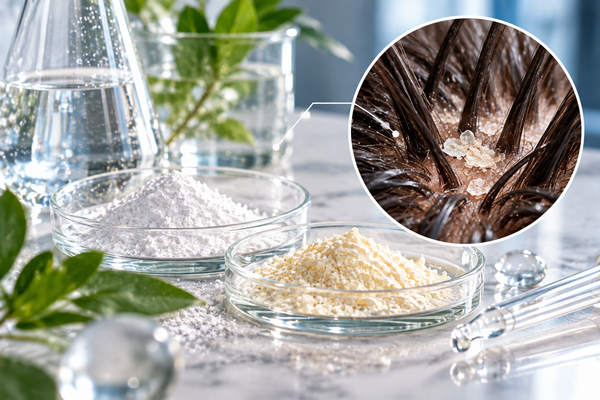



The question is simple, and so is the answer: yes, niacinamide and salicylic acid can be used together without any problems, and it is actually one of the most sensible combinations for blemish-prone skin. They work on different fronts — salicylic acid inside the pore, niacinamide on the barrier and redness — and each compensates for the other's weak point.
In practice: salicylic acid enters the pore and dissolves the buildup of sebum, but it tends to cause dryness. Niacinamide strengthens the barrier, reduces redness, and regulates sebum, but it does not clean the pore. Together, one does what the other cannot and helps mitigate its side effect. The old rule that considered them incompatible is not supported by current cosmetic formulations.
[INDICE:h2]
Why they work better together than alone
Salicylic acid is a lipophilic beta-hydroxy acid: this is what allows it to penetrate the pores and remove excess sebum, dead skin cells, and impurities that contribute to the appearance of comedones. Its strength lies in deep cleansing, and it is particularly suitable for oily and combination skin, unlike AHA acids, which remain on the surface.
The downside is familiar to anyone who has used it too enthusiastically: if applied too often or to sensitive skin, it can cause dryness and irritation. That is why gradual use and barrier support are crucial.
Niacinamide is a form of vitamin B3 involved in cellular repair mechanisms, known for its soothing and anti-redness action. It contributes to the well-being of the skin barrier and promotes ceramide production, helping the skin retain moisture. It also has a documented effect on sebum regulation, acting at the source rather than on an already clogged pore.
The simplest way to remember it: salicylic acid removes, while niacinamide protects. An active ingredient that removes without one that protects almost always leaves skin dry and reactive; a routine that only protects leaves the pores as it found them.
Salicylic acid or niacinamide: which should you choose if you use only one?
Not everyone wants to build a routine with two active ingredients, and the question “which of the two?” is a valid one. The answer depends on what you see in the mirror.
| If the main problem is… | It’s best to start with | Why |
|---|---|---|
| Blackheads and clogged pores | Salicylic acid | It is the only one of the two that enters the pore and dissolves its contents |
| Shiny skin all over the face | Niacinamide | Acts on sebum production, not on individual blockages |
| Redness and reactive skin | Niacinamide | It is soothing and well tolerated; salicylic acid may make things worse here |
| Dark marks left by blemishes | Both, but start with niacinamide | Works to even out skin tone without causing irritation |
| Uneven texture and dull skin | Salicylic acid | Helps loosen dead surface skin cells |
| Sensitive skin or an already weakened barrier | Niacinamide | Introduce salicylic acid later, once your skin is stable |
If your skin tolerates them well, using both remains the best solution: people who start with just one usually end up adding the other within a few months.
How to use them together in practice
Three rules, and the routine works.
- Apply products from the lightest to the richest texture. Salicylic acid is generally found in a cleanser or serum, while niacinamide comes in a serum or cream: the natural sequence is cleansing, BHA treatment, niacinamide product, cream.
- There’s no need to space them out. Apply them one after the other in the same routine, without waiting twenty minutes between steps: this is a widely repeated precaution, but it has no basis in modern cosmetic formulations, where the pH is already buffered.
- Increase one active ingredient at a time. If you’re introducing both, start with niacinamide every day and add salicylic acid on alternate days. That way, if discomfort appears, you’ll know what caused it.
A sign to watch for in the first few weeks: if your skin stings when you apply the cream that you previously tolerated well, it isn’t the niacinamide—it’s the salicylic acid working too intensely. Reduce the frequency rather than abandoning the routine.
For acne-prone skin
Acne is a multifactorial condition linked to excess sebum and inflammation, and the synergy between the two active ingredients makes sense precisely for this reason: BHA acts directly on pores and comedones, while vitamin B3 helps reduce inflammation and support the skin barrier. Niacinamide is also being studied as a support for tolerability when the skin is undergoing more irritating acne treatments.
One clarification is necessary: acne is a dermatological condition, not simply a cosmetic concern. A well-formulated cosmetic can support the process and improve the appearance of the skin, but in inflammatory or nodulocystic forms, a dermatologist remains the appropriate reference.
The LeLang protocol for blemish-prone skin
The goal of our formulations is to purify skin in a targeted way while supporting the skin barrier, reducing blemishes and shine without increasing sensitivity and reactivity.
1. Targeted cleansing: cleanse without overdoing it
The first step is effective but gentle cleansing. When cleansing is too harsh and stripping, it can trigger a rebound effect, meaning increased shine. Cleansing Active Mousse is the ideal foundation for blemish-prone skin because it combines the purifying action of salicylic acid with tea tree oil and burdock.

CLEANSING ACTIVE MOUSSE Facial cleanser with salicylic acid Purifying mousse with Tea Tree Oil, Burdock and Betaine Reduces the appearance o... Discover CLEANSING ACTIVE MOUSSE
2. Active treatment: unclog pores and rebalance
The heart of the protocol is a leave-on treatment that works consistently on pores and sebum. Acnerebal Serum combines the action of BHA with the balancing properties of niacinamide, enhanced by the addition of Zincidone, which targets sebum production at its source. It is the simplest way to have both active ingredients in the same formula, already balanced.

ACNEREBAL SERUM Serum with salicylic acid and niacinamide For oily skin and enlarged pores, with Zincidone®, Burdock and Provitamin B... Discover ACNEREBAL SERUM
3. Moisturizer: even out, mattify, and protect
A balancing cream reduces dryness and discomfort. Acnerebal Cream helps control shine and improve skin tone thanks to azeloglycine, which regulates sebum production and reduces the appearance of post-inflammatory marks.

ACNEREBAL CREAM Cream for hormonal acne and oily skin, mattifying effect Sebum-regulating cream with Azeloglycine, Zincidone® and Nia... Discover ACNEREBAL CREAM
In the morning, always finish with sunscreen to prevent the formation of dark spots on healing blemishes.

SPOT DEFENCE 50 SPF SPF 50 anti-dark-spot facial sunscreen serum With encapsulated vitamin C, plant glycogen and postbiotic ferments, for... Discover SPOT DEFENCE 50 SPF
4. Soothing the skin: the action of thermal waters
Redness and flaking are signs that should not be ignored. Multi Vit is the thermal water spray that provides immediate relief and restores balance.

MULTI VIT THERMAL WATER Multivitamin thermal water face mist Balancing toner with Valdieri Thermal Water, stabilized Vitamin C, Niacinamide a... Discover MULTI VIT THERMAL WATER
For more reactive skin, Nutralight Sensitive is formulated with thermal water from the mountains of Piedmont and a soothing complex of mallow, calendula, and marshmallow.

NUTRALIGHT SENSITIVE Soothing face cream for sensitive, redness-prone skin With thermal water from the Piedmont Alps, for sensitive and re... Discover NUTRALIGHT SENSITIVE
The complete sequence for this type of skin is described in the routine for oily skin and enlarged pores.
Frequently asked questions
Can niacinamide and salicylic acid be used together?
Yes, and it is one of the most sensible combinations for blemish-prone skin. Salicylic acid works inside the pore, while niacinamide supports the barrier and reduces redness, offsetting the acid's tendency to cause dryness. There is no need to alternate them or space them out: apply them in the same routine, from the lightest to the richest texture.
Is salicylic acid or niacinamide better?
It depends on the concern. For blackheads and clogged pores, salicylic acid wins because it is the only one that physically penetrates the pore. For overall shine, redness, and reactive skin, niacinamide wins because it acts on sebum at its source and is much better tolerated. With sensitive skin, always start with niacinamide, adding salicylic acid only once the barrier is stable.
Can they be used on the same night?
Yes. The only precaution concerns introduction: when both are new, it is best to introduce them one at a time to determine what may have caused any reaction. Once the skin tolerates them, they can be used in the same application without interference.
In what order should they be applied?
From the lightest texture to the richest. Salicylic acid is generally found in a cleanser or serum, while niacinamide is found in a serum or cream: the natural sequence is cleansing, BHA treatment, niacinamide product, cream.
How often should salicylic acid be used?
In a cleanser that remains on the skin for only a few seconds, it can be used every day. In a serum or peel that remains on the skin, it is best to start every other day and increase frequency only if the skin responds well. Niacinamide, on the other hand, can be used safely morning and evening.
If I develop more imperfections at first, should I stop?
An active ingredient that accelerates skin renewal can bring existing but not yet visible blockages to the surface. This phenomenon tends to subside within four to six weeks and affects the areas where imperfections usually appear. If lesions instead appear in new areas, or if there is no improvement after two months, it is best to review your routine.
Are they suitable for sensitive skin?
Niacinamide is fine, and is in fact one of the best-tolerated active ingredients. Salicylic acid should be introduced more gradually, starting with low concentrations and rinse-off formulas before leave-on treatments.
Can they also be combined with retinol?
Niacinamide is absolutely fine, with no reservations—in fact, it is useful for keeping irritation under control. Salicylic acid and retinol are best used on alternate nights: both accelerate skin renewal, and layering them increases the risk of irritation without multiplying the results.
In conclusion
Effective treatment of blemish-prone skin requires an approach that does more than eliminate imperfections—it must also preserve the integrity of the skin tissue. The synergy between salicylic acid and niacinamide helps unclog pores while providing a soothing action that prevents redness and irritation.
Adopting a structured protocol, starting with gentle cleansing and leading to targeted hydration, is the key to improving skin texture and reducing the risk of rebound effects.
You can also find LeLang products at partner pharmacies throughout Italy.
Free 15-minute consultation with the founder
Want to understand how to build the right protocol for blemish-prone skin? Book a free virtual skincare consultation with Elisa Avalle, founder of LeLang.