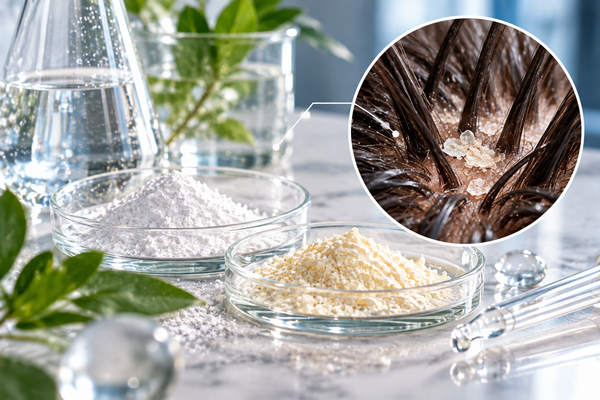



Mandelic acid is the alpha hydroxy acid to start with, and it is also the only one that can be used without too many precautions during the warmer months. The reason lies entirely in the size of its molecule.
At 152 Daltons compared with glycolic acid's 76, it is the largest molecule in the AHA family: it passes through the stratum corneum more slowly and evenly, resulting in gradual rather than aggressive exfoliation. This is why it is chosen for reactive skin and darker phototypes, where a fast-acting acid may leave post-inflammatory spots.
In this guide, you'll learn what it is, what concentration it works at, how often to use it, and how it compares with glycolic and salicylic acid.
[INDICE:h2]
What is mandelic acid?
Mandelic acid is an alpha hydroxy acid (AHA) derived from almonds: its name comes from the German word for almond, Mandel. In cosmetics, it is almost always used in purified or synthetic form.
Like all AHAs, it works by dissolving the bonds that hold together the dead cells in the stratum corneum, promoting skin renewal. What distinguishes it is the speed at which it does so: the large molecule penetrates slowly, so the effect is more gradual and less irritating at the same concentration.
There is also a second, lesser-known characteristic: being partially oil-soluble, mandelic acid has a good affinity with sebum and can also work at the opening of the pores. Glycolic and lactic acids, which are soluble only in water, remain confined to the most superficial layers instead. This dual affinity makes it interesting for combination and blemish-prone skin, which generally does not tolerate AHAs well.

What is mandelic acid used for on the face?
In addition to its exfoliating action, mandelic acid helps support the balance of the skin's surface, making it useful in formulas designed for skin with recurring imperfections. It is mainly chosen for:
- dull skin and uneven texture, where it clears the surface and restores its ability to reflect light;
- marks left by acne and post-inflammatory spots;
- discoloration and sunspots, whose appearance it helps reduce;
- fine lines, by supporting cell turnover;
- sensitive and reactive skin that reacts poorly to other acids.
The first effects can be noticed after about three weeks of consistent and appropriate use: skin that feels smoother, looks brighter, and appears more even. Dark spots take longer to improve, and the result depends largely on the sun protection applied in the meantime.
Mandelic acid is just one of the peels available, but it is among the easiest to manage: it does not increase photosensitivity like other AHAs and is much less irritating. This does not change the fact that sun protection remains essential throughout the treatment.
What percentage should you use?
In cosmetics suitable for home use, mandelic acid is generally found at concentrations between 2% and 10%. Below 5%, its action is mainly smoothing and maintenance; between 5% and 10%, the exfoliating effect becomes more noticeable and it also targets dark spots and blemishes.
Higher concentrations are used in professional peels, which are performed in a clinic using protocols and controlled neutralization: they cannot be compared with cosmetic products and should not be replicated on your own.
The formula's pH also matters: an acid with a pH that is too high is effectively inactive, while one with a pH that is too low becomes irritating. European cosmetic regulations define the limits within which a formula can be placed on the market, and this is one of the reasons why a well-formulated product outperforms one with a higher stated percentage.
Mandelic, glycolic, or salicylic acid: how to choose
| Acid | Molecule size | Key strength | Who it's for |
|---|---|---|---|
| Mandelic acid (AHA) | 152 Da | Good tolerability, does not cause photosensitivity | Sensitive skin, darker skin tones, beginners |
| Glycolic acid (AHA) | 76 Da | Speed and potency for wrinkles | Thick, resilient skin already accustomed to acids |
| Salicylic acid (BHA) | 138 Da, oil-soluble | Works inside the pore | Oily skin, blackheads, clogged pores |
The rule of thumb: glycolic acid delivers faster results but requires skin that can tolerate it, salicylic acid is the choice when clogged pores are the problem, and mandelic acid is the best compromise when skin is reactive or you don't know where to start. The complete overview is in the guide to acids in skincare, while the dedicated guide to salicylic acid covers BHA.
How to use mandelic acid
It is recommended to incorporate it into your evening routine, after cleansing and before serum and moisturizer. In general, it can be used in any season; even in summer, when it is one of the few acids suitable for use, it is still preferable to apply it in the evening.
- Cleanse your face and pat it dry;
- Apply the product, avoiding the eye and lip contours;
- Follow the application time indicated on the packaging without extending it;
- Rinse with lukewarm water, if the product instructions call for it;
- Follow with a moisturizing serum and cream to complete the routine.
Masks and peels are generally a weekly extra in your routine, with the aim of enhancing the effectiveness of the products applied afterward. If you want to understand how exfoliation fits into your routine as a whole, you will find everything in the article on how to exfoliate your skin.
It is now possible to apply the peel yourself, but it is important to follow the application times and doses indicated on the product. Alternatively, ask someone who knows what they are talking about: try contacting your trusted pharmacy or dermatologist.
LeLang's mandelic acid peel
Mandelic Enzymatic Soft Peel is a gentle exfoliant designed for all skin types, including the most sensitive. Apply the gel to the face and leave it on for about 10 minutes, then rinse with lukewarm water.

MANDELIC ENZYMATIC SOFT PEEL Mandelic Acid and Enzymatic Facial Peel Highly tolerated, gentle exfoliant that stimulates cell turnover. Removes de... Discover MANDELIC ENZYMATIC SOFT PEEL
In it, the action of mandelic acid is supported by papain, an enzyme derived from papaya fruit, and bromelain, a proteolytic enzyme extracted from pineapple stems. The two enzymes work on the outermost layer, where they break down the proteins that hold dead cells together: a mechanism different from that of the acid. Combining the two makes it possible to achieve the desired result with lower concentrations of each. Chamomile extract and organic aloe vera juice complete the formula, providing a soothing profile that complements the exfoliation.
On the mandelic acid ingredient page you will find the complete list of LeLang formulas that contain it.
If you have oily or acne-prone skin, you can find more targeted guidance in the dedicated routine for oily skin.
Frequently asked questions about mandelic acid
How often should mandelic acid be used?
Start with once a week and increase to twice a week only if your skin responds well. Brief tingling during application is normal; redness that persists the next day or skin that burns when you apply cream means you are using it too often.
Is mandelic acid or glycolic acid better?
It depends on the skin, not the acid. Glycolic acid has a smaller molecule, penetrates more deeply, and delivers faster results on thick, accustomed skin. Mandelic acid is the right choice for reactive skin, darker skin tones, and beginners: an acid that is well tolerated and used consistently delivers better results than an aggressive one that is abandoned.
Can it be used in summer?
Yes, and that is one of its advantages: unlike other AHAs, it does not increase photosensitivity. Daily sun protection is still necessary, however, because any exfoliation temporarily reduces the surface layer of dead skin cells.
Can people with almond allergies use it?
Mandelic acid used in cosmetics is a purified molecule, generally synthetic, and does not contain the almond proteins that trigger allergies. Anyone with a confirmed allergy should still discuss it with their doctor.
Can it be used together with retinol?
Not in the same application. It is better to alternate evenings: layering them increases the risk of irritation, especially during the first few weeks of retinol use.
Can it be used during pregnancy?
Low-concentration alpha hydroxy acids are generally considered compatible with pregnancy, unlike retinoids. Since this is a special phase, always ask your gynecologist or dermatologist for confirmation.
Is it suitable for the eye area?
No. The eye area has much thinner skin and is not intended for facial peels: when applying, stay away from the eye socket.
15-Minute Free Consultation with the Founder
Not sure how often to exfoliate or which acid is right for your skin? Book a free virtual skincare consultation with Elisa Avalle, founder of LeLang.