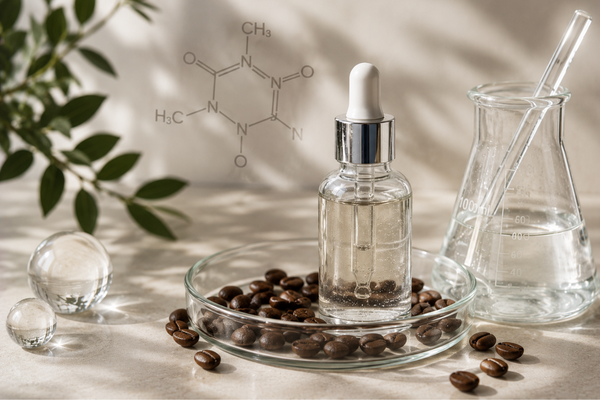



Niacinamide is one of the few cosmetic ingredients that appears both in anti-dark-spot serums and in creams for sensitive skin. This is not a contradiction: it is a vitamin B3 that works on multiple fronts at the same time, and what mainly changes the result is the concentration at which it is used.
This is also why two niacinamide serums can produce very different results. In this guide, you'll find out what this active ingredient really does, the ten documented benefits, what percentage you need for your goal, when to apply it, and which other ingredients it pairs well with.
[INDICE:h2]
What is niacinamide?
Niacinamide, also called nicotinamide, is a form of vitamin B3. It is found in foods, supplements, and—in its topical form—in a growing number of cosmetics. Despite their similar names, niacin and niacinamide are not the same molecule: they are two different forms of the same vitamin, and the latter is used in cosmetics because it is much better tolerated.
When applied to the skin, niacinamide is a precursor to two cellular coenzymes, NAD+ and NADP+. These molecules fuel many of the reactions through which skin cells produce energy, renew themselves, and repair daily damage. This explains the unusually broad range of its effects: it does not act on a single target, but on the skin's basic metabolism.
The second mechanism, which explains niacinamide's success with fragile skin, involves lipids. Vitamin B3 supports the synthesis of ceramides, the fats that hold together the outermost layer of the epidermis. A more cohesive skin barrier retains water better and lets in less of what causes irritation.
Niacinamide is water-soluble and stable across a broad pH range. This is one of the practical reasons it is found in so many formulations: it is compatible with almost everything, without the stability complications typical of other active ingredients.
The 10 benefits of niacinamide for the skin
1. Strengthens the lipid barrier
By supporting ceramide production, niacinamide helps the skin rebuild its protective film. This is a broad benefit: it applies to dry, reactive, and mature skin, which progressively loses surface lipids over the years.
2. Improves the appearance of acne-prone skin
On blemish-prone skin, niacinamide works in two complementary ways: it reduces the red appearance of blemishes and helps normalize sebum production. The visible result is less shiny skin with less noticeable blemishes. It does not replace dermatological treatment for acne, but it is one of the cosmetic active ingredients that integrates best alongside it. We have dedicated an in-depth article to niacinamide and salicylic acid, the exfoliant of choice for blemish-prone skin.
3. Evens skin tone and reduces dark spots
This is the most extensively studied benefit. Niacinamide does not affect melanin production, but rather the transfer of pigment from melanocytes to surface cells: less pigment delivered means dark spots gradually appear lighter. Concentrations of around 5% are those for which the most data exist for this purpose, which is why niacinamide appears so often in formulas designed for skin discoloration.
4. Protects against oxidative stress
By supporting the coenzymes involved in cellular metabolism, vitamin B3 helps counteract the effects of free radicals generated by the sun, pollution, and smoke.
5. Reduces fine lines and wrinkles
The effect on wrinkles is indirect but real: more hydrated skin with an intact barrier reflects light better and appears smoother. Over the medium term, niacinamide also supports the environment in which fibroblasts produce collagen.
6. Supports the production of structural proteins
Over time, it slows the synthesis of keratin, filaggrin, and involucrin, the proteins that provide firmness to the stratum corneum. Vitamin B3 participates in the processes that produce them, improving the firmness and evenness of the skin's surface.
7. Helps sun-exposed skin
Niacinamide supports the repair mechanisms that the skin activates after exposure to UV rays. It should be understood that it does not filter radiation and in no way replaces sun protection, which is essential to avoid undoing the work done on dark spots.
8. Soothes redness and reactive skin
It is one of the most widely used active ingredients for sensitive skin precisely because it combines a soothing action with high tolerability: it rarely causes irritation, and when it does, it is almost always due to the concentration.
9. Refines skin texture and reduces visible pores
By regulating the amount of sebum, niacinamide reduces the appearance of enlarged pores—which do not “close,” but look less noticeable when they are not dilated by excess sebum. This is a benefit you will appreciate especially in a routine for oily skin.
10. Improves hydration
It is not a humectant like hyaluronic acid: niacinamide does not draw in water; it retains it. In other words, it acts by reducing transepidermal water loss, making it complementary to—and not an alternative to—classic moisturizers.
What percentage of niacinamide is needed
This is the question that really makes the difference between a product that works for you and one that leaves you indifferent. There is no objectively “best” percentage: there is one that suits the goal.
| Concentration | Main goal | Who it is for |
|---|---|---|
| 2-4% | Skin barrier, comfort, redness | Sensitive, reactive skin that is in a repair phase |
| 4-5% | Even skin tone, dark spots, early wrinkles | The most extensively studied range: suitable for most skin types |
| 10% | Sebum, pores, blemishes | Oily, resilient skin, preferably already accustomed to active ingredients |
Increasing the concentration does not multiply the benefits proportionally. Above 5%, the additional benefits mainly concern sebum and pores, while the likelihood of temporary discomfort—warmth or slight redness—increases for more delicate skin. If your skin is reactive, starting at 4–5% is almost always the most sensible choice.
Many cosmetics do not state the percentage of niacinamide on the label because it is not mandatory. Its position in the INCI provides an indirect indication: if it appears among the first five ingredients, the concentration is likely significant.
How and when to use niacinamide
Niacinamide can be used both morning and evening, and it is one of the few active ingredients for which this flexibility is genuine rather than a compromise: it does not cause photosensitivity and does not degrade in light.
In your routine, apply it after cleansing and before moisturizer, during the serum step. If you use multiple serums, the rule is consistency: start with the most fluid ones, then move on to the thicker ones. The difference between serum and moisturizer really matters here.
- Facial cleansing;
- Optional toner, to bring the skin’s pH back to its physiological value;
- Niacinamide serum, on still slightly damp skin;
- Moisturizer, to seal in its effects;
- Sunscreen, if it is morning.
How long does it take to see results?
The timing varies depending on the target, and knowing it helps you avoid giving up on a product too soon:
- Comfort and redness: the first two weeks;
- Sebum, pores, and skin texture: between the fourth and eighth weeks;
- Dark spots and an even skin tone: eight to twelve weeks of consistent use, and only when accompanied by daily sun protection.
Which active ingredients can niacinamide be combined with?
Its compatibility is its real strength. Here are the combinations that matter:
- Vitamin C: they can be used together, despite an old myth claiming otherwise. We explored the issue in our article on using vitamin C and niacinamide together;
- Retinol: a particularly successful pairing, because niacinamide reduces the dryness and redness that retinol can cause during the first few weeks;
- Hyaluronic acid: complementary: one draws in water, while the other prevents it from evaporating;
- Salicylic acid and AHAs: compatible, but on sensitive skin, it is best to alternate them on different evenings rather than layer them. You can find the complete overview in the guide to acids in skincare;
- Peptides: no interference; they work well together in anti-aging formulas.
Niacinamide in LeLang products
In the Formula Eyes Duo Peptide + Coffein Eye Contour Serum, vitamin B3 works alongside biodynamic peptides and caffeine. On the eye contour, niacinamide has a precise role: maintaining hydration in an area where the skin is thinner and dehydrates more quickly, while peptides work on the skin’s tone and the appearance of puffiness and dark circles.

FORMULA EYES DUO PEPTIDE Eye contour serum Peptide booster: apply first, before the cream. Reduces expression lines Targets pigmented and vas... Discover FORMULA EYES DUO PEPTIDE
In the niacinamide ingredient guide, you will find the complete list of LeLang formulas containing it, for face and body.
If you want to understand how to treat the eye area depending on your age, you will find everything in the complete guide to the eye contour.
Frequently asked questions about niacinamide
Can niacinamide be used every day?
Yes, and that is actually when it works best. It is one of the best-tolerated active ingredients for daily use, morning and evening. The only precaution concerns high concentrations, which are best introduced every other day.
Can niacinamide and vitamin C be used together?
Yes. The idea that they cancel each other out comes from experiments conducted in the 1960s at high temperatures—conditions that have nothing to do with a cosmetic applied to the face. Those with very reactive skin may still prefer vitamin C in the morning and niacinamide in the evening.
Does niacinamide cause breakouts at first?
It does not cause the "purging" phase typical of chemical exfoliants and retinoids because it does not accelerate cell turnover. If blemishes appear after introducing it, the cause is more often another ingredient in the formula—an oil, a silicone, or a fragrance—rather than niacinamide itself.
Is 5% or 10% niacinamide better?
5% covers most concerns, including dark spots, with better tolerability. 10% makes sense for oily, resilient skin when sebum and pores are the main concerns.
Is niacinamide safe during pregnancy?
Topical niacinamide is generally considered compatible with pregnancy and breastfeeding, and is one of the alternatives used when retinoids should be avoided. Since this is a special circumstance, confirmation should be sought from your doctor or dermatologist.
Which skin type does it work best for?
All skin types, but with different goals: barrier support and redness for sensitive skin, sebum and pores for oily skin, tone and dark spots for mature skin. This versatility is what makes it one of the most common ingredients in functional cosmetics.
15-Minute Free Consultation with the Founder
Want to find out whether niacinamide is the right active ingredient for your skin and at what concentration? Book a free virtual skincare consultation with Elisa Avalle, founder of LeLang.