


If you are looking for valuable support for your anti-aging skincare routine, ferulic acid is a natural antioxidant that can make a difference to your skin, improving your complexion and reducing the appearance of fine lines and wrinkles. It is the ideal ingredient for facing summer and sun exposure with greater peace of mind, because it helps combat free radicals induced by UV rays. It works by inhibiting the enzymes that catalyze their production, thereby offering protection on multiple levels.
We are not talking about sun protection, of course, but about a powerful and underrated antioxidant whose effectiveness is enhanced when combined with Vitamin C and Vitamin E. It counteracts photoaging and supports the skin’s hydration. But where does ferulic acid come from? And how is it used in cosmetics?
[INDICE:h2]
What Is Ferulic Acid: Origins and Nature
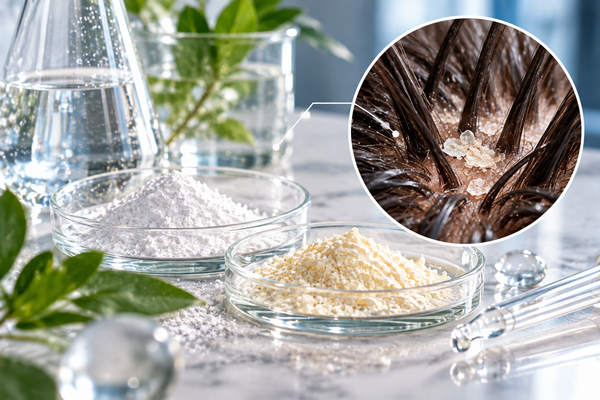
Ferulic acid is a natural compound belonging to the polyphenol family, more precisely a hydroxycinnamic acid. Its name derives from the plant Ferula, a herbaceous genus widespread in the temperate regions of Asia and the Mediterranean. It can be found in rice bran, coffee, grapes, wheat, and even spinach leaves. In practice, it is an ingredient your body already knows, but in cosmetics it is used in a much more targeted way.
It is therefore a plant-based polyphenol produced by plants to protect themselves from oxidative stress, UV rays, and pathogens. It is no coincidence that it performs essentially the same job on your skin. It can be extracted from plant sources such as rice and bran, or obtained through synthesis to ensure purity and stability in the final form.
How It Works on the Skin: The Mechanism of Ferulic Acid
This ingredient acts on the skin through a particular mechanism, and this may be precisely what makes it special. When you expose your skin to UV rays, pollution, and environmental stress, a cascade of free radicals is triggered: unstable molecules that attack skin cells, degrade collagen, and accelerate the aging process. Most antioxidants work by neutralizing free radicals as soon as they form. Ferulic acid, on the other hand, acts through a dual shield:
- on the one hand, it directly captures and neutralizes free radicals that are already present, donating electrons to them and interrupting the chain reaction before the skin is damaged;
- on the other, it inhibits the enzymes that catalyze the production of those free radicals in response to external factors such as UV rays.
In this sense, ferulic acid does not simply put out a fire that has already started; it works to prevent it from igniting in the first place.
Chronic oxidative stress damages fibroblasts, the cells responsible for producing collagen and elastin. Over time, the skin’s ability to remain firm and toned therefore decreases. Ferulic acid protects fibroblasts and helps preserve the skin’s elasticity and structure through a consistent action that builds over time.
Ferulic Acid Combined with Vitamin C and Vitamin E
In addition to these inherent properties, many cosmetic companies choose to include it in formulations together with pure Vitamin C, namely ascorbic acid, another powerful antioxidant capable of supporting collagen synthesis, evening out the complexion, and fighting free radicals. Vitamin C is, however, a highly unstable ingredient that oxidizes rapidly when exposed to air, light, and heat, losing its effectiveness—and this is where ferulic acid comes in. Thanks to its phenolic structure, it significantly slows the degradation process and keeps Vitamin C active and bioavailable in the formula.
But its effectiveness is not limited to stabilization alone: according to studies by Dr. Sheldon Pinnell’s team at Duke University, published in the Journal of Investigative Dermatology in 2005, when combined with 15% Vitamin C and 1% Vitamin E, it markedly enhances photoprotective and antioxidant activity compared with the active ingredients used separately. A documented biochemical synergy is therefore activated, in which each ingredient stabilizes and amplifies the action of the others.
The Tangible Benefits of Ferulic Acid for the Skin
Now that we have seen why these effects occur, it is easier to discuss the benefits. Here is what ferulic acid really does for your skin:
- Reduces the appearance of sunspots and photoaging. Discoloration does not appear overnight: it is the cumulative result of years of unprotected exposure to UV rays, which stimulate irregular melanin production. Ferulic acid acts on photoaging by reducing the oxidative stress that triggers this process, with a consistent action that does not conceal the spot but gradually evens out the complexion.
- Reduces the appearance of wrinkles and expression lines. Here too, the focus is photoaging—in this case, the lines that appear on the cheekbones, around the eyes, and around the lips as a result of damage to collagen and elastin fibers caused by free radicals. Ferulic acid works by protecting fibroblasts from this oxidative damage.
- Improves radiance and complexion quality, for a more even, vibrant, and less tired-looking complexion.
- Comfort and reduced redness. Studies on ferulic acid-based peels have found reductions in skin erythema during the first weeks of treatment. The mechanism is linked to its ability to modulate pro-inflammatory mediators activated in response to UV stress.
In addition, skin that is less oxidized is more balanced, retains water more effectively, and stays hydrated for longer. When combined with hyaluronic acid, ferulic acid provides valuable support for hydration.
It is an ingredient suitable for mature skin and for anyone seeking an anti-aging effect, as well as for skin prone to spots and discoloration that needs help achieving a more even complexion. Ideal for facing summer with greater peace of mind. It is also suitable for sensitive skin, because it supports the skin’s natural barrier.
This does not mean forgetting about SPF: ferulic acid does not replace sun protection; it complements UV filters by neutralizing the free radicals that exposure generates anyway. For existing spots, a targeted serum applied in the morning completes the routine.

SPOT DEFENCE 50 SPF SPF 50 anti-dark-spot facial sunscreen serum With encapsulated vitamin C, plant glycogen and postbiotic ferments, for... Discover SPOT DEFENCE 50 SPF
FeruliC+HA: LeLang’s Antioxidant Facial Serum
If you are looking for a practical way to incorporate ferulic acid into your routine, we have developed a formula that addresses the issue from two directions at the same time. The FeruliC+HA facial serum combines the antioxidant and stabilizing action of ferulic acid with the hydrating action of hyaluronic acid. Ferulic acid protects cells from oxidative stress and keeps the Vitamin C in the formula active, while hyaluronic acid draws water into the surface layers, compensating for moisture loss.

FERULIC + HA SERUM Vitamin C and ferulic acid face serum Antioxidant and tone-evening, with dual hyaluronic acid. Helps prevent dark sp... Discover FERULIC + HA SERUM
This is not a random combination of ingredients: it is a formulation choice based on a precise rationale. Better-hydrated skin responds more effectively to antioxidant actives, while an effective antioxidant creates the conditions for hydration to last longer. Vitamin C helps brighten the complexion and support collagen synthesis, while ferulic acid’s stabilizing action keeps it active over time. Vitamin E and arginine, an amino acid that contributes to hydration and skin comfort, complete the formula.
It is a serum designed for anyone who wants to take prevention seriously without complicating their routine: one step, multiple actions. In the ferulic acid ingredient page, you will find the complete list of LeLang formulas containing it.
Frequently Asked Questions About Ferulic Acid
When should it be applied, morning or evening?
In the morning, because its action complements that of sun protection during exposure hours. Using it in the evening does no harm, but you will make less use of its potential.
Does ferulic acid serum turn yellow?
The color change observed in serums of this type concerns Vitamin C, not ferulic acid; in fact, ferulic acid is what slows it down. A pronounced amber color nevertheless indicates that the formula has oxidized and should be replaced.
Can it be used with retinol and exfoliating acids?
Yes, but it is better to alternate them: ferulic acid and Vitamin C in the morning, retinoids or acids in the evening. Layering them in the same application may cause irritation, especially at first.
At what concentration does it work?
In the most studied formulas, it appears at around 0.5%, always combined with other antioxidants. It is not an active ingredient used alone at high concentrations: its value lies in the synergy.
Is it suitable for oily skin?
Yes. In serum formulations, it has a lightweight, non-occlusive texture, and its antioxidant action is also beneficial for blemish-prone skin, where oxidized sebum contributes to imperfections.
What is the difference between natural and synthetic ferulic acid?
The molecule is identical. The synthetic form generally offers more consistent purity and stability, which is not a minor detail for an active ingredient whose role is to stabilize others.
Conclusion: Choose the Right Path for Your Skin
Ferulic acid performs at its best when incorporated into a tailored, thoughtfully designed routine. Concentrations, pH, combinations, and application order make the difference between a product that works and one that remains unused on your nightstand.
LeLang products are available at partner pharmacies located throughout the area: a place where you can receive direct advice, experience the textures firsthand, and understand which formula best suits your skin.
Free 15-Minute Consultation with the Founder
If you prefer to do it from home, you can receive personalized advice before choosing, with no obligation and no rush. Book a free virtual skincare consultation with Elisa Avalle, founder of LeLang.