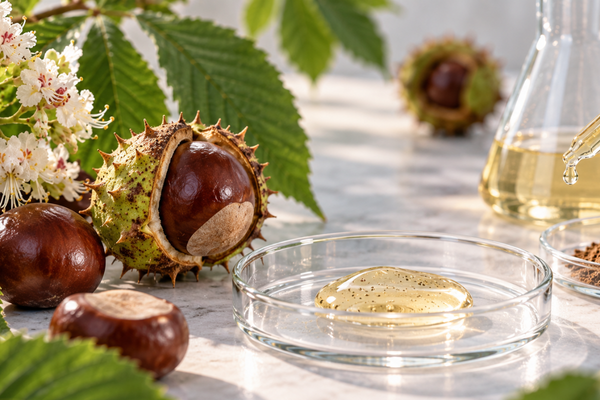



Not everyone knows that hazelnuts can be used to extract an oil rich in active ingredients and with numerous cosmetic properties.
Hazelnut oil is obtained from the fruit through cold extraction, a process that preserves its beneficial and organoleptic properties. Once extracted, this amber-hued oil gives off a distinctive aromatic fragrance.
[INDICE:h2]
What sets it apart: rapid absorption
The quality that distinguishes hazelnut oil from many other vegetable oils is its rapid absorption, which is useful in preventing skin dehydration.
The reason lies in its composition: hazelnut oil is mainly made up of oleic acid, an omega-9, along with a proportion of linoleic acid. It also has a low unsaponifiable fraction and low viscosity, and these three elements together give it the dry feel that heavier oils lack.
Its low greasiness also makes it a suitable ingredient for combination and oily skin, which often rejects oily textures.
Cosmetic properties
Its mildly astringent qualities allow it to be used as an anti-impurity ingredient, helping to make the skin’s texture more even.
Hazelnut oil is also a good emollient and soothes irritation, making it suitable for more delicate and sensitive skin.
It is also a nourishing oil, rich in omega-9 and omega-6 and vitamin E, which slows oxidation and helps counteract free radicals. For this reason, it is also useful for mature skin, where it helps maintain softness and elasticity.
Where to find it in LeLang products
You can find it in Nutralight Sensitive, the lightweight face cream that hydrates without feeling greasy, where it works together with carrot oil, thermal water, and a group of soothing active ingredients.

NUTRALIGHT SENSITIVE Soothing and repairing face cream with thermal water from the Piedmont Alps – ideal for sensitive and reactive skin ... Discover NUTRALIGHT SENSITIVE
It also appears in the cleansing oil and body treatments, for the same reason: wherever an oil phase is needed without leaving a heavy film. On the hazelnut oil ingredient page, you can find the complete list of formulas containing it.
The hazelnuts used come from the Langhe hills in Piedmont, in keeping with the choice to enhance local raw materials. You can also find the products in partner pharmacies throughout Italy.
Frequently asked questions about hazelnut oil
Is hazelnut oil comedogenic?
It is considered to have low comedogenic potential and is among the vegetable oils most commonly used on combination skin. The response is still individual, however: if your skin is very seborrheic, it is best to test it first on a small area.
Can people with a tree nut allergy use it?
Anyone with a confirmed hazelnut allergy should avoid it or consult their doctor. Refined oils contain minimal amounts of residual proteins, but caution is the right choice.
Can I use culinary hazelnut oil?
Chemically, it is similar, but it does not offer the same guarantees of purity and cosmetic grade, and toasted oil should be avoided altogether. For the face, it is best to use an oil intended for topical application.
Is it suitable for use pure on the face?
Yes. Unlike essential oils, vegetable oils can be applied pure. It works better on slightly damp skin because it helps retain the water already present rather than merely sitting on the surface.
Is it also suitable for hair?
Yes, especially for dry lengths. Its lightness also makes it suitable for fine hair, where heavier oils can weigh it down.
How should it be stored?
Keep it away from light and heat, and do not store it for too long: oils rich in unsaturated fats can go rancid. A sharp or pungent smell indicates that the oil has oxidized and should no longer be applied to the skin.