


[INDICE:h2]
If your face tends to look shiny by mid-morning and your pores are becoming increasingly noticeable, you probably have oily skin. With the right routine and effective ingredients, you can restore balance and a matte finish without irritating your skin.
In this article, we’ll look at how to care for oily skin step by step, and which products to choose for a simple but effective routine.
What is oily skin and why does it look shiny?
Oily skin is characterized by excessive sebum production, a condition clinically known as hyperseborrhea. Sebum is a natural substance that is essential for protecting and lubricating the skin; when it is excessive, however, it makes the face look shiny and greasy, especially in the T-zone — forehead, nose and chin — with enlarged pores and uneven texture.
The mistake you should never make is thinking that oily skin does not need hydration. Sebum does not replace water. Oily skin can be perfectly dehydrated and, to compensate, produce even more sebum. The difference between the two conditions is explained in the article on dry or dehydrated skin.
Oily skin or combination skin?
The distinction is simple but it changes your routine. With oily skin, hyperseborrhea affects the entire face fairly evenly. With combination skin, two different behaviors coexist: a shiny T-zone and normal or even dry cheeks.
The practical consequence is that combination skin does not require doubling the number of products, but rather adjusting how much you use: less cream on the T-zone, more on the cheeks and contours. For signs of aging on this skin type, see the dedicated article on first wrinkles on combination or oily skin.
Causes and symptoms
The causes are often combined: hormonal (puberty, menstrual cycle), genetic, or related to stress and diet. Using overly harsh cosmetics can also trigger or worsen hyperseborrhea.
The main signs:
- Persistent shine and a greasy feeling;
- Enlarged pores, especially visible on the nose and cheeks;
- Frequent presence of blackheads and comedones, and in some cases acne.
Who really controls sebum production
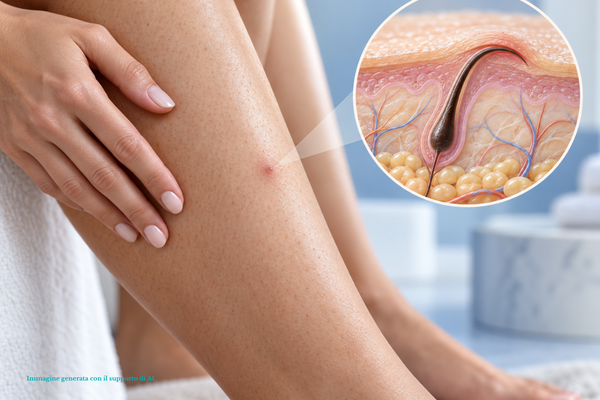
There is an anatomical detail that explains many things and is almost never mentioned: no nerve surrounds the sebaceous gland. Instead, it is enveloped by a dense network of blood vessels.
The consequence is clear: its activity is not regulated by the nervous system, but by the hormones that reach it through the blood. There is no direct pathway between a moment of tension and the gland.
This does not mean that stress is unrelated — it means that it is involved by another route. Prolonged stress alters the hormonal balance, and the hormones produced by the adrenal glands include androgens. That is the pathway, and it is why the effect is not immediate but becomes visible over weeks, not hours.
Androgens and 5-alpha-reductase
Androgens, produced by the testes, ovaries, and adrenal glands, stimulate secretion. The biologically active hormone in the gland is dihydrotestosterone (DHT): free testosterone enters the cell and is rapidly converted into DHT, which binds to a specific receptor and sets lipid synthesis in motion.
This is exactly where zinc comes in, inhibiting 5-alpha-reductase, the enzyme that carries out this conversion. It is not a generic action "against sebum": it is an upstream block, at the step that switches on the gland.
The gland also responds to other androgens besides testosterone, such as dehydroepiandrosterone and androstenedione. Estrogens, on the other hand, have an inhibitory effect, although how much this matters at normal physiological concentrations is still debated.
Why it changes with age (and not in the same way in men and women)
After the neonatal phase, sebum secretion is practically nonexistent in children. It resumes at puberty, alongside the increase in sex hormones, rises until adulthood, and then remains stable. It begins to decline from the age of fifty, much more in women than in men.
This gives rise to two very common and seemingly contradictory situations: a woman who, after menopause, no longer recognizes her own skin, which has suddenly become dry after a lifetime of combination skin; and a man who still has shiny skin at sixty. Neither is a defect: it is the hormonal curve.
What is sebum made of
The composition explains, in numbers, why sebum does not hydrate. It consists largely of triglycerides and diglycerides (about 57%), waxes (26%), and squalene (12%), with smaller amounts of cholesterol and cholesterol esters.
They are lipids that form a film and reduce evaporation, but none of them retains water. Water retention in the stratum corneum depends on lipids of an entirely different origin, produced by keratinocytes. This is the structural reason why skin can be shiny on the surface and dehydrated underneath: they are two separate systems, and one does not compensate for the other.
The three pillars of treatment
- Gentle cleansing: cleanse thoroughly morning and evening without irritating or disrupting the skin barrier. If your skin feels tight after washing, the cleanser is not right.
- Targeted treatments: serums and creams with sebum-regulating active ingredients to mattify the skin and minimize imperfections.
- Balanced hydration: lightweight, non-comedogenic creams that hydrate without weighing the skin down.
The active ingredients that really work
Oily skin responds well to ingredients that speak its own language: the language of lipids.
Salicylic acid
Unlike other exfoliants that act only on the surface, salicylic acid is lipophilic: it penetrates the sebum-filled follicle and dissolves the blockage that causes blackheads, with comedolytic and soothing action. The technical sheet is on the salicylic acid page.
Mandelic acid
If your skin is oily but also reactive, mandelic acid is the best alternative: it has a larger molecule, penetrates more slowly, and is therefore much better tolerated.
Niacinamide
Niacinamide does more than reduce sebum: it strengthens the skin barrier, improves texture by helping make pores less visible, and reduces residual redness. Its synergy with salicylic acid is among the best documented.
Azeloglycine
Azeloglycine combines the properties of azelaic acid and glycine. It regulates sebum in the T-zone and reduces post-inflammatory hyperpigmentation left by blemishes, with a lower irritation potential than pure azelaic acid. For the marks left by acne, see the in-depth guide on red and dark post-acne marks.
Zincidone
Zincidone combines zinc's sebum-regulating action with the hydrating power of PCA. Zinc acts on 5-alpha-reductase, the enzyme that converts testosterone into dihydrotestosterone: this is the step described above, the one that activates the gland. It is the active ingredient to look for if the main problem is midday shine.
The point is not to accumulate products, but to choose a few suitable active ingredients and use them consistently. Introduce one active ingredient at a time and observe how your skin reacts before adding others.
The daily routine
1. Cleansing, morning and evening
Cleansing Active Mousse is the foundation of every treatment for oily skin: it contains 0.5% salicylic acid, tea tree oil and burdock.

CLEANSING ACTIVE MOUSSE Facial cleanser with salicylic acid Purifying mousse with Tea Tree Oil, Burdock and Betaine Reduces the appearance o... Discover CLEANSING ACTIVE MOUSSE
2. Exfoliation, once or twice a week
To remove dead skin cells and unclog pores without being harsh.

MANDELIC ENZYMATIC SOFT PEEL Mandelic Acid and Enzymatic Facial Peel Highly tolerated, gentle exfoliant that stimulates cell turnover. Removes de... Discover MANDELIC ENZYMATIC SOFT PEEL
3. Targeted serum
Acnerebal Serum balances and mattifies the skin, with Zincidone and niacinamide.

ACNEREBAL SERUM Serum with salicylic acid and niacinamide For oily skin and enlarged pores, with Zincidone®, Burdock and Provitamin B... Discover ACNEREBAL SERUM
If you are instead looking for an antioxidant and brightening effect, the alternative is FeruliC + HA.

FERULIC + HA SERUM Vitamin C and ferulic acid face serum Antioxidant and tone-evening, with dual hyaluronic acid. Helps prevent dark sp... Discover FERULIC + HA SERUM
4. Hydration
Acnerebal Cream hydrates the skin and keeps it matte without feeling heavy.

ACNEREBAL CREAM Cream for hormonal acne and oily skin, mattifying effect Sebum-regulating cream with Azeloglycine, Zincidone® and Nia... Discover ACNEREBAL CREAM
If your skin is oily but also sensitive, a more soothing formula is preferable.

NUTRALIGHT SENSITIVE Soothing face cream for sensitive, redness-prone skin With thermal water from the Piedmont Alps, for sensitive and re... Discover NUTRALIGHT SENSITIVE
5. Sun protection
You need a non-comedogenic SPF 50 suitable for blemish-prone skin.

SPOT DEFENCE 50 SPF SPF 50 anti-dark-spot facial sunscreen serum With encapsulated vitamin C, plant glycogen and postbiotic ferments, for... Discover SPOT DEFENCE 50 SPF
Weekly treatment
A clay purifying mask completes the routine, absorbing excess sebum and refining skin texture.

SKINPURE REBALANCE Purifying clay face mask for oily and blemish-prone skin With Potassium Azeloyl Diglycinate, Zinc PCA, purifying clay... Discover SKINPURE REBALANCE
You can find the full range in the LeLang selection for oily skin; if yours is combination skin, with a shiny T-zone and normal cheeks, see the selection for combination skin.
Diet and oily skin
Diet is not the main cause of hyperseborrhea — which remains hormonal and genetic — but some dietary factors can influence the condition.
Foods with a high glycemic index, such as refined sugars and white flour, cause insulin spikes that indirectly stimulate sebum production. A randomized controlled study found an improvement in symptoms among acne patients following a low-glycemic-load diet.
However, omega-3 — oily fish, walnuts, and flaxseeds — can be helpful for their contribution to inflammation modulation, as can foods rich in zinc and antioxidants.
An honest clarification: no diet can replace a proper skincare routine, and diet alone rarely solves the problem. It is a supporting factor, not the main lever. If you suspect a link between diet and your skin, speaking with a nutritionist provides more useful answers than any list of foods to avoid.
Mistakes to avoid
- Skipping moisturization: oily skin can be dehydrated, and without hydration it produces even more sebum.
- Giving up sunscreen: the problem is not sunscreen itself but the wrong texture. Skipping it can lead to worsening in the months after summer, a phenomenon we explored in depth in the article on why acne improves in summer and worsens in September.
- Washing your face too much: the more you strip away oil, the more sebum your skin produces to compensate. It is the most common vicious cycle.
- Touching your face unnecessarily and failing to wash brushes and sponges.
Frequently asked questions
What to use if you have oily skin?
A gentle cleanser with salicylic acid, an oil-regulating serum with niacinamide and zinc, a lightweight non-comedogenic cream, and a fluid-texture sunscreen. Plus gentle exfoliation once or twice a week. Four products used consistently are worth more than ten used at random.
What order should you follow for your skincare routine?
From the lightest to the richest texture: cleanser, optional toner, serum, cream, and in the morning, sunscreen as the final step. It is best to wait two or three minutes between serum and cream.
What is the difference between oily and combination skin?
With oily skin, sebum production affects the entire face; with combination skin, it affects only the T-zone, while the cheeks and contours may be normal or dry. The routine is the same; the dosage changes: with combination skin, use less on the T-zone and more wherever the skin feels tight.
Does stress cause oily skin?
Indirectly, yes, but not in the way people might think. The sebaceous gland has no innervation: no nerve reaches it, so there is no direct connection between tension and sebum production. Prolonged stress acts through hormonal pathways, via adrenal androgens. That is why the effect appears over weeks, not within a single bad day.
Why is skin no longer oily after menopause?
Because sebum production begins to decline around the age of fifty, and it does so much more in women than in men. Someone who has lived with combination or oily skin for thirty years may find themselves with dry, reactive skin within just a few years: the routine needs to be started from scratch, not adapted.
What is the best diet for oily skin?
There is no specific diet, but reducing foods with a high glycemic index - refined sugars and white flour - may help, because insulin spikes indirectly stimulate sebum production. Omega-3s, zinc, and antioxidants can be beneficial. It is still only supportive: the main factor is your skincare routine.
Does oily skin age more slowly?
Partly: sebum helps maintain the skin's hydrolipidic film, and oily skin tends to show fine lines later than dry skin. However, it is not immune to photoaging or loss of firmness, and sun protection remains essential.
In short
Even the shiniest skin can regain comfort and a more even appearance with a balanced routine. Consistency matters more than the number of products: proper cleansing, targeted exfoliation, and smart hydration do more than any intensive treatment.
If you're not sure whether you have oily skin, combination skin, or dehydrated oily skin — three situations that require different routines — you'll find a pharmacist at LeLang partner pharmacies who can assess it in person.
Sources for this article
01 Stamatiadis D., Bulteau-Portois M.C., Mowszowicz I., Inhibition of 5 alpha-reductase activity in human skin by zinc and azelaic acid, British Journal of Dermatology, 1988; 119(5): 627-632.
02 Draelos Z.D., Matsubara A., Smiles K., The effect of 2% niacinamide on facial sebum production, Journal of Cosmetic and Laser Therapy, 2006; 8(2): 96-101.
03 Arif T., Salicylic acid as a peeling agent: a comprehensive review, Clinical, Cosmetic and Investigational Dermatology, 2015; 8: 455-461.
04 Smith R.N., Mann N.J., Braue A., Mäkeläinen H., Varigos G.A., A low-glycemic-load diet improves symptoms in acne vulgaris patients: a randomized controlled trial, American Journal of Clinical Nutrition, 2007; 86(1): 107-115.
05 Kligman A.M., Shelley W.B., An investigation of the biology of the human sebaceous gland, Journal of Investigative Dermatology, 1958; 30: 99-125.
06 Matias J.R., Orentreich N., Stimulation of hamster sebaceous glands by epidermal growth factor, Journal of Investigative Dermatology, 1983; 80: 516-519.
15-minute free consultation with the founder
Do you have oily skin and don't know which active ingredient to start with, or whether the one you're using is making things worse? Book a free virtual skincare consultation with Elisa Avalle, founder of LeLang.
On the website: understanding acne · early wrinkles on combination skin · salicylic acid · dry or dehydrated skin · oily skin selection