


[INDICE:h2]
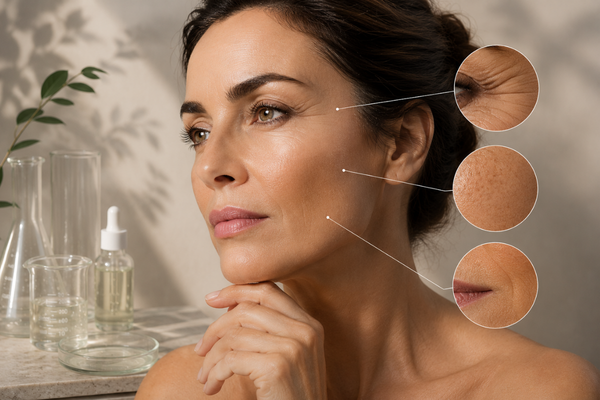
It is often said that there is no cosmetic product suitable for everyone, and the reason is simple: every person’s skin is different. Skin is the body’s largest organ and acts as a shield against external agents, but it is also subject to stressors that come from within—stress, an unbalanced diet, and too little sleep.
Knowing your skin type helps you understand how it responds to different active ingredients and which ones to avoid. But keep one point in mind: skin types should not be confused with dermatological conditions. A condition such as acne or dermatitis can occur with any skin type. There are predispositions—sensitive skin is more easily irritated—but no automatic correlations.
If you are starting from scratch, before identifying your skin type, it is worth clarifying what a routine actually includes and the order in which the steps should be followed: we explain it in the article on skincare: what it means and where to start.
How to determine your skin type
The simplest method is the tissue test. Cleanse your face with a gentle product, pat it dry, and do not apply anything. Wait two hours, then press a tissue onto your forehead, nose, chin, and cheeks. If it remains oily everywhere, your skin is oily; if it is oily only in the T-zone, it is combination; if there is no trace of sebum and your face feels tight, it is dry; if there is no oiliness but no feeling of tightness either, it is normal. Sensitivity is a separate characteristic: it is assessed by reactivity, not sebum.
Two precautions make the test reliable. First: it should be done away from hot showers and any exfoliating treatment, which temporarily alter sebum production. Second: it should be repeated in different seasons. The same person may have combination skin in July and dry skin in January, and that is not a testing error—it is the skin genuinely changing.
If you prefer some guidance, we have a skin type quiz that reaches the same result in just a few questions.
The five main skin types
From a cosmetic perspective, skin is classified based on the balance between sebum production, hydration, and sensitivity level:
- Normal skin
- Combination skin
- Sensitive skin
- Oily skin
- Dry skin
It is perfectly normal to identify with more than one category, and needs change with age, the season, and where you live.
There is also a different, complementary classification: skin prototyping, which describes how skin reacts to the sun. The most widely used method is the Fitzpatrick scale, first described in 1975, which distinguishes six phototypes from lightest to darkest. It is used to determine the appropriate sun protection factor and is a prevention tool, not an aesthetic judgment.
In addition to the five types, there are more specific conditions — mature, asphyxiated, and thickened skin — that do not always coincide with the main categories.

Why the five types are an oversimplification (and what professionals use)
The five categories are convenient, but they do not come from a measurement: they come from what can be seen with the naked eye. And the naked eye can assess only two things — how much sebum is present on the surface and how rough or flaky the skin appears. The third parameter, namely how much water the stratum corneum contains, is not visible.
In cosmetology, skin is described using three independent criteria:
- Water content: hydrated or dehydrated skin.
- Lipid content: oily skin, including seborrheic skin, or alipidic skin, meaning skin that is low in surface lipids.
- Structural condition of the stratum corneum: smooth skin, when corneocytes detach in small invisible groups, or rough, flaky skin, when cohesion between corneocytes increases and the scales become visible to the naked eye.
These are three axes that combine freely and, on their own, produce eight skin types, not five. At the extremes are dehydrated, alipidic, rough skin on one side, and hydrated, oily, rough skin caused by thickening on the other. All the others lie between them.
The point that changes how products are chosen: the three criteria are independent. Skin can be rough and flaky while having perfectly normal water and lipid content. This is why a very rich cream sometimes solves nothing: if the problem is corneocyte cohesion, exfoliation and turnover are needed, not more oils.
“Dry skin” is a misnomer
Piérard's group measured the degree of keratosis, water content, and lipid content in clinically defined dry skin. The result is counterintuitive: there is no correlation between how rough and flaky skin appears and how much water or how many lipids it actually contains. Hence the very direct title of one of those papers: “dry skin” is a misnomer.
There is an even older piece of evidence that points in the same direction. As early as 1958, Kligman and Shelley observed that children, who produce very little sebum, show no signs of dry skin. If sebum were what keeps the skin soft, they would all have dry skin. Sebum-derived lipids contribute far less than commonly believed to the epidermis’s ability to retain water: that depends on the lipids produced by the keratinocytes themselves and on natural moisturizing factors.
The practical consequence is that “I have dry skin” is not enough to choose a product. You need to know which of the three parameters is out of balance — and they lead to three different answers.
The first two criteria are assessed with instruments, and the measurements are neither complicated nor expensive: this is precisely what enables a dermocosmetics professional to tailor a treatment instead of assigning a category. This is the type of assessment carried out at the counter, and it is one of the reasons why LeLang is distributed in partner pharmacies rather than everywhere.
Normal skin
It is neither too dry nor too oily: sebum production and natural hydration are balanced, and it is not very reactive to a wide range of active ingredients.
This does not mean it does not need care. In fact, it is the most neglected skin type, and even normal skin develops wrinkles, dark circles, a dull complexion, and loss of firmness. The goal here is to maintain balance and prevent it from changing over time.
Cleansing, hydration, and protection are the three essential steps, adapting the moisturizer to the season: richer in winter, lighter in summer.

PERLAGE Anti-wrinkle face cream - antioxidant with high antioxidant and protective power. Reduces the depth and intensity of... Discover PERLAGE
Combination skin
It is characterized by a combination of different features: typically an oily T-zone — forehead, nose, and chin — and normal or dry cheeks. It may also present as a mix of dryness and sensitivity, because dry skin often has a weakened barrier.
It requires a more structured routine: gentle cleansing, adequate hydration, protection, and, when needed, targeted treatments for specific areas. A lightweight serum can work on the driest areas without weighing down the T-zone, while localized blemishes can be treated precisely.
If the active ingredients you need risk conflicting with one another, the practical solution is to spread them between morning and evening instead of layering them.

Sensitive skin
It is immediately recognizable: itching, burning, or stinging after applying a product or following a temperature change. It reacts to the climate, makeup, and cleansers because the barrier function is impaired. The causes are analyzed in the article on what makes skin sensitive.
Cleansing must be gentle: harsh surfactants remove dirt and sebum along with part of the barrier. A cream enriched with soothing active ingredients helps rebuild it — niacinamide is among the most useful, because it reduces redness and supports ceramide production.

NUTRALIGHT SENSITIVE Soothing and repairing face cream with thermal water from the Piedmont Alps – ideal for sensitive and reactive skin ... Discover NUTRALIGHT SENSITIVE
Oily skin
It is caused by above-normal sebum production, which can lead to clogged pores and blemishes. The most common mistake is washing it too much: deprived of its lipids, the skin responds by producing even more sebum.
Balanced cleansing is best, possibly with salicylic acid, along with lightweight serums that rebalance oil production and mattifying but non-aggressive creams. The complete protocol is in the guide to an oily-skin routine.

CLEANSING ACTIVE MOUSSE Purifying face cleansing mousse anti-imperfections Reduce enlarged pores Purifies the skin from impurities Improves ... Discover CLEANSING ACTIVE MOUSSE
Dry skin
It feels rough and tight to the touch, and is sometimes flaky. It results from the loss of the protective lipid layer: the cells remain more exposed and retain less water. Climate, air conditioning, heating, age, and some medications can contribute.
Be careful not to confuse dry skin with dehydrated skin: the former lacks lipids and is a constitutional characteristic, while the latter lacks water and is a temporary condition that can also affect oily skin. The differences are explained in the article dedicated to dry or dehydrated skin.
The main allies are hyaluronic acid in different molecular weights and richer creams, both day and night. If the dryness persists or is accompanied by cracking or intense itching, it is worth having it evaluated by a dermatologist.

SUNRISE Firming, toning face cream collagen stimulator. Rassoda in two weeks (instrumental effectiveness test) Improves even... Discover SUNRISE
Frequently asked questions
What are the 4 skin types?
The most widespread classification includes four basic types — normal, dry, oily, and combination — plus sensitive skin, which many manuals treat separately because it concerns reactivity rather than sebum: skin can be both oily and sensitive. That is why you may see “four types,” “five types,” or even more: there is no contradiction; it simply depends on where sensitivity is placed.
So why do people talk about 6 skin types?
Because that is something else: the six phototypes of the Fitzpatrick scale, which classify skin according to how it reacts to the sun — whether it burns, whether it tans, and how easily. They are used to choose sunscreen, not moisturizer. They are two parallel classifications: you can have combination skin and phototype II.
How many skin types are there really?
It depends on how precise you want to be. Using the three measurable criteria — water, lipids, and the structure of the stratum corneum — and considering only their extreme values, you get eight. But each criterion is a continuous scale, not an on-off switch: once intermediate values are included, the number grows indefinitely. The five commonly used categories are a useful approximation for navigating a perfumery, not a taxonomy.
Does skin type change over time?
Yes. It changes with age — sebum production gradually decreases after the age of thirty — but also with the season, climate, hormones, and the products you use. Repeating the test once or twice a year is more useful than treating it as a fixed label.
Combination or oily skin: how can I tell the difference?
Look at the cheeks. With oily skin, sebum is spread across the entire face, including the cheeks; with combination skin, it is concentrated in the T-zone while the cheeks remain normal or even dry. In practice, this means that on combination skin, mattifying treatments should be applied only where needed; otherwise, they can dry out areas that did not need them.
My skin is oily but feels tight: how is that possible?
This is the most misunderstood situation of all, and it usually means that the skin is oily but dehydrated: it produces excess sebum while retaining little water. It is often the result of overly harsh cleansers. The answer is not to wash more, but to moisturize.
Does the menstrual cycle affect skin type?
Not in terms of type, but in terms of condition. In the first few days of the menstrual cycle, the skin pH rises compared with its usual levels because the composition of sweat and sebum secretions changes periodically. These are temporary changes: they become a characteristic of a skin type only when they remain stable over time.
And you, what is your skin like?
Recognizing your skin type is the first step, but your needs change over time. If you want to understand which products are right for your current situation, you can start with our skin type quiz or talk to us directly.
Sources for this article
01 Rurangirwa A., Piérard-Franchimont C., Le T., Ghazi A., Piérard G.E., Corroborative evidence that "dry skin" is a misnomer, Bioengineering and the Skin, 3, 1987, pp. 35-42
02 Piérard G.E., What does "dry skin" mean?, International Journal of Dermatology, 26, 1987, pp. 167-168
03 Kligman A.M., Shelley W.B., An investigation of the biology of the human sebaceous gland, Journal of Investigative Dermatology, 30, 1958, pp. 99-125
04 Proserpio G., Skin variability: skin types, in The Basics of Cosmetology, SEPEM, Milan, 1992, pp. 109-112
05 Fitzpatrick T.B., classification of skin phototypes
On the website: dry or dehydrated skin · the skin barrier · causes of sensitivity · LeLang partner pharmacies