


Menopause involves a natural decline in estrogen and a period of hormonal changes that affect the skin and hair. Estrogen protects both: its decline reduces SHBG (the proteins that bind sex hormones), and as free androgens increase, seborrhea and hair loss appear. The result is skin that loses elasticity and becomes dry, while the hair becomes thinner.
Skin and dermis, which are rich in estrogen receptors, may develop hyperpigmentation, hyperhidrosis, and reduced elasticity; the hair, on the other hand, enters a prolonged telogen phase, with the hair-growth cycle slowing down.
[INDICE:h2]
Menopause and low estrogen: effects on skin and hair
If you want to understand in detail the hormonal mechanism behind these changes, read the in-depth article on how to improve facial skin during menopause. This page focuses on what happens when estrogen levels decline, affecting the skin and hair.
Effects of low estrogen on the skin
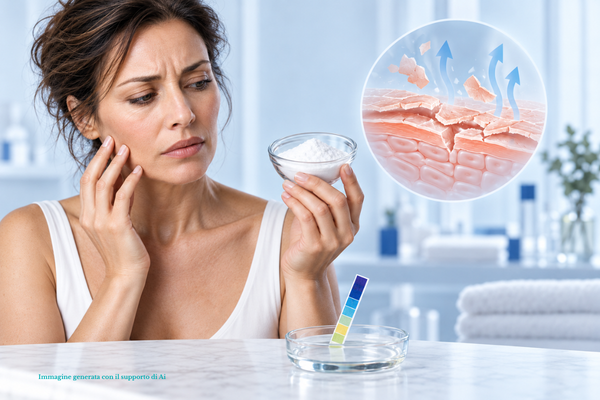
Low estrogen levels lead to reduced collagen and elastin production. For the skin, this means increased dryness, deeper wrinkles, and thinning. Water loss makes the skin less hydrated and more fragile, and increases the barrier's sensitivity to the sun.
The most surprising aspect concerns the timing. Research on skin aging during menopause — particularly the work of Brincat and colleagues — indicates that collagen loss is not distributed evenly over the years: a substantial amount occurs during the first five years after menopause, then slows down. This is why prevention is most effective during this phase.
The impact on hair
The decline in estrogen weakens the follicles and leads to finer, drier, more fragile, and thinner hair. The relative increase in androgens promotes female androgenetic alopecia, with volume loss mainly along the central parting.
It is important to be clear: androgenetic hair thinning is a dermatological condition, not a cosmetic imperfection, and no cosmetic product can treat it. Effective therapies are available, but they must be prescribed by a dermatologist, and the earlier treatment begins, the better the response.
Not all hair loss noticed during this phase is androgenetic: in autumn, many women see an increase in hair shedding for a few weeks, and this is a normal physiological renewal process. How to distinguish between the two situations is explained in the article on autumn hair loss.
Cosmetic support for declining estrogen levels
Cosmetics can do a great deal for the appearance of the skin during this phase: there are active ingredients that support hydration and firmness without causing irritation. Applying non-comedogenic products every day is a practical way to help preserve tone and radiance.
Hair also benefits from formulas containing niacinamide, zinc, and biotin, which improve fiber strength and reduce breakage.
How to counteract the effects on facial skin
Formulas rich in peptides, retinoids, and hyaluronic acid with different molecular weights are needed to provide hydration at multiple levels. The goal is to support firmness without causing irritation, an important factor when the stimuli of hormonal change are already numerous.
Phytoestrogens: what they are and what they are not
Phytoestrogens are plant molecules with a structure that resembles estrogen, which is why they interact with estrogen receptors. The most studied phytoestrogen in cosmetics is Kudzu.
However, one important clarification is needed: when applied to the skin, phytoestrogens do not replace hormone therapy and do not affect the body's hormonal balance. Their contribution is cosmetic and local, supporting the appearance and comfort of the skin. Anyone considering hormone replacement therapy should discuss it with their gynecologist: these are two different approaches that do not overlap.
Alongside phytoestrogens, ceramides work on a more tangible front: they are lipids that form part of the skin barrier's structure, and applying them externally helps limit transepidermal water loss, which increases during this phase.
Collagen in skincare formulas
Collagen is a structural component of the dermis and determines its firmness and elasticity. Without it, the skin loses volume, becomes dry, and wrinkles become more visible.
Collagenetic Serum is a facial serum designed for skin that has lost firmness. It works with a complex of biomimetic peptides, Kudzu, and hyaluronic acid for hydration.

COLLAGENETIC SERUM Firming facial collagen-stimulating serum Biotechnological plant collagen and Matrixyl® stimulate new collagen. Gard... Discover COLLAGENETIC SERUM
Useful creams and serums during menopause
Serums rich in vitamin C and resveratrol can be added alongside creams to help neutralize free radicals; vitamin A, in the form of retinol or derivatives, also works as an anti-aging ingredient.
Daily sun protection is an essential step: it blocks UV rays that damage the remaining collagen and prevents photoaging and dark spots, which may become more pronounced due to the increased sensitivity of menopausal skin.
For particularly dry skin, you can add Alba cream, which works on density and firmness.

ALBA Firming, toning face cream Collagen stimulator. Firms skin in two weeks (instrumental efficacy test) Improves even d... Discover ALBA
In conclusion
If you want a practical step-by-step guide to which active ingredients to choose and in what order to apply them, you can find everything in the skincare routine for skin after age 50.
Frequently asked questions about menopause, skin, and hair
When do skin changes begin?
Often before menopause itself, during perimenopause, when estrogen levels begin to fluctuate. Many women notice dryness and reduced firmness years before their last menstrual period and do not connect the two.
Are phytoestrogens in creams safe?
At cosmetic concentrations, yes: they act locally and do not alter hormonal balance. Anyone with a history of hormone-sensitive cancer should nevertheless discuss their use with their oncologist or gynecologist beforehand, including for topical application.
Does drinking collagen work for the skin?
Available studies on oral collagen peptides show encouraging results for hydration and elasticity, but they are often funded by manufacturers and conducted on small samples. They do not replace sun protection and retinoids, which remain the interventions with the strongest evidence.
Why do pimples appear during menopause, as they did at age twenty?
Because the relationship between hormones matters, not their absolute level. When estrogen levels decline, androgens remain relatively higher and stimulate the sebaceous glands, leading to late-onset acne that typically appears on the chin and jawline.
Does hair grow back after menopause?
Androgenetic hair thinning tends to progress if left untreated, and follicles that have been miniaturized for a long time are unlikely to recover. This is why seeing a dermatologist early makes a real difference.
Do you need to change your entire routine?
No, and changing everything at once is actually counterproductive: skin is more reactive during this phase. Start with hydration and sun protection, then add one active ingredient at a time, leaving three or four weeks between additions.