


Calendula is one of the most frequently mentioned ingredients in natural cosmetics and one of the least explained. Everyone calls it soothing, but almost no one says which molecule makes this possible - and that is a shame, because that molecule is also the way to determine whether calendula is high quality or not.
Article written by Elisa Avalle, founder of LeLang Skin Care and a dermocosmetics specialist. Cover image generated with the support of artificial intelligence.
[INDICE:h2]
What is calendula?
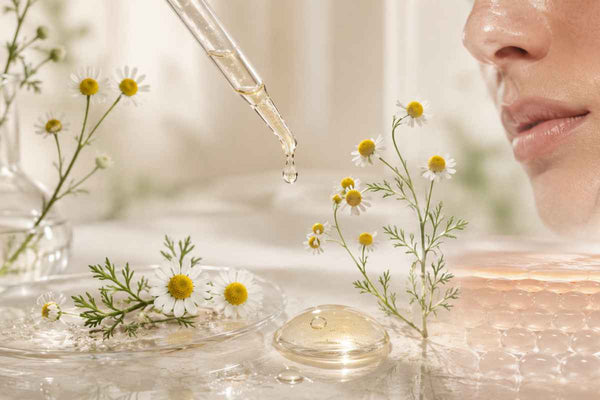
The calendula used in cosmetics is Calendula officinalis, a plant in the Asteraceae family with characteristic orange flower heads. The name comes from the Latin calendae, the first day of the month, because it flowers almost continuously.
In INCI, it appears as Calendula Officinalis Flower Extract when it is an extract of the flower heads, or as Calendula Officinalis Flower Oil in the case of an infused oil, meaning flowers macerated in a vegetable oil.
Beware of a common misconception: “Mexican calendula” or “African flower” is not calendula. It is Tagetes, a different genus whose derivatives have their own usage restrictions. If you read Tagetes on the label, you are not reading calendula.
Faradiol: the molecule that makes calendula soothing
This is the answer no one gives. It is not the flower itself that soothes, but a specific group of molecules.
A study published in Planta Medica by Della Loggia and colleagues fractionated the flower-head extract to identify the components responsible for its topical activity. The results indicated that triterpenoids were primarily responsible and, among them, that the faradiol monoester was the most relevant because of its quantitative predominance.
But the study’s most useful finding is something else. The authors observed that the activity of the different extracts is proportional to their faradiol monoester content, and proposed this content as a parameter for quality control of calendula preparations.
In other words: “contains calendula” says almost nothing. What matters is how much faradiol that extract contains, which depends on the cultivated variety, the time of harvesting, and the extraction method.
Variability is not theoretical: a study that quantified eight triterpenoid monoesters in ten different varieties of Calendula officinalis found marked differences in the active compound content from cultivar to cultivar. This is why, with a plant-based raw material, the supply chain matters as much as the botanical species.
What calendula does for the skin
Alongside triterpenoids, two other groups of molecules are at work.
The flavonoids — quercetin and isorhamnetin among the most prominent — provide antioxidant action against free radicals. The carotenoids, responsible for the orange color, complete the profile. And the mucilages form a film that reduces friction and the feeling of tightness.
The result is skin that reacts less to external stimuli and appears more even. It is an effect on comfort and appearance that develops with regular use.
Extract, oleate, or tincture: which form should you choose?
They are not the same thing, and the difference lies in what the solvent can carry with it.
| Form | How it is obtained | Where it is used |
|---|---|---|
| Extract | Flowers extracted in a hydroalcoholic or glycolic solvent | Serums, creams, cleansers |
| Oleate | Flowers macerated in vegetable oil | Body oils, balms, oil cleansing |
| Mother tincture | Alcoholic herbal preparation | Herbal use, not cosmetic use |
Triterpenoids such as faradiol are fat-soluble: they therefore concentrate better in oleates and lipophilic extracts than in purely aqueous preparations. This is one reason calendula so often appears in oils and balms.
What is calendula used for in skincare?
Calendula is used on sensitive skin that reddens easily, in cleansing to temper the degreasing effect, and in body products after sun exposure or hair removal.
In cleansing
In oil cleansing, its fat-soluble nature works to its advantage: oil is the natural vehicle for triterpenoids.

CLEANSING GENTLE OIL Makeup-removing facial cleansing oil non-comedogenic, the first step of double cleansing Dissolves makeup, including... Discover CLEANSING GENTLE OIL
In mousse cleansers, it works alongside surfactants, tempering their degreasing effect.

CLEANSING DETOX MOUSSE Makeup-removing facial cleansing mousse Detoxifying, for sensitive skin and all skin types, with Hydromanil®, Red Vin... Discover CLEANSING DETOX MOUSSE
In face creams
In formulas for reactive skin, it supports other soothing ingredients, covering a mechanism different from theirs.

NUTRALIGHT SENSITIVE Soothing face cream for sensitive, redness-prone skin With thermal water from the Piedmont Alps, for sensitive and re... Discover NUTRALIGHT SENSITIVE
In anti-aging formulas, it complements actives that work on the skin's structure, taking care of comfort.

SKINAGE ADVANCE Anti-wrinkle face mask with Q10 and peptides With Calamine, Ceramides, Palmitoyl Tripeptide-5 and Hyaluronic Acid Vi... Discover SKINAGE ADVANCE
On the body
On the body, the area to be treated is large and the skin generally receives less attention: this is where a well-tolerated soothing ingredient performs at its best, because it can be used every day.

RELAX SHOWER GEL Moisturizing shower gel for sensitive skin Shower gel with neurocosmetics, for a shower that relaxes skin and mind. ... Discover RELAX SHOWER GEL

RELAX BODY CREAM Relaxing moisturizing body cream With neurocosmetics and 4 hyaluronic acids, for soothed and nourished skin. Multi-l... Discover RELAX BODY CREAM
If reactivity is a recurring concern for you, in the LeLang selection for sensitive skin you will find formulas built around this principle: documented soothing complexes, gentle surfactants, no harsh actives and nickel-tested products. Where a fragrance is present, the allergens are listed in full on the label as required by EC Regulation 1223/2009: if you have a confirmed sensitivity to fragrances, this is the list to read before choosing.
Calendula and allergies: who should be careful
This is the information that is missing almost everywhere, and it is paradoxical that it is missing precisely for an ingredient intended for delicate skin.
Calendula belongs to the Asteraceae family, the same botanical family as chamomile, arnica, ragweed and mugwort. Anyone with Compositae pollinosis or who has already reacted to other plants in this family may also develop a reaction through topical use.
This is not a reason to avoid it outright: it affects only a minority of people. But it is why, if you know you are allergic to chamomile or ragweed, it is advisable to try a calendula product on a small area - the crook of your elbow - for a couple of days before using it on your face.
This is also why, if your skin often reacts, it is worth having someone check the INCI before you buy: at LeLang partner pharmacies, you can find a pharmacist who can check whether Asteraceae are present in products you already use.
Frequently asked questions about calendula
Is calendula suitable for facial skin?
Yes, and it is one of the most widely used ingredients in formulas for reactive skin. It is found in cleansers, creams and oils, with no frequency limits: it can be used morning and evening.
Does calendula treat dermatitis or eczema?
No, and it is worth being precise because the opposite is often stated. Dermatitis and eczema are dermatological conditions that require a diagnosis and medical treatment. A calendula cosmetic improves the skin's comfort and appearance and can complement that treatment, but it does not replace it.
What is the difference between calendula and chamomile?
They belong to the same botanical family, but they are different plants with different molecules: in calendula, the most relevant active compound is faradiol, while in chamomile, it is bisabolol and apigenin. They act on different aspects of skin reactivity, which is why they can coexist in a formula.
Can calendula be used on children's skin?
It is among the ingredients most commonly used in products for children's delicate skin. It is best to stick to products formulated for their age and, if there is a family history of allergy to Compositae, discuss it with the pediatrician first.
Is calendula cream or oil better?
It depends on the purpose. Oil is the best vehicle for triterpenoids, which are fat-soluble, and is suitable for the body and oil cleansing. Cream is more practical for the face and allows calendula to be combined with water-soluble active ingredients that would not work in oil.
Can calendula be used during pregnancy?
Topical cosmetic use has no known issues. As with any product used during pregnancy, if you have any doubts, consult your doctor.
In the calendula ingredient profile you will find the INCI and the complete list of LeLang formulas containing it.
Sources for this article
01 Della Loggia R., Tubaro A., Sosa S., Becker H., Saar S., Isaac O., The role of triterpenoids in the topical anti-inflammatory activity of Calendula officinalis flowers, Planta Medica, 1994; 60(6): 516-520.
02 Quantification of eight triterpenoid monoesters in ten varieties of Calendula officinalis (PubMed, PMID 14979524).
03 Cosmetics, 2021; 8(2): 31 - study on calendula flower extract.
15-minute free consultation with the founder
Not sure whether calendula is suitable for your skin, or whether your reactivity is caused by something else? Book a free virtual skincare consultation with Elisa Avalle, founder of LeLang.
On the website: bisabolol · what sensitive skin is · what to apply to reddened skin · calendula profile · sensitive skin collection