

[INDICE:h2]
Glycogen is the energy reserve that cells keep on hand for when they need it. We know it from muscles and the liver, but it's also found in the skin, and its amount decreases with age. This gave rise to the idea of replenishing it from the outside: a different approach from the usual active ingredients, because it doesn't add a function; it provides the fuel to support several.
Article written by Elisa Avalle, founder of LeLang Skin Care and dermocosmetics specialist. Cover image generated with the support of artificial intelligence.
What is glycogen, and why does skin need it?
Glycogen is a polysaccharide: many glucose molecules linked together in a highly branched, very compact structure. It stores glucose in the smallest possible space, ready to be released when a cell needs to produce ATP, the energy currency for every biological process.
We have known that skin contains glycogen since the 1960s, when Halprin and Ohkawara documented it in the Journal of Investigative Dermatology. Skin cells are metabolically active: they repair themselves, renew themselves, produce collagen and hyaluronic acid, and neutralize damage from the sun and pollution. All this takes energy. When energy availability falls, so does production of the things that depend on it.
It isn't sugar in the dietary sense, and has nothing to do with glycation, the process in which free sugars bind to collagen and stiffen it. Glycogen is glucose that's already packaged and destined for cellular metabolism, not circulating sugar.
Plant glycogen: why phytoglycogen changed the rules
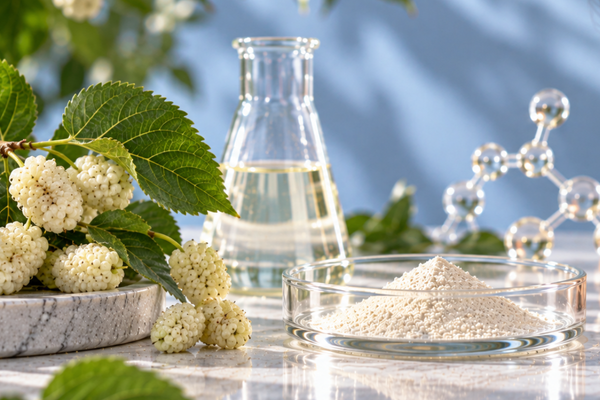
There was a practical problem. Glycogen is an animal molecule, and for years the only way to use it in cosmetics was to extract it from animal sources. The solution came from sweet corn: some varieties produce and store phytoglycogen, a molecule chemically identical to the animal one.
The difference from other plant polysaccharides lies in the branching. L's common corn amylopectin branches every twenty glucose units; phytoglycogen every ten, twice as often. This branching density gives it a spherical, compact shape, with a high capacity to bind water and low viscosity: it retains water without feeling heavy.
On the label, you’ll find it listed as Glycogen. The material we use comes from non-GMO sweet corn and is extracted using a water-based process, without solvents.
What glycogen does for the skin
The data below comes from the active ingredient manufacturer’s tests, not from published independent studies: it should be read as an indication of the trend, not as definitive measurements.
In the lab, on cultured skin cells, phytoglycogen increased ATP production by almost fifty percent in twenty-four hours. In fibroblasts, proliferation rose by twenty percent and metabolic activity by twelve percent. With more energy available, the fibroblasts also produced more material: the amount of hyaluronic acid released increased by eighty-three percent compared with the control, alongside a similar increase in type I collagen.
In a placebo-controlled study involving sixty-three volunteers aged fifty-one to sixty-five, who applied a cream containing 0.1% twice a day for six weeks, hydration was found to be fifty-three percent higher than at baseline as soon as one hour after the first application, with the effect still present at two and six weeks. In the same study, skin tone evenness improved compared with the placebo.
More impressive numbers are often cited for wrinkles, but these came from a subgroup of just four or five people: too few for the data to be reliable, and we’d rather say so than report them.
Glycogen and hyaluronic acid: a winning combination
The most interesting part is how they work together. In a test on thirteen volunteers, three formulas with the same total amount of active ingredient were compared: phytoglycogen alone, hyaluronic acid alone, and both together at half concentration each.
On their own, the two produced comparable results. Together, at half the dose, they performed better than either did individually. This is a true synergy: their effects don’t just add up, they enhance each other. That makes sense when you consider how they work - one holds water on the surface, while the other gives fibroblasts the energy to produce their own.
How to use glycogen and which LeLang product contains it
Use concentrations are low, between 0.1 and 0.3 percent: this is an active ingredient that works on cellular metabolism, not a humectant to be used at high percentages. Since it is water-soluble, it goes into the water phase of formulas and is compatible with almost everything, including acids and vitamins.
In our formulas, plant-based glycogen is in the anti-dark-spot sunscreen serum, alongside stabilized vitamin C and lactobacillus ferments. The idea is to apply energy to protection: skin exposed to the sun has to clear more damaged molecules than usual, and clearing them uses ATP.

SPOT DEFENCE 50 SPF SPF 50 anti-dark-spot facial sunscreen serum With encapsulated vitamin C, plant glycogen and postbiotic ferments, for... Discover SPOT DEFENCE 50 SPF
Apply it in the morning as the final step of your routine, after moisturizer, and reapply while exposed, like any sunscreen. It's best to be realistic about timing: hydration is noticeable right away, while an even skin tone takes weeks of consistent use, not days.
Frequently asked questions about glycogen
Is glycogen in cosmetics animal-derived?
It can be, but not necessarily. The molecule is animal-derived, but there are varieties of sweet corn that produce phytoglycogen that is chemically identical. The one we use is plant-based and vegan. On the label, the INCI name is the same, Glycogen, for both sources: if this matters to you, the only way to find out is to ask the brand.
Can glycogen cause glycation or worsen acne?
No. Glycation involves circulating simple sugars binding to structural proteins, an internal process linked mainly to diet. Glycogen applied to the skin is a high-molecular-weight polysaccharide intended for cellular metabolism, and it does not feed skin microorganisms in the way a simple sugar would.
Is it useful under thirty?
The skin's glycogen reserves gradually decline with age, so the rationale is stronger after forty. Before then, the most tangible benefit remains hydration, which is relevant at any age.
Can it be used with retinol or acids?
Yes. It is stable across a wide pH range and has no known incompatibilities with common active ingredients. In fact, in a routine that includes exfoliants, supporting cellular metabolism makes even more sense.
How long does it take to see results?
L'The moisturizing effect is noticeable from the first application. Anything that depends on cell renewal — firmness, evenness — takes at least six weeks, which is the duration of the manufacturer's study.
A cosmetic improves the appearance of the skin: it does not treat conditions or replace medical treatment. If you notice spots changing shape or color, consult a dermatologist.
Sources for this article
01 Halprin K.M., Ohkawara A., Glucose and glycogen metabolism in the human epidermis, Journal of Investigative Dermatology, 46, 1966
Technical documentation from the active ingredient manufacturer, declared as such