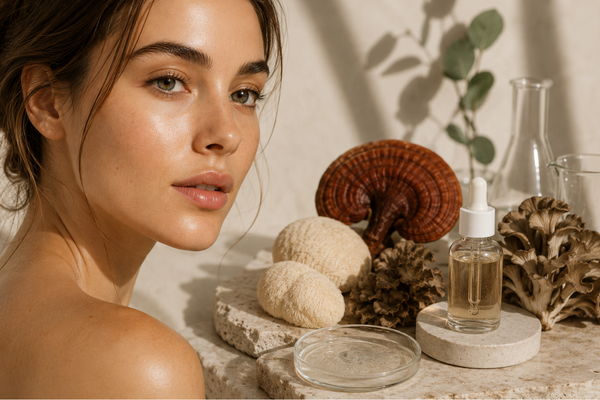
For a few years, the ideal social-media complexion was glossy, smooth, and almost reflective. First Korean glass skin, then glazed skin and the glazed-skin effect: different names for the same very hydrated, very luminous complexion, beautiful in front of a camera.
Now the pendulum swings back. People are talking about cloud skin, or blurred skin: skin that does not reflect light like glass, but diffuses it as a cloud would. Even-toned without being flat, luminous without looking wet.
I am interested in writing about it, but not to announce yet another trend. I am interested because of something I discovered by looking at it closely, something few articles discuss.
Cover image generated with the support of artificial intelligence.
[INDICE:h2]
Cloud skin is not a 2026 trend
The term is attributed to British makeup artist Dominic Skinner, and has been circulating since 2019. In 2021, the French beauty press described it as the trend of the spring. In 2023, it appeared on lists of the year's trends alongside sunburn blush. Today, in 2026, it is being presented as something new.
This is the third time this same idea has been launched as something new in seven years. I am not saying this to belittle it: cloud skin is a sensible idea, and I will get to that. I am saying it because the mechanism is worth understanding. The industry needs a continuous cycle of names, and when one name runs out, an old one is taken, given new packaging, and put back into circulation. Glass skin, glazed skin, dolphin skin, jello skin, buttery skin, cloud skin: underneath, there are four or five ideas, not twenty.
If you have ever felt behind because you were not keeping up with trends, here is the thing: most trends are not waiting for you up ahead. They are circling around you.
The figure that is everywhere, and where it comes from
The same figure appears in many articles about cloud skin: an increase in online searches for870%, with around 724,000 monthly searches.
The figure is real, but it is worth knowing whose figure it is: it comes from an analysis by a commercial salon booking platform, not from an independent research institute or a search engine's public data. That does not mean it is false. It means it is a biased figure, produced by a company that has an interest in highlighting trends, and one that does not appear to have been independently verified. However, it is often repeated as if it were official statistics, sometimes attributed to publications that merely reported it.
It is a small example of how a beauty fact comes into being: a commercial figure, a quotation, a second quotation that loses its source, and at that point it is true because everyone says so.
What cloud skin really is
That said, the underlying idea is good, which is why it keeps coming back.
Glass skin works beautifully in photographs and much less well in real life: on combination skin, in warm weather, after six hours, that luminosity simply becomes shine. Cloud skin seeks a compromise: hydration underneath, selective control of light on top.
It isn’t the matte look of the Nineties, created with full-coverage foundation and lots of powder to eliminate every reflection. Here, the light remains where the face is naturally fuller, on the cheekbones, and is controlled only where it becomes distracting.
There’s one clarification that matters to me, because this is often misunderstood: cloud skin is an optical effect, not a skin condition. Soft-focus products contain particles that diffuse light and reduce the visibility of pores and irregularities. They don’t change the texture: they make it less noticeable to the eye, just as soft light does compared with a focused spotlight. No makeup changes the structure of the skin, and no product should imply otherwise.
How to achieve it without buying anything new
The practical part is simpler than the number of products might suggest.
- A comfortable base. A moisturizer suited to your skin, well absorbed before you continue. Powders settle and become visible on dry areas, so this is where the result is won or lost.
- Light, satin-finish color. A skin tint or lightweight foundation, without aiming for full coverage. Effective cloud skin lets the skin show through.
- Powder only where needed. The center of the forehead, the sides of the nose, and the chin. Not everywhere, or you’ll end up back at matte.
- Soft edges. Blended blush, with no graphic lines. The lips follow the same idea: dabbed-on color and a soft outline.
You don’t need a new routine. In most cases, it’s enough to change the amount you use and where you apply what you already have at home. That’s also why you won’t find recommended products in this article: I don’t believe every trend has to lead to a purchase, and our job is the skin beneath the makeup, not makeup itself.
Who it suits and who it doesn’t
- Combination and oily skin: this is where it works best, because it controls shine without dulling the face.
- Dry skin: it requires more careful preparation and very little powder; otherwise, the texture becomes more pronounced instead of less noticeable.
- Mature skin: a very thin base is best. Powder that settles into expression lines creates the opposite effect to the one intended.
If the skin underneath is dehydrated or the barrier is compromised, no finish can save it: makeup sits poorly and doesn’t last. It’s the boring but true part of the discussion, and it always comes before everything else. If you don’t know where to start, the guiding principle is always your skin type, not the trend of the month.
The boundary between makeup and skincare
The return of cloud skin coincides with the boom in hybrid foundations, presented as makeup and skincare in one. It’s an interesting direction, but it should be considered carefully.
The presence of an active ingredient in the INCI does not indicate the concentration in which it was used, nor what result it produces in the finished product. A foundation can be more comfortable, less drying, and formulated not to damage the skin barrier. It does not replace serum, moisturizer, or sunscreen. Its primary purpose remains to even out the complexion and provide a certain finish, and that’s perfectly fine: just don’t ask it to be something else.
What I like about this trend
Despite everything I’ve written above, I’m rather fond of cloud skin. After years of almost unreal-looking skin, the idea that a well-cared-for complexion doesn’t necessarily have to look wet, filtered, and poreless is a small step forward.
What I especially like is the implicit premise: texture is not a flaw. Pores exist on every skin type, as do imperfections, and spending ten years photographing them away hasn’t made them disappear. A face can be radiant and real at the same time.
It’s fashion, not medicine, and in two years it will have another name. But every now and then, fashion captures a change accurately: today, luxury isn’t looking perfect; it’s having skin that holds up even when viewed up close.
Elisa
Sources for this article
- The data on the increase in searches (870%, approximately 724,000 monthly searches) comes from an analysis by a commercial booking platform for the beauty industry, which was covered by the trade press in spring 2026. It is not an independent measurement.
- The term is attributed to British makeup artist Dominic Skinner; the first mentions in the beauty press date back to 2019, with subsequent coverage in 2021 and 2023.
- Regulation (EC) No. 1223/2009 on cosmetic products.
On the website: Korean glass skin · skin types · the skin’s pH · minimalist routine · what is skincare
15-minute free consultation with the founder
If you want to understand where to start with the skin beneath your makeup, I’m available for a free, personalized consultation.