


[INDICE:h2]
Who has never wanted glass-like skin: smooth, even, and able to reflect light like a mirror? Glass Skin is one of the most viral beauty ideals of recent years, and all it takes is opening Instagram or TikTok to be flooded with faces so smooth they appear translucent.
Its success is easy to explain: it embodies an ideal of "clean" beauty that does not cover with makeup but focuses on skincare. Achieving that result, however, requires consistency, technique, and a good understanding of your skin barrier.
The truth behind those flawless faces is that glass skin is often not a naturally achievable goal: it is the result of editing and filters, not a reflection of the skin's actual health. Chasing it by layering products or using harsh exfoliants can damage the barrier, cause irritation, and accelerate aging.
Let's look at the science behind the glass effect, how to get closer to the result without causing damage, and why it might not be the right choice for you.
What Is Glass Skin
It is an aesthetic ideal that originated in South Korea as part of K-Beauty, involving skin that is smooth, even, and hydrated enough to appear translucent.
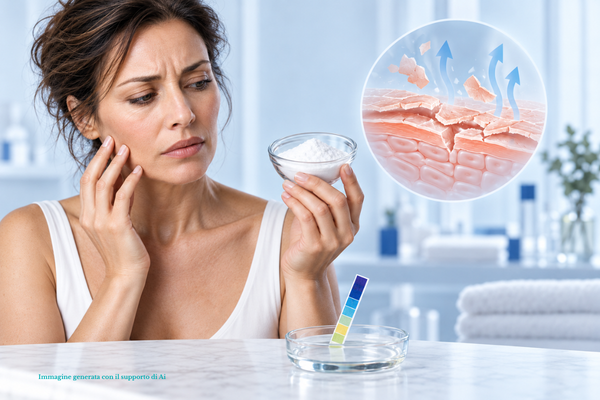
From a physical standpoint, the effect is a play of light reflection: when the stratum corneum is well hydrated and free of irregularities, light is not scattered in every direction but reflected specularly. Hence the "glass-like" appearance.
The Korean Glass Skin routine is a chemistry lesson: the goal is to saturate the epidermis with water to maximize cellular turgidity. It relies heavily on humectants — glycerin, hyaluronic acid, beta-glucan, panthenol — hygroscopic molecules that draw water toward the stratum corneum.
Butter Skin, on the other hand, addresses a different need: a lack of lipids. This is where emollients and occlusives such as shea butter, squalane, or ceramides are needed. They do not add water, but fill the spaces between corneocytes, reducing transepidermal water loss and creating a softer, more satin-like glow.
How It Is Achieved
There is no magic product, but there is a precise technique: layering.
Products are applied in sequence, from the lightest and most watery to the densest and most creamy. The order is not arbitrary: the stratum corneum acts as a semipermeable membrane, and small, hydrophilic molecules penetrate more easily than large, lipophilic ones. Applying an occlusive product first would create a physical barrier that prevents water-soluble active ingredients from working.
However, beware of the excessive occlusive effect: layering more than six or seven products can alter the skin microbiota. In a constantly humid and occluded environment, certain microorganisms proliferate more easily, increasing the risk of perioral dermatitis or folliculitis.
The routine generally starts with double cleansing — an oil cleanser followed by a gentle foaming cleanser — and continues with exfoliation using gentle acids.
Next comes toner or essence, the most characteristic step: it is patted onto the face and can be repeated several times, creating a reservoir of water in the superficial layers. Then comes the serum — often based on niacinamide or fermented extracts — and finally the cream, which seals in the moisture.
The Glass Skin Paradox
There is one point worth understanding clearly: to have a reflective surface like glass, skin must be free of irregularities, which encourages frequent exfoliation. But constantly removing the superficial stratum corneum exposes the immature underlying layers. The result is greater immediate radiance and, at the same time, a barrier that is thinner and more permeable to irritants and microorganisms. The more intensely the effect is pursued, the less sustainable it becomes.
The consequences of over-exfoliation or excessive layering include often silent inflammation and sensitization.
That said, Korean skincare offers useful lessons: consistency, attention to technique, the habit of listening to your skin's needs, and adapting treatments accordingly.
How to Find Your Glow
The sensible goal is not an aesthetic ideal, but skin eubiosis: a state of balance in which the skin is hydrated, the barrier is intact, and radiance is natural rather than forced.
1. Hydrate and Soothe
Hydrated skin reflects light naturally. You need products that nourish and retain moisture without stripping away natural lipids: thermal water, hazelnut oil, and bisabolol extracted from chamomile.

NUTRALIGHT SENSITIVE Soothing face cream for sensitive, redness-prone skin With thermal water from the Piedmont Alps, for sensitive and re... Discover NUTRALIGHT SENSITIVE
2. Cleanse Gently
If you want to try double cleansing, use gentle products that respect the microbiome.

CLEANSING GENTLE OIL Makeup-removing facial cleansing oil non-comedogenic, the first step of double cleansing Dissolves makeup, including... Discover CLEANSING GENTLE OIL

CLEANSING DETOX MOUSSE Makeup-removing facial cleansing mousse Detoxifying, for sensitive skin and all skin types, with Hydromanil®, Red Vin... Discover CLEANSING DETOX MOUSSE
3. Exfoliate, but in Moderation
At most twice a week, with a targeted exfoliant. Mandelic acid is one of the best-tolerated AHAs, here combined with bromelain, papain, and chamomile extract.

MANDELIC ENZYMATIC SOFT PEEL Mandelic Acid and Enzymatic Facial Peel Highly tolerated, gentle exfoliant that stimulates cell turnover. Removes de... Discover MANDELIC ENZYMATIC SOFT PEEL
4. Choose the Right Serum
Some ingredients provide a natural glow. Mullein works through luminescence: it absorbs part of UV radiation and returns it as visible light, producing a measurable brightening effect.

LYCOGLOW SERUM Anti-pollution brightening face serum Brightens dull skin with mullein extract. Lycopene and algae extract: an antio... Discover LYCOGLOW SERUM
Do not underestimate vitamin C, which evens out the complexion and is a powerful antioxidant, especially when stabilized with ferulic acid.

FERULIC + HA SERUM Vitamin C and ferulic acid face serum Antioxidant and tone-evening, with dual hyaluronic acid. Helps prevent dark sp... Discover FERULIC + HA SERUM
Which Products Do You Really Need for Glass Skin
The question we receive most often is which product to buy to achieve the glass effect. The answer is that there is no glass skin cream: the result depends on three functions that must coexist in your routine, not on a single cosmetic product.
- A humectant that draws water into the stratum corneum: glycerin, hyaluronic acid, panthenol, beta-glucan.
- An emollient or lightweight occlusive that retains that water. Without this second layer, in a dry environment, the humectant alone may even worsen dehydration.
- Moderate exfoliation, no more than twice a week, to even out the surface that reflects light.
Essences, pat-on toners, and brightening serums work on top of these three functions, not in place of them. This is why a four-step routine made up of well-chosen products delivers more than a ten-step routine built through imitation.
Do You Really Need a Complete Korean Routine?
No. The number of steps is not an indicator of effectiveness: what matters is covering the three functions and having a routine that is sustainable every day. With oily or combination skin, in fact, reducing occlusive layers is almost always the more sensible choice.
How Long Does It Take to See the Glass Skin Effect?
Surface hydration can be felt within a few days, and this is the part that provides immediate radiance. Even skin texture, on the other hand, follows the timeline of skin renewal: at least four to six weeks. Anyone who changes their routine every two weeks never gets to see the second effect.
In Conclusion
Radiant skin can be achieved without damaging the barrier: simply respect your skin type instead of chasing a result created in post-production.
If you want to understand where to start, you can take our skin type quiz.
Or request a free 15-minute consultation with Elisa Avalle, founder of LeLang Skin Care.