


Every year, toward the end of August, I receive the same message: I found last summer's cream at the bottom of my beach bag; can I still use it? And immediately afterward: what about the sunscreen, the one I opened last year - should I keep it?
These are two questions that seem identical but have opposite answers.
My position, in two lines: for most cosmetics, the PAO is a safety margin, not a threshold beyond which something happens, and a well-preserved product with no signs of alteration can still be used a few weeks late. Not sunscreen. When in doubt, replace it, and this is not a commercial position: the cost of making a mistake is different.
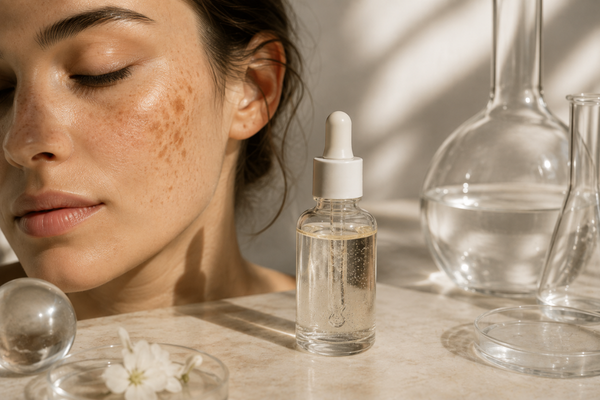
Cover image generated with the support of artificial intelligence.
[INDICE:h2]

Elisa Avalle · Founder and dermocosmetics specialist
We decide the number printed on the open jar, as the people who place the product on the market, based on average conditions of use. Your beach bag, under those average conditions, was not taken into account.
Langhe, August 30, 2026
The PAO is not the expiration date
This is often where the confusion starts, so I'll clear it up right away. The open jar with 6M, 12M, or 24M inside indicates how many months the product remains compliant after first opening. The hourglass with a date indicates how long it remains compliant if you do not open it. They are two different pieces of information, and you almost never find them together.
We explained in detail how that number is established (microbiological testing of the finished product, stability tests, and checking that the formula and container do not damage each other) in the guide to the PAO and cosmetic expiration dates. Here, I'm interested in the part that guide cannot cover: the decision you make in front of the cabinet, with the product in your hand.
The right question isn't how many months, but where it has been
The PAO is calculated assuming reasonable use: a product kept at home, at room temperature, and used by one person. It is an average, and like all averages, it poorly describes edge cases.
Two months in a bedroom drawer and two months in a beach bag are not the same thing. A car parked in the sun in summer can easily exceed sixty degrees inside, and stability tests generally do not cover those conditions. The same applies to the shelf beneath the bathroom window, which is the most common location and one of the worst: high humidity and temperature fluctuations with every shower.
So the first question I ask is not when you opened it. It is where you kept it.
Last year's sunscreen
Here I am changing tack, because the reasoning is different.
If the PAO is 12M and you opened it in June last year, you are already at or beyond the limit according to the calendar. But that is not the only point: that bottle has probably spent weeks in a bag exposed to the sun. Under those conditions, organic filters can degrade and the emulsion can destabilize. The SPF number printed on the packaging refers to the intact product, tested in a laboratory - not to what you are holding now.
“With a moisturizer, a month’s delay is an acceptable risk. With sun protection, it is damage that we then spend years correcting.”
And it is also why we created a pocket-sized single-dose format. The real weak point of sun protection is not the first application, but the second: the one that does not happen because the bottle was left at home. A sachet that fits in your wallet is always freshly opened, so the problem of a bottle that has been open for months simply does not arise.

Face Sunscreen SPF 50 Pocket Size, Travel Size (5 pcs) Pocket-sized SPF 50 facial sunscreen in single doses The problem isn’t applying sunscreen. It’s reapplying it. Smalle... Discover Face Sunscreen SPF 50 Pocket Size, Travel Size (5 pcs)
The container matters more than it seems
If I had to name a single variable that determines how long an opened product really lasts, I would point to the packaging, which people perceive as an aesthetic matter but is, for us, a technical choice.
- Wide-mouth jar: the most exposed option. Fingers go inside, and a large surface comes into contact with the air every time it is opened.
- Tube or bottle with a dispenser: reduced contact, but a little air gets back in with each pump.
- Airless: the formula remains almost completely protected from air, and fingers do not get inside. It is the system that best protects oxidation-prone active ingredients.
- Single-dose: the dose is protected until opening and is used immediately. The problem simply does not arise.
For an exfoliant used twice a week, the choice between airless and single-dose packaging is exactly this: the former protects a formula that remains open for a long time, while the latter prevents both oxidation and contamination from the outset.

MANDELIC ENZYMATIC SOFT PEEL Mandelic Acid and Enzymatic Facial Peel Highly tolerated, gentle exfoliant that stimulates cell turnover. Removes de... Discover MANDELIC ENZYMATIC SOFT PEEL
Which products lose effectiveness before others
Not all formulas age at the same rate, and not all of them become dangerous in the process: many simply stop working.
The textbook case is vitamin C in the form of pure ascorbic acid: when exposed to oxygen, light, and heat, it degrades and turns yellow-orange. A serum that has turned amber isn't dangerous; it simply does much less of what you bought it for: it's a different but equally valid way of being expired. Similar reasoning applies to retinol and plant oils rich in polyunsaturated fatty acids, which go rancid and develop a recognizable pungent odor.
The five signs that matter more than the calendar
If you find even one of them, replace the product regardless of how many months remain.
- The smell has changed: pungent, rancid, or simply different from how you remember it. This is one of the most reliable signs.
- The color has changed: yellow or orange in a clear serum, grayish in a white cream.
- The texture has separated: water on the surface, lumps, or a grainy consistency.
- There are dark spots or haziness: possible fungal contamination.
- Your skin reacts to a product it previously tolerated: stinging or redness from a formula you've used for months without any problems.
And the reverse is also true, which I think is worth saying even if it isn't convenient: a product that has been stored properly, in airless packaging, with its PAO exceeded by two months and none of these signs can, in the vast majority of cases, still be used. The only categories where I wouldn't apply this reasoning are eye contour products, because of the delicacy of the area, and sunscreen, for the reason mentioned above. If a skin reaction persists, that's the time to consult a doctor or pharmacist, not to wait.
What I do, in practice
Four habits, none of which costs anything.
- I write the opening date on the bottom of the package with a marker. Two seconds, and the doubt never comes back.
- I keep my skincare in a bedroom drawer, not in the bathroom.
- I use a small spatula for jars. It's one of the habits that most extends a product's real shelf life.
- I don't carry over sunscreen opened last season into the next one. I make no exceptions on this.
If you have a product in hand and can't decide, at a partner pharmacy or parapharmacy they'll check it for you: scent, color, and texture can be assessed in thirty seconds, and it's a question many people ask at the counter.
15-Minute Free Consultation with the Founder
Have two products open and don't know whether to keep or replace them? Book a free virtual skincare consultation with me: we'll look together at what you have and what your skin really needs.

Elisa Avalle is the founder of LeLang Skin Care, specializing in dermocosmetics at the University of Barcelona. She founded the brand in the Langhe for Italian pharmacies and parapharmacies.
Sources for this article
01 Regulation (EC) No 1223/2009 of the European Parliament and of the Council on cosmetic products, Article 19 (indication of the date of minimum durability and the period after opening beyond 30 months).
02 ISO 11930 standard, evaluation of the antimicrobial protection of a cosmetic product.
03 Commission Regulation (EU) No 655/2013, common criteria for the justification of claims relating to cosmetic products.
On the website: PAO and cosmetic expiration dates · vitamin C · retinol