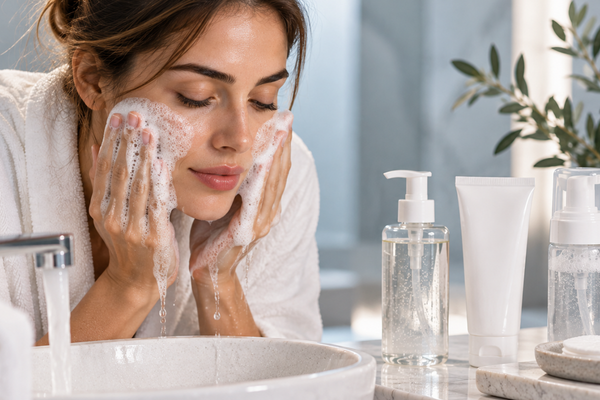


Facial Gua Sha is a flat stone with rounded edges, usually made of jade or rose quartz, that is glided over the face lubricated with oil or serum. Originally a body technique in traditional Chinese medicine, in recent years it has become one of the most filmed beauty practices on social media, often presented as a facelift without a scalpel.
A figure is often cited for this tool that is worth examining, because it clearly shows how incorrect expectations arise: it is widely claimed that Gua Sha increases circulation by 400%. The figure exists and is real, but it does not concern the face. Let us see what the research actually says, and what changes in practice.
Article written by Elisa Avalle, founder of LeLang Skin Care and a dermocosmetics specialist. Cover image generated with the support of artificial intelligence.
[INDICE:h2]
What Gua Sha is and how it works
The name combines two Chinese words: gua, to scrape, and sha, the pinpoint redness that appears on the skin after treatment. In the original body-focused version, the pressure is decidedly vigorous and produces visible petechiae. The cosmetic version for the face is an entirely different thing: light pressure, no intense redness, no bruising.
From a physiological standpoint, it falls among the techniques for mobilizing soft tissue with an instrument. The smooth movement of the rounded edge produces two measurable effects:
- Increased superficial microcirculation: controlled friction dilates the smallest blood vessels and brings more blood to the treated area. That is why the complexion looks more flushed immediately afterward.
- Encouraging fluid drainage: lymph has no pump of its own and moves thanks to muscle contraction and external pressure. A slow movement toward the lymph nodes helps fluids that have accumulated to drain away.
To these we can add a third effect, which is ultimately the most interesting and least discussed: the effect on facial muscle tone.
The famous 400%: where it really comes from
That figure comes from a 2007 pilot study published in the journal Explore, conducted on 11 volunteers using Doppler laser. The treatment was applied to the back, using the vigorous traditional technique that causes petechiae to appear. The fourfold increase in microperfusion was recorded during the first 7.5 minutes; over the full 25-minute observation period, circulation remained significantly higher than at baseline, but not at 400%.
Three clarifications, then. The data concerns the back, not the face. The technique measured was the intense one, not the gentle massage performed on the face. And the two figures, 400% and 25 minutes, belong to different points in the measurement. Anyone combining them into a single sentence is claiming something the study does not say.
What was measured on the face
Specific research on the face exists and is recent. A randomized controlled study published in 2025 in the Journal of Cosmetic Dermatology compared Gua Sha and a facial roller in 34 women between the ages of 20 and 50 over eight weeks, with ten-minute sessions five times a week. Facial contours were recorded with a three-dimensional scanner, muscle tone with a myotonometer, and skin elasticity with a cutometer.
The results are interesting precisely because they are measured, and therefore modest and concrete.
| Parameter | Gua Sha | Facial roller |
|---|---|---|
| Facial contour (surface distances) | 2.2-2.4 mm reduction | 2.8-3.3 mm reduction |
| Masseter muscle tone | significant reduction | no significant change |
| Skin elasticity | no significant change | 7-9% improvement |
The two tools were equivalent for facial contour and definition, and the changes exceeded the 2-millimeter threshold beyond which a change becomes visible to the naked eye. But they got there by different routes: Gua Sha by working on the muscles and deep tissues, and the roller by improving the skin's elastic properties at the surface.
This is the most useful conclusion of the entire article. Gua Sha acts on the muscle, not on the structure of the skin. Anyone who uses it expecting it to replace an anti-aging treatment is asking the tool to do something it does not do.
What it does and does not do
To sum up honestly, facial Gua Sha can reasonably:
- Immediately provide a brighter, more even complexion by increasing microcirculation.
- Help de-puff facial features in the morning by supporting fluid drainage. Useful for those who wake up with a heavy-looking face and under-eye puffiness caused by fluid retention.
- Reduce muscle tension, particularly in the jaw and masseter muscles, where the day’s stress accumulates. This is the area for which the evidence is strongest, and it connects with how emotional tension shows on the face.
- Turn serum application into a slow, relaxing ritual that has value in itself.
What it does not do, and what it is worth being clear about: it does not replace fillers or aesthetic medical treatments, it does not change the bone structure of the jaw, it does not dissolve subcutaneous fat, it does not eliminate significant skin laxity, and it has no detoxifying effect. As for skin elasticity, the 2025 study found no significant changes.
The same logic applies to nasolabial folds: you can work on tension and stagnation around the area, not on the loss of volume that causes them.
How to use it: the correct technique step by step
The most common mistake is using too much force. The rule is light pressure, a low angle, slow movements. In the studio’s standardized protocol, the pressure was described as follows: enough to move the superficial tissue, never enough to cause bruising.
- Prepare the skin. Never use the stone on dry skin: direct friction can cause microtrauma and put stress on the capillaries. First apply an oil or serum that ensures smooth gliding.
- Start with the neck. Glide the concave side upward from the center of the collarbone to the base of the jaw. Three to five passes per side. This helps open the drainage pathways before working on the face.
- Unblock the area beneath the ears. Pause for a few seconds with very light pressure in front of the earlobe, where the lymph nodes converge and where the masseter attaches.
- Jawline. Place the V-shaped notch at the center of the chin and glide along the jawline to the earlobe. This is the most useful step for anyone who clenches their teeth.
- Cheeks and cheekbones. Use the long, flat side of the stone from the corner of the mouth toward the temple, just below the cheekbone.
- Eye area. Use the smaller curve with barely perceptible pressure, moving from the inner corner outward and then toward the temple. The skin here is the thinnest on the face: if you feel any pulling, you’re pressing too hard.
- Forehead. Move from the center toward the temples for horizontal wrinkles, which are caused by the frontalis muscle. The two vertical lines between the eyebrows are different: they are caused by the corrugator muscles and are worked with small movements from the inside toward the outside of the eyebrow. This distinction matters because different wrinkles respond to different movements.
- Finish by moving down the neck again, to guide out what you have mobilized. If you are interested in this area, it is worth extending the motion to the neck and décolleté.
Ten minutes, five times a week: this was the frequency used in the study, and eight weeks was the period over which any effects were measured. Occasional use does not produce the same effects.
When it is best to avoid it
Gua Sha is a mechanical technique and is not suitable for all skin types. The 2025 study excluded eczema, acne in the inflammatory phase, and rosacea, and these are exactly the situations in which it should also be avoided at home.
- Couperose, rosacea, visible capillaries: friction and vasodilation worsen the condition. In these cases, consult a dermatologist before any massage.
- Inflammatory acne: the stone drags the contents of the lesions and spreads the inflammation.
- Very reactive skin or a compromised barrier: if the skin is already struggling, adding mechanical irritation will not help. It is better to restore the barrier first.
- Anticoagulant therapy or capillary fragility: risk of bruising even with light pressure.
- Recent medical-aesthetic treatments: wait for the time period indicated by your doctor.
It is also worth noting that dermatological literature has repeatedly reported that petechiae caused by the body technique may be mistaken for traumatic injuries. On the face, they should not appear when the technique is performed correctly: if they do, the pressure is wrong.
What to apply to the skin beforehand
This is where the massage alone falls short. The stone works on the muscles and circulation; it's the active ingredients applied to the skin that work on the skin. The 2025 study shows this clearly: Gua Sha changed muscle tone but not skin elasticity. That part is up to the formula.
In the evening, on dry or mature skin
You need a lipid-based texture that ensures smooth gliding and nourishes the skin while you work. 5 Complex Night combines prickly pear oil and rice bran oil with vitamin E.

5 COMPLEX NIGHT Elasticizing night facial oil With precious oils offering powerful nourishing benefits Deeply nourishes Helps improv... Discover 5 COMPLEX NIGHT
If the goal is expression lines
The massage releases muscle tension, while peptides work on expression lines. Multi Peptide Lift Formula also contains biotech resveratrol. It's worth distinguishing between an immediate tightening effect and structural firming: they are two different things and work on different timelines.

MULTI PEPTIDE LIFT FORMULA - BOTOXIL TECHNOLOGY Anti-wrinkle face serum with Botoxil Technology® Two biomimetic peptides for expression lines, biotechnological resve... Discover MULTI PEPTIDE LIFT FORMULA - BOTOXIL TECHNOLOGY
In the morning, for radiance
Ferulic + HA Serum combines stabilized vitamin C, ferulic acid and niacinamide to brighten the complexion and reduce the appearance of discoloration. If you're looking for the firm, radiant effect typical of glass skin, this is where to start.

FERULIC + HA SERUM Vitamin C and ferulic acid face serum Antioxidant and tone-evening, with dual hyaluronic acid. Helps prevent dark sp... Discover FERULIC + HA SERUM
Frequently asked questions about facial Gua Sha
How many times a week should you use Gua Sha?
In the study that measured its effects, it was used five times a week for ten minutes over eight weeks. This is a sustainable and realistic frequency. Using it occasionally provides an immediate complexion benefit, but not the benefit to muscle tone.
Does Gua Sha slim the face?
It reduces facial surface distances by about two millimetres, a noticeable but limited change, mainly by acting on muscle tension and fluid retention. It does not reduce fat or alter the bone structure.
Is Gua Sha or a facial roller better?
It depends on the goal. In a direct comparison, Gua Sha acted on muscle tone, while the roller affected skin elasticity, with similar results for the contour. If you clench your teeth or have a tense jaw, choose Gua Sha. If you are looking for superficial firmness, choose the roller.
Can Gua Sha be used with couperose?
It is not recommended. Friction and vasodilation tend to worsen redness and visible capillaries. Couperose and rosacea require a dermatological evaluation and a different approach.
Should Gua Sha be used in the morning or evening?
In the morning if the goal is to reduce puffiness, in the evening if it is to release accumulated tension and promote relaxation. In the evening, it pairs better with a rich texture.
In conclusion
Facial Gua Sha is neither a miracle nor an empty trend. It is a mechanical technique with real, measurable effects, mainly concerning muscle tone and fluid retention, which become visible with consistency, not in a single session. What it does not do is improve the quality of the skin tissue: that part is left to active ingredients, and the two approaches work together.
You can also find LeLang products at partner pharmacies and parapharmacies throughout Italy.
Sources for this article
- S. Ahn, U. Hwang, H. Han et al., Comparative Effects of Facial Roller and Gua Sha Massage on Facial Contour, Muscle Tone, and Skin Elasticity: Randomized Controlled Trial, Journal of Cosmetic Dermatology, vol. 24, no. 6, 2025.
- A. Nielsen, N. Knoblauch, G. Dobos, A. Michalsen, T. Kaptchuk, The Effect of Gua Sha Treatment on the Microcirculation of Surface Tissue: A Pilot Study in Healthy Subjects, Explore, vol. 3, no. 5, 2007, pp. 456-466.
- A. Hamp, J. Anderson, M. R. Laughter et al., Gua-Sha, Jade Roller, and Facial Massage: Are There Benefits Within Dermatology?, Journal of Cosmetic Dermatology, vol. 22, no. 2, 2023, pp. 700-703.
- T. Marion, K. Cao, J. Roman, Gua Sha, or Coining Therapy, JAMA Dermatology, vol. 154, no. 7, 2018, p. 788.
On the website: expression lines and static wrinkles · immediate lifting effect · glass skin · eye contour
Free 15-minute consultation with the founder
If you want to understand which active ingredients to pair with your Gua Sha massage, Elisa Avalle, founder of LeLang, is available for a personalized, free consultation.