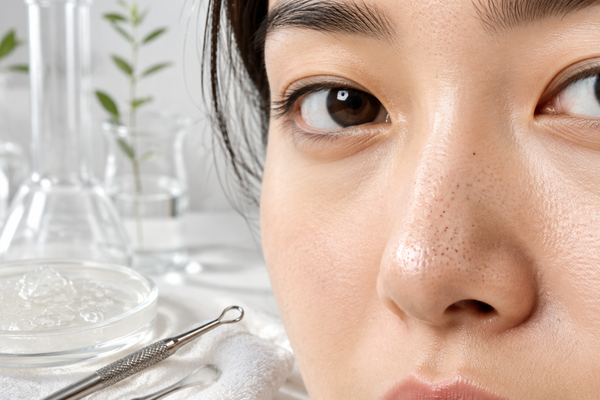



Male skin produces more sebum than female skin and has generally larger pores. This is not a defect to correct, but a structural characteristic linked to androgens, which stimulate the activity of the sebaceous glands.
The mistake almost everyone makes is treating it as something to eliminate. Stripping oily skin makes it oilier: when too much of the hydrolipidic film is removed, the sebaceous gland compensates. Controlling sebum means regulating it, not removing it.
[INDICE:h2]
Oily skin does not mean acne
This is the first distinction to make, because the two conditions require different strategies.
Oily skin becomes shiny within a few hours of cleansing, has visible pores in the central area of the face, tends to develop blackheads, and tolerates products well. It has no inflamed lesions.
Acne-prone skin has papules, pustules, lesions that hurt to the touch, and marks they leave behind. It is an inflammatory condition that requires specific active ingredients and, in moderate or severe cases, a dermatologist. If this is the case, the recommended approach is described in acne and oily skin in men.
This article focuses on the first case: abundant sebum, shine, visible pores, and blackheads, with no active inflammation. It is the most common situation and, paradoxically, the one most often treated incorrectly, because it is addressed with products designed for acne.
Why male skin produces more
Three structural differences explain almost everything.
Testosterone and its derivatives directly stimulate the sebaceous gland. Male skin produces more sebum, and this remains stable for much longer throughout life, whereas sebum production in female skin declines more significantly after the age of forty.
Skin thickness is generally greater, with a collagen-rich dermis. This is an advantage when it comes to aging, but less so for skin texture: a thicker stratum corneum retains dead cells more readily, and pores become clogged more easily.
Shaving is a daily form of mechanical exfoliation. It removes surface cells, but also disrupts the hydrolipidic film and puts the skin in a state of constant repair. If shaving causes problems, the solution is covered in sensitive skin after shaving.
The overall differences between male and female skin are covered in the practical guide to men's skincare.
The minimal routine that really works
Four steps, three of them daily. Adding more does not achieve better results; it only leaves your skin more confused.
Cleansing, twice a day. Morning and evening, with a cleanser that removes excess sebum without stripping it completely. The difference between a good cleanser and an aggressive one is immediately noticeable: if your skin feels tight after rinsing, the product is causing damage even if it seems clean at first. The water should be lukewarm, never hot.
Light moisturizer, every day. This is the step most often skipped, based on the belief that oily skin does not need it. Sebum and water are different things: skin can be shiny and dehydrated at the same time, in which case it produces even more sebum to compensate. You need a lightweight, water-based texture that absorbs quickly.
Sun protection, in the morning. It is non-negotiable and not seasonal. Today, fluid, mattifying formulas are available that do not leave a shiny finish.
Exfoliation, once or twice a week. This is the step that truly acts on pores and blackheads—and the one people most often overdo.

CLEANSING DETOX MOUSSE Detoxifying facial cleansing mousse Remove makeup and any trace of impurities Respect the skin's balance Brightens a... Discover CLEANSING DETOX MOUSSE
“Oily skin does not need to be dried out. It needs to stop being attacked four times a day.”
The actives that matter
For oily skin without acne, the useful ingredient families are few and well established.
- Niacinamide. It is the active ingredient with the best balance of effectiveness against sebum and tolerability. It acts on surface lipids while improving barrier function at the same time—which is exactly what this type of skin needs. Details are available in what niacinamide is.
- Salicylic acid. Oil-soluble, it enters the pore and dissolves its contents. It is the go-to beta hydroxy acid for blackheads and clogged pores: learn more in the article on salicylic acid.
- Zinc and derivatives. Useful for regulating sebum production and associated redness: see zinc for oily, acne-prone skin.
- Clay. It works through absorption and is the easiest weekly step to add, as described in green clay for the face.
What is not useful instead: highly concentrated denatured alcohol, traditional solid soaps with an alkaline pH, and anything that promises an immediate mattifying effect by working only on surface absorption without addressing the cause.

SKINPURE REBALANCE Purifying Green Clay face mask for oily and impure skin based on Potassium Azeloyl Diglycinate, Zinc PCA, Green Clay... Discover SKINPURE REBALANCE
Pores and blackheads: what can be achieved
This should be stated clearly, because many illusions are sold around this topic: pore diameter is anatomical and does not shrink. No cosmetic product can permanently tighten it.
What changes is how full it is. A pore clogged with oxidized sebum and dead skin cells appears larger because its contents dilate it and cast more shadow. Emptying it makes it less visible, and that is a real, verifiable result. But it is a maintenance result: if you stop, the pore fills up again.
For exfoliation, the most sensible choice for at-home use is an enzymatic peel, which works selectively and does not require mechanical pressure. Anyone who shaves every day is already getting a certain amount of daily exfoliation and can limit it to once every ten days.
If the skin is oily but dull, thick, and covered in blackheads that do not go away, the condition could be the one described as asphyxiated skin.

Elisa's note
Men who come in for a consultation with oily skin almost always have two products: a very harsh cleanser and nothing else. Removing the harsh cleanser and adding a lightweight moisturizer changes the result in three weeks and costs less than what they were already doing.
The mistakes that keep the problem going
- Washing your face more than twice a day. Each excessive cleanse signals the gland to compensate.
- Skipping moisturizer. Dehydration is one of the factors that increases sebum production.
- Using hot water. It dissolves the remaining lipids and leaves the surface unprotected.
- Exfoliating every day. The result is a weakened barrier and skin that becomes oily and sensitive at the same time—the worst combination.
- Squeezing blackheads. It causes inflammation and, on skin that pigments easily, leaves marks that remain for months.
- Changing products every two weeks. Skin turnover takes about twenty-eight days: before four weeks have passed, you're not evaluating anything.
For response times and how often to perform each step, see men's skincare: how many times a day.
Frequently asked questions
Is a specific cleanser enough?
No. A specific cleanser controls shine temporarily, but without hydration and a sebum-regulating active ingredient, production remains unchanged.
Are blotting papers useful?
They're a temporary cosmetic solution, useful during the day. They don't alter sebum production and don't replace anything.
Does oily skin age more slowly?
It tends to show fine lines later because the lipid film protects against surface dehydration. There is no advantage when it comes to deeper tissue sagging.
Is it better to shave before or after cleansing?
Afterward. Cleansed, softened skin offers less resistance to the blade, reducing the risk of folliculitis.
Is a toner necessary?
It's not essential. If you use one, it should be free of high concentrations of denatured alcohol: the immediate astringent effect is followed by compensatory sebum production.
Does diet have an impact?
Some evidence links high-glycemic-index diets to increased sebaceous activity, but the individual impact varies greatly. It's a factor to consider, not the main cause.
Sources for this article
01 Regulation (EC) No 1223/2009 on cosmetic products
02 Commission Regulation (EU) No 655/2013 on common criteria for cosmetic product claims
03 Dermatological literature on differences in skin thickness, collagen density, and sebum production between men's and women's skin
04 Documentation on the androgenic regulation of sebaceous gland activity
On the website: men's skincare · acne and oily men's skin · facial enzyme peel · niacinamide