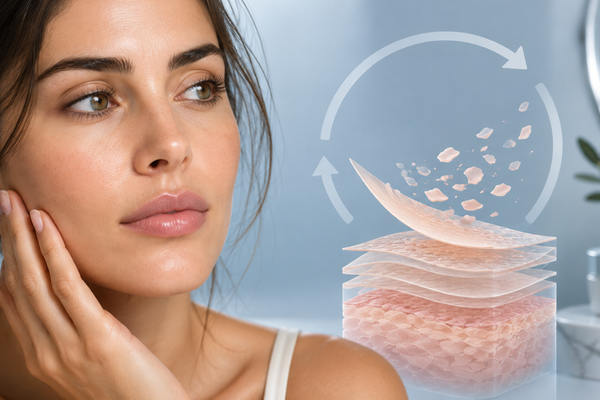



Asphyxiated skin means skin that “cannot breathe”: the pores are clogged with oxidized sebum and dead cells, to the point of blocking normal renewal. The result is a paradox — the face looks shiny and greasy but at the same time feels rough and dry on the surface, with an uneven texture and a dull complexion.
In a nutshell: it is not a skin type in its own right, but a complication of combination or oily skin that has become congested. That is why treating it with degreasing products makes the situation worse instead of solving it: the surface is dry from lack of water, not lacking sebum.
It is a confusing condition because it seems to require two opposite things at once. Let’s see how to recognize it, why it develops, and how to build a routine that restores its balance.
[INDICE:h2]
What it looks like and how it develops
Asphyxiated skin is skin that cannot breathe. It is not just a figure of speech: the pores are so congested that they hinder normal renewal. The result is skin that looks shiny because of trapped sebum, yet feels tight and is flaky on the surface because the hydrolipidic film is compromised.
The heart of the problem lies in the pores. Here, sebum, composed of various lipids including squalene, is altered by UV rays, smog, and free radicals.
When squalene oxidizes on contact with oxygen, lipid peroxidation occurs: it transforms into squalene peroxide, a comedogenic molecule that further clogs the pores. This is why pollution worsens this condition so noticeably: more oxidation means more clogs.
Meanwhile, corneocytes accumulate on the surface, creating a layer that hinders renewal and alters the skin microbiome.
Where does the word come from
"Asphyxiated" derives from the Greek asphyxia, meaning lack of breath, and is the same word used figuratively in Italian for an enclosed environment without air circulation. Applied to skin, it indicates exactly this: tissue in which exchange with the outside is blocked.
It is a term from the Italian and French aesthetic tradition, not a category in international dermatology. In English, there is no exact equivalent: people refer to congested skin or, more precisely, dehydrated oily skin. It is useful to know this if you happen to read English-language sources and cannot find the term.
How to tell if you have asphyxiated skin
The term is often used incorrectly. However, there are fairly precise signs: the more boxes you tick, the more likely this is your skin condition.
- The face looks shiny yet dull at the same time: greasy to the touch, but lacking radiance.
- After cleansing, the skin feels tight, even though it is oily.
- The skin texture is uneven: running your fingers over it, you can feel tiny bumps, especially on the cheeks and chin.
- There are many closed comedones—those flesh-colored bumps beneath the skin—rather than open blackheads.
- Foundation settles unevenly and tends to emphasize rough areas.
- Products seem to remain on the surface without absorbing.
Be careful not to confuse the two: asphyxiated skin is often oily yet dehydrated. A sensation of dryness on the surface does not indicate a lack of lipids, but a lack of water. This is why treating it with degreasing products is counterproductive. The difference is explained in the article on dry or dehydrated skin.
The causes
- Unsuitable cosmetics: overly occlusive creams on combination skin, or harsh cleansers that trigger reactive seborrhea.
- Pollution and smoking: fine particulate matter accelerates the oxidation of epidermal fatty acids.
- Internal factors: androgen-related hormonal imbalances, stress, and a diet rich in refined sugars.
- Nutritional deficiencies: a lack of B vitamins and omega-3, -6, and -9 fatty acids weakens the barrier function.
If the skin also has recurring blemishes, the guide to a routine for oily skin and enlarged pores may be helpful.
Remedies
Treating this condition requires a strategy of subtraction: removing obstacles without being harsh.
1. Deep yet gentle cleansing
The first step is to unclog the pores. Cleansing Active Mousse contains salicylic acid, a fat-soluble beta hydroxy acid that can penetrate the pore and dissolve the waxy plug, along with tea tree oil and betaine.

CLEANSING ACTIVE MOUSSE Purifying face cleansing mousse anti-imperfections Reduce enlarged pores Purifies the skin from impurities Improves ... Discover CLEANSING ACTIVE MOUSSE
2. Regular exfoliation
This is the decisive step for this condition: if the problem is a buildup of corneocytes, one or two treatments a week are needed to promote cell turnover. An enzymatic or mandelic acid exfoliant is preferable to a physical scrub, which can increase inflammation in already congested skin.

MANDELIC ENZYMATIC SOFT PEEL Delicate face scrub of high tolerance, stimulates cell turnover Cell turnover stimulation Regenerating action Fades ... Discover MANDELIC ENZYMATIC SOFT PEEL
3. Sebum-regulating treatment
Acnerebal Serum harnesses the synergy between salicylic acid and niacinamide, with Zincidone controlling sebum production and supporting the skin barrier.

ACNEREBAL SERUM Sebum-normalizing serum and reduction of enlarged pores based on Salicylic Acid, Zincidone, Niacinamide Reduce enlar... Discover ACNEREBAL SERUM
4. Non-comedogenic hydration
It should never be skipped. For young or blemish-prone skin, Acnerebal Cream contains azeloglycine, which treats blemishes and evens out the complexion.

ACNEREBAL CREAM Sebum-normalizing, evening and mattifying cream based on Azeloglicina®, Zincidone®, Niacinamide Reduces sebum produc... Discover ACNEREBAL CREAM
For mature or dull skin, Elyx Performance combines snail slime and rosehip oil, renewing the texture without clogging pores.

ELYX PERFORMANCE Multifunctional regenerating face cream Regenerates tissues Stimulates collagen production Illuminate and even out t... Discover ELYX PERFORMANCE
5. Weekly purifying treatment
A clay mask absorbs excess sebum and refines the texture, making it especially useful when congestion is more pronounced.

SKINPURE REBALANCE Purifying Green Clay face mask for oily and impure skin based on Potassium Azeloyl Diglycinate, Zinc PCA, Green Clay... Discover SKINPURE REBALANCE
6. Antioxidant protection
Since the underlying mechanism is squalene oxidation, daily sun protection is not an accessory: it is part of the treatment.

SPOT DEFENCE 50 SPF Anti-spot face sunscreen serum SPF 50 with encapsulated vitamin C and probiotic ferments for skin with discolorations... Discover SPOT DEFENCE 50 SPF
The routine at a glance
| Step | Product | Action |
|---|---|---|
| Cleansing | Cleansing Active Mousse | Purifying, with salicylic acid |
| Exfoliation (1–2 times a week) | Mandelic Enzimatic Soft Peel | Promotes cell turnover |
| Serum | Acnerebal Serum | Sebum-regulating, with zinc |
| Face cream | Acnerebal Cream or Elyx Performance | Moisturizing or regenerating |
| Mask (weekly) | SkinPure Rebalance | Purifying and mattifying |
| Protection | Spot Defence 50 SPF | Antioxidant and photoprotective |
Frequently asked questions
What does “congested skin” mean?
It refers to skin whose pores are congested with oxidized sebum and dead skin cells, to the point of hindering normal cell turnover. The result is a mixed condition: a shiny, oily surface that is simultaneously dry to the touch, with uneven texture and a dull complexion. It is not a skin type in its own right, but a complication of combination or oily skin.
What is the difference between oily and congested skin?
Oily skin produces a lot of sebum but expels it regularly: it looks shiny, feels soft to the touch, has visible pores, and often open blackheads. Congested skin is oily skin in which that sebum has become trapped and oxidized: roughness, closed comedones beneath the skin, and a dull complexion are added to the shine. In practice, all congested skin starts as oily or combination skin, but not all oily skin becomes congested.
How can I tell if I have congested skin?
The three most telling signs occur together: the face looks shiny but dull, the skin feels tight after cleansing despite being oily, and the texture feels rough to the touch with many closed comedones. If foundation settles in patches and products seem not to absorb, the picture is fairly typical.
How do you treat congested skin?
With a three-step strategy: clear the pores with salicylic acid, encourage renewal with gentle exfoliation once or twice a week, and rehydrate without occluding the skin. Results generally appear after four to six weeks of consistency. The most common mistake is using harsh, degreasing cleansers, which trigger compensatory sebum production.
Which products are needed for asphyxiated skin?
Four, no more: a salicylic acid cleanser that penetrates the pore, a gentle exfoliant—enzymatic or with mandelic acid—to use once or twice a week, a sebum-regulating serum with niacinamide or zinc, and a non-comedogenic moisturizer. Avoid: coarse-grained scrubs, harsh foaming cleansers, and very rich creams. The rule is to remove obstacles, not add layers.
Is asphyxiated skin the same thing as acne?
No, although they can coexist. Asphyxiated skin is a congested condition characterized mainly by closed comedones; acne is an inflammatory condition involving papules and pustules. If inflamed or painful lesions are present, consult a dermatologist.
Are asphyxiated skin and dull skin the same thing?
No. A dull complexion is a symptom, and asphyxiated skin is one possible cause—the one in which dullness results from the buildup of corneocytes and oxidized sebum. But skin can also appear dull without any congestion, due to dehydration, slowed cell turnover, or oxidative stress: the other causes and corresponding remedies are covered in the article dedicated to dull skin.
A journey of consistency
Asphyxiated skin does not return to balance in a week: it requires time and a simplified but rigorous routine. In addition to cosmetics, water intake and essential nutrients also matter.
You can also find LeLang products at partner pharmacies throughout Italy.
15-minute free consultation with the founder
Unsure about your skin type or how to build the right routine? Book a free virtual skincare consultation with Elisa Avalle, founder of LeLang.