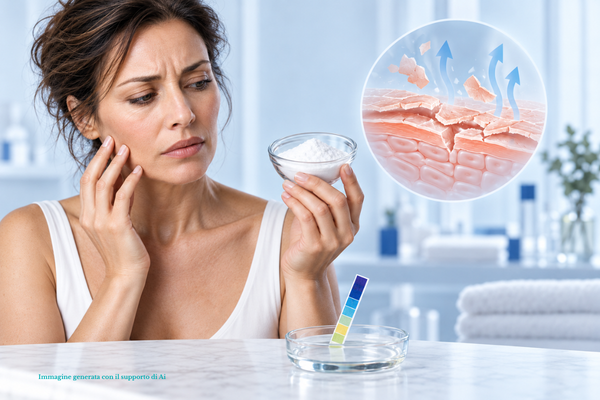



Dry skin is an uncomfortable condition: the skin feels tight, looks dull, and tends to flake. You have probably already tried remedies based on hyaluronic acid or glycerin.
There is, however, an ingredient capable of restoring the skin's balance with particular precision: urea. Often underestimated, it is one of the pillars of modern dermatology - and it is not a foreign ingredient, because the skin already produces it.
The factor that changes everything, and that almost no label explains: urea does not have just one function. Below 10% it hydrates; above 10% it exfoliates. It is the same molecule, but the percentage determines what it does - and this is why a heel cream is not used on the face.
[INDICE:h2]
What is urea and why does the skin recognize it
Urea is a natural component of the epidermis and makes up around 7% of the NMF (Natural Moisturizing Factor), the complex of substances that keeps the skin soft, supple, and intact.
In cosmetics, a biomimetic synthetic version is used, identical to the one produced by the body. Its effectiveness lies in its hygroscopic nature: it works like a magnet for water, capturing and retaining it in the stratum corneum - the outermost layer of the epidermis - limiting its evaporation.
When the skin is dry or affected by xerosis, its natural urea concentration drops dramatically. Replenishing it topically means restoring a capability the skin already had. If you want to understand where the stratum corneum fits into the overall architecture, find it in the guide to how the skin is made.
One molecule, three actions: a matter of concentrations
- From 2% to 10%: it acts as a pure moisturizer. Suitable for the face and body, for daily use, it restores water levels without being harsh.
- Above 10%: the keratolytic properties begin to appear. Urea dissolves the bonds between dead cells, promoting gentle yet effective exfoliation.
- Around 30% and above: this is the range for treating very thickened areas - heels, elbows, knees - where the keratolytic action is the main goal.
The benefits for dry and sensitive skin
Why choose a product with urea instead of a generic moisturizer? Because urea does more than relieve the feeling of dryness: it works on three levels.
Long-lasting hydration. Increases the skin's ability to bind water, providing immediate and prolonged relief from the feeling of tight skin.
Barrier support. A review published in Dermatology and Therapy in 2021 documented that urea contributes to regulating gene expression in keratinocytes, which is involved in their differentiation and the production of antimicrobial peptides: it therefore strengthens the skin barrier indirectly as well, not only by retaining water.
Gentle renewal. Its keratolytic action removes dead cells without being harsh, leaving the surface smoother and more receptive to subsequent treatments.
One clarification applies to all percentages: urea in a cosmetic product improves the hydration, softness and appearance of dry or rough skin. Conditions such as psoriasis, ichthyosis or atopic dermatitis are dermatological conditions: urea is still used for them, but on a doctor's recommendation and in products other than an over-the-counter cream.
LeLang's biomimetic alternatives
Urea is an excellent ingredient, but it is not the only way to achieve the same result. In LeLang formulas, we target the same biological goals — barrier restoration and support for cell turnover — through synergies between different active ingredients.
For hydration
The FeruliC + HA serum combines hyaluronic acid and arginine with the antioxidant action of vitamin C, vitamin E and ferulic acid.

FERULIC + HA SERUM Vitamin C and ferulic acid face serum Antioxidant and tone-evening, with dual hyaluronic acid. Helps prevent dark sp... Discover FERULIC + HA SERUM
For sealing and repairing
Where urea retains water, ceramides and shea butter work on the lipid component, reducing transepidermal water loss.

ALBA Firming, toning face cream Collagen stimulator. Firms skin in two weeks (instrumental efficacy test) Improves even d... Discover ALBA
For renewal
If you are looking for the smoothing effect typical of high concentrations of urea, the gentler alternative is mandelic acid. Unlike urea, which can sting inflamed skin at high percentages, mandelic acid exfoliates without irritation.

MANDELIC ENZYMATIC SOFT PEEL Mandelic Acid and Enzymatic Facial Peel Highly tolerated, gentle exfoliant that stimulates cell turnover. Removes de... Discover MANDELIC ENZYMATIC SOFT PEEL
For overnight regeneration
A serum based on plant oils supports the lipid component overnight, when the skin is more active in renewal. Alternatively, formulas based on niacinamide, which supports the production of ceramides and strengthens the barrier.

5 COMPLEX NIGHT Elasticizing night facial oil With precious oils offering powerful nourishing benefits Deeply nourishes Helps improv... Discover 5 COMPLEX NIGHT

NUTRALIGHT SENSITIVE Soothing face cream for sensitive, redness-prone skin With thermal water from the Piedmont Alps, for sensitive and re... Discover NUTRALIGHT SENSITIVE
Frequently asked questions
What percentage of urea is needed for the face?
Between 2% and 5% for daily use, up to 10% if the skin is very dry and rough. Above that threshold, urea becomes keratolytic: it makes sense on the body, but on the face it may be excessive and sting. The practical problem is that the percentage almost never appears on the label, unless the manufacturer chooses to disclose it: if it is not stated, the product's intended use is the best clue.
How is urea identified in the INCI?
It simply appears as Urea. The synonym Carbamide refers to the same molecule. Its position in the list gives an approximate indication of the amount: if it appears among the first five or six ingredients, the concentration is probably high; if it appears near the end, it is low.
Can the skin's urea levels be increased without applying urea?
Partly, yes, and this is a little-known point. A study published in Der Hautarzt in 2004 observed that applying 2.5% arginine hydrochloride for four weeks increases the concentration of urea in the stratum corneum: the body synthesizes urea from arginine, so providing the precursor is an indirect way to correct the deficiency. It does not replace a urea cream when a keratolytic action is needed, but it explains why formulas that do not list urea on the label may still improve hydration.
Urea or hyaluronic acid: what is the difference?
Both are humectants, but they do not do the same thing. Hyaluronic acid attracts and retains water, and that is all: it is a pure hydrator, but in a dry environment it can release that water if nothing is applied over it. Urea hydrates and, at higher concentrations, also acts on flaking, thus improving roughness that hyaluronic acid does not address. On skin that is both dry and rough, urea covers both needs.
Can urea burn or sting?
Yes, and that does not necessarily mean the product is unsuitable. The stinging occurs mainly at high concentrations and on chapped or micro-injured skin, where the molecule penetrates more quickly. Brief tingling is normal; burning that persists is not, and in that case rinse it off and discontinue use. On very reactive skin, it is best to start with low percentages and increase gradually.
Can urea be used every day?
At moisturizing concentrations, yes, morning and evening, like any cream. Keratolytic formulas above 10% are different: they are used in cycles, on the areas that need them, and not habitually over the entire body.
Can urea be used during pregnancy?
For topical use, urea is one of the ingredients that can continue to be used without particular reservations, and it is often a convenient choice during a phase when the skin tends to become drier and more reactive. As always during pregnancy, if using high-concentration products or applying them to large areas, it is worth mentioning this to your gynecologist.
Urea and exfoliating acids together?
It is best not to layer them in the same application if the urea is at a keratolytic concentration: the two actions would target the same thing. Below 10%, however, urea is a moisturizer and works well with acids, niacinamide, and retinoids — in fact, it improves their tolerability.
In conclusion
Whether you choose urea or a biomimetic alternative, what matters is listening to your skin's signals: dryness is not just a cosmetic concern, but a cry for help from a struggling barrier.
If you want to understand whether your skin is dry or dehydrated — two different conditions that require different responses — the dedicated article explains how to tell them apart.
You can also find LeLang products at partner pharmacies and parapharmacies throughout Italy.
Sources for this article
01 Piquero-Casals J., Morgado-Carrasco D., Granger C., Trullàs C., Jesús-Silva A., Krutmann J. — Urea in Dermatology: A Review of its Emollient, Moisturizing, Keratolytic, Skin Barrier Enhancing and Antimicrobial Properties, Dermatology and Therapy, vol. 11, no. 6, 2021, pp. 1905-1915.
02 Nenoff P. et al. — study on the topical application of 2.5% arginine hydrochloride and the increase in urea content in the stratum corneum, Der Hautarzt, 2004.
03 Regulation (EC) No 1223/2009 of the European Parliament and of the Council on cosmetic products.
04 Commission Regulation (EU) No 655/2013, common criteria for the justification of claims relating to cosmetic products.
On the website: dry or dehydrated skin · the skin barrier · arginine · mandelic acid · how the skin is structured.
15-Minute Free Consultation with the Founder
Want to understand what concentration of urea or which alternative your skin needs? Book a free virtual skincare consultation with Elisa Avalle, founder of LeLang.