


If you think of your skin as merely a surface to treat, or worse, an enemy to fight, it is worth changing your perspective. The skin is a living, dynamic, and intelligent organ: it changes over time, reacts to stimuli, and needs consistent care. It is what stands between you and the world, which is why it should be understood before it is treated.
In this guide, you will find everything you need to understand how the skin is structured, how it works, and how to care for it: from anatomical foundations to the pro-age philosophy. If instead you are looking for practical basics—what steps are needed and in what order—the starting point is the article on skincare: what it means and where to start.
[INDICE:h2]
A complex organ, not just a surface
The skin is the largest organ in the human body. It performs essential functions: mechanical and chemical protection, temperature regulation, hydration, sensory perception, and immune defense. It is not a static covering, but a tissue that renews itself, adapts, and communicates with the rest of the body.
Skin varies depending on the area: it is thicker on the hands and feet, finer on the face, and extremely thin around the eyes. That is why every routine should take these structural differences into account—and why a face cream is not suitable for the eye area.
Not all skin is the same, and each skin type should be treated specifically. Having one skin type rather than another depends on genetics, lifestyle, and hormonal balance: we discuss this in the article on different skin types.
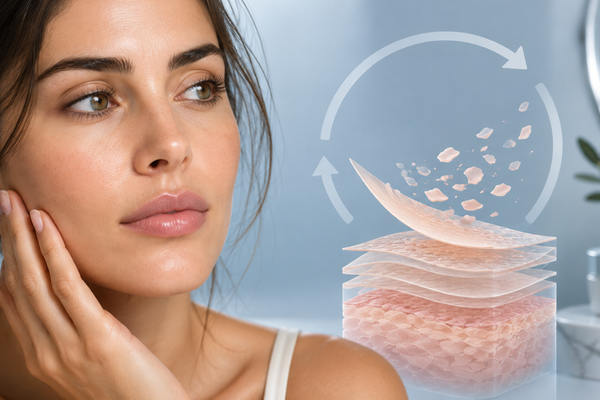
How it is structured: epidermis, dermis, and hypodermis
The epidermis: the barrier that protects
The outermost layer is the epidermis. This is where the skin barrier is found—the structure that keeps water in and external agents out.
Imagine it as a wall: the bricks are the cells of the stratum corneum, while the cement is a lipid matrix made up of ceramides, fatty acids, and cholesterol. When the barrier is intact, the skin retains water effectively; when it is compromised, it becomes dry, rough, and more sensitive.
The dermis: the structure that supports
Beneath the epidermis is the dermis, where the proteins that provide structure are found: collagen, which provides strength, and elastin, which allows the skin to return to its original shape. Hyaluronic acid is also found here, along with fibroblasts, the cells that produce all three of these substances.
The dermis also contains blood vessels and nerves. This is where loss of firmness develops when collagen and elastin production decreases: it is not an error, but a physiological process.
The hypodermis: the cushion
The deepest layer, composed mainly of fatty tissue, protects against impacts and pressure, serves as an energy reserve, and regulates temperature. Fat distribution changes over time and with hormones, contributing to the changes we observe in the face.
The fourth layer almost no one talks about: the epicutaneous mantle
There are three layers, but the final boundary with the outside world is not the stratum corneum. Above it is an extremely thin film, the epicutaneous mantle, and that is what we actually touch when we run a hand over our face.
It is a water-in-oil emulsion made from materials of different origins. The aqueous phase is sweat—99% water, with dissolved mineral salts, urea, amino acids, lactic acid, citric acid, and urocanic acid. The fatty phase comes from two sources that should not be confused: sebum produced by the sebaceous glands, and epidermal cholesterol, released by keratinocytes as they move toward the surface.
This second source explains something that causes a great deal of confusion in cosmetics: cholesterol sulfate regulates desquamation. It is not residue; it is a signal that determines when corneocytes detach. Skin that sheds does not necessarily need more fat on the surface: it may have a problem with controlling cell detachment, which is something entirely different.
Why does the pH return to normal on its own after using soap?
The water-soluble substances in the mantle — especially the organic acids — give it a pH between 5 and 6 and, above all, a strong buffering capacity. This is why, after using an alkaline cleanser, the skin quickly returns to its usual values: it defends itself without needing products that “rebalance the pH.” The complete picture is in the article on skin pH.
The real damage is something else. A highly degreasing cleanser does not alter the pH permanently: it removes the oil-soluble fraction of the mantle, and without it the stratum corneum is left exposed. That is what causes the tight-skin sensation and flaking after a shower. Under normal conditions, it rebuilds itself in a short time; if this happens every day, it does not have time to.
There is also one function that almost no one associates with this film: the urocanic acid contained in sweat absorbs some ultraviolet radiation. A minimal defense that in no way replaces sunscreen, but that reveals something about how the skin protects itself — and what improper cleansing washes away.
The functions of the skin
- Defense: it protects against mechanical agents, chemicals, microorganisms, and UV rays. The skin microbiota lives on the surface and helps keep the barrier strong.
- Hydration balance: healthy skin keeps transepidermal water loss low. When the barrier is damaged, it becomes dry and flaky.
- Thermoregulation: through vasodilation, vasoconstriction, and sweating.
- Sensory perception: receptors that perceive touch, pressure, temperature, and pain. This is also why the sensory experience of a cosmetic is not a secondary detail: it influences how consistently we use it.
- pH balance: the acid mantle, between 4.5 and 5.5, inhibits the proliferation of pathogens.
The skin barrier: the starting point
If the skin is a complex organ, its barrier is the starting point. A healthy barrier maintains hydration, reduces reactivity and sensitivity, and allows active ingredients to work better without causing irritation.
That is why every routine should begin by respecting the skin barrier: gentle cleansers, non-aggressive formulations, and supportive ingredients such as ceramides, physiological lipids, niacinamide, and hyaluronic acid. Caring for the skin does not simply mean adding active ingredients; first and foremost, it means preserving what already works.
How it changes over time: the pro-aging philosophy
Over the course of life, collagen and elastin production decreases, hyaluronic acid levels decline, and fibroblasts become less active. These are physiological processes, not flaws.
Some factors, however, accelerate it: unprotected sun exposure, pollution, stress, insufficient sleep, and overly harsh products. Cumulative damage from UV rays, photoaging, causes more pronounced wrinkles, loss of firmness, and uneven skin tone.
Sun protection is the preventive measure with the strongest evidence: it blocks the cumulative damage that accelerates collagen loss and promotes blemishes. It is not optional; it is the foundation of any pro-aging routine.
While anti-aging treats wrinkles and blemishes as flaws to eliminate, the pro-aging approach accepts aging as a natural process and supports it with realistic goals: supporting the skin barrier and hydration, using active ingredients that improve skin quality, and adapting the routine to age.
Menopausal skin
There is a time when the skin changes particularly noticeably: menopause. The reduction in estrogen leads to lower collagen and elastin production, a decrease in hyaluronic acid, and drier, more reactive skin.
It is not a fault, but a physiological consequence. The skin does not become "wrong": its characteristics change, and it needs different care. The goal is not to restore thirty-year-old skin, but to help it function well in its new phase—as we explain in the routine for skin after age 50.
Neurocosmetics: the dialogue between skin and brain
There is a deep connection between the skin and the nervous system: both derive from the same embryonic layer. This dialogue is known as the brain-skin axis and underlies neurocosmetics.
Under stress, the brain releases cortisol, which disrupts the barrier, increases sebum production, and makes the skin more fragile. But the dialogue does not go in just one direction: the skin also communicates with the brain, which is the principle behind neurocosmetics.
How to choose products
Start with cleansing
A cleanser that is too harsh removes natural lipids and compromises the barrier. It is better to choose products with a pH close to the physiological pH, free from harsh soaps and aggressive sulfates.

CLEANSING GENTLE OIL Rich cleansing and makeup removing gel oil for a deep cleansing, protects the hydrolipidic barrier Protects the skin... Discover CLEANSING GENTLE OIL
Among the useful active ingredients during the renewal phase is mandelic acid, which exfoliates without disrupting the barrier's balance.

MANDELIC ENZYMATIC SOFT PEEL Delicate face scrub of high tolerance, stimulates cell turnover Cell turnover stimulation Regenerating action Fades ... Discover MANDELIC ENZYMATIC SOFT PEEL
Functional ingredients, not trends
A functional ingredient has a clear mechanism of action, is supported by research, and acts on a specific function. Ceramides, hyaluronic acid, niacinamide, peptides, vitamin C, and urea all have a specific role. It is better to use a few well-researched, well-tolerated active ingredients.
Changing your routine too often makes it impossible to see the real effects and increases the risk of irritation. Keep your routine consistent for at least 4-8 weeks, observe how your skin reacts, and make changes only if necessary. Consistency is more important than product perfection.
In conclusion
Understanding how skin is structured and how it works is the first step toward caring for it consciously. You don’t need to chase perfect skin; you need to support its health, comfort, and functionality.
If you don’t know which skin type to start with, you can try our skin type quiz, or have your skin assessed in person at one of the LeLang partner pharmacies: the condition of the hydrolipidic film and the hydration level of the stratum corneum cannot be assessed from a photo.
15-minute free consultation with the founder
If you’re looking for practical support and don’t know where to start, book a free virtual skincare consultation with Elisa Avalle, founder of LeLang.
Sources for this article
01 Jackson S.M., Williams M.L., Feingold K.R., Elias P.M., Pathobiology of the stratum corneum, Western Journal of Medicine, 158, March 1993, pp. 279-285
02 Kligman A.M., The uses of sebum?, in The sebaceous glands, Advances in Biology of Skin vol. 4, Pergamon Press, Oxford, 1963, pp. 110-124
03 Proksch E., Brandner J.M., Jensen J.M., The skin: an indispensable barrier, Experimental Dermatology, 2008
On the website: skin types · the skin barrier · skin pH