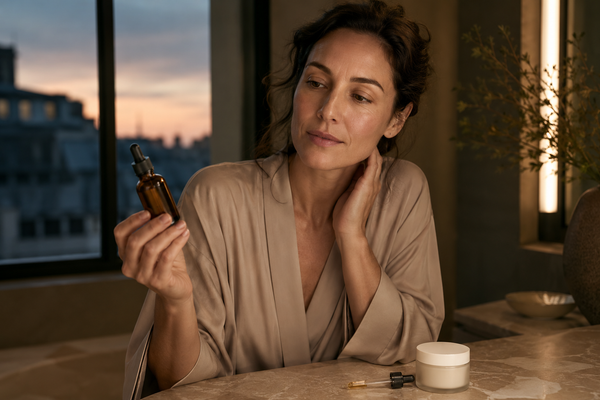



More and more people come to consultations with a routine already prepared. They didn’t read it in a magazine, and an aesthetician didn’t give it to them: they asked a chatbot. They arrive with five products, an application order, and the conviction that the work has already been done.
The problem isn’t that artificial intelligence says false things. In most cases, it says things that are correct and useless: the right active ingredients, the right order, the right explanations. What it can’t do is the only thing that really matters: start from the skin in front of it rather than from the question it was asked.
[INDICE:h2]

Elisa Avalle · Founder and dermocosmetics specialist
I use artificial intelligence every day, and I find it useful. But a routine isn’t information to retrieve: it’s a decision made for a specific person’s skin, and you need to see that skin.
Langhe, September 27, 2026
Why the answers seem so good
Because for the most part, they are. A language model has read an enormous amount of dermatological and educational literature, and in theory it is often more accurate than much of the content circulating on social media. If you ask what niacinamide does, the answer is correct. If you ask in what order to apply serum and cream, the answer is correct.
That is precisely what makes the problem difficult to see: the error isn’t in the individual statements; it’s in the leap between knowing what an active ingredient does and deciding that a particular person should use it.
The four points where a routine breaks down
1. Tolerance isn’t a variable you can simply state
A person with reactive skin writes, “I have sensitive skin,” and receives a routine tailored to that statement. But “sensitive” isn’t a fact: it’s a self-diagnosis that, in consultations, almost always turns out to be something else. A compromised skin barrier caused by overuse of exfoliants, dehydrated skin that feels tight, active dermatitis, or a reaction to a single ingredient. These are four situations with four opposite responses, yet the word used to describe all of them is the same.
2. No one asks what you already have in your bathroom
The recommended routine almost always starts from scratch, as if the person had to buy everything. In reality, they already have six opened products, three of which do the same thing and one of which is causing the problem they’re asking for help with.
The first question I ask in a consultation isn’t “what’s your skin type?” It’s “what are you using right now?” Almost always, the solution is to remove something, not add something. A model responding to a request for a routine, on the other hand, tends to build a new one, because that’s what it was asked to do.
3. Concentration and formulation aren’t included in the answer
This is the distinction I repeat most often: an active ingredient isn’t a finished product. Knowing that azelaic acid works on blemishes says nothing about which formulation actually delivers it, at what pH, with what level of tolerability, in what texture, or whether that texture will suit skin that flakes in winter.
Generated advice stays at the level of the molecule. The difference between a result and a failure almost always lies one level below, in the formulation.
“A correct answer given to the wrong person remains a correct answer. It’s simply of no use.”
4. The recommended product list may no longer exist
This is the most concrete point, and the one discussed least. The products mentioned may have been discontinued, reformulated, or no longer comply with regulations that have since come into force. This is the case with high-concentration retinol cosmetics: Regulation (EU) 2024/996 set the limits at 0.3% for the face and 0.05% in body lotions, and products exceeding those limits have a date after which they can no longer be sold. Advice that names them as a reference is already outdated the moment it is given.
Where it is useful instead
I’m not saying you shouldn’t use it, and it would be hypocritical of me to say so: I use it every day to read regulations, compare studies, and organize my work.
It works very well for understanding: what an abbreviation in INCI means, the difference between two forms of vitamin C, why a preservative is a safeguard rather than a flaw, and what a claim you read on a package means. For all of this, it’s an excellent teacher—patient and available at any hour.
It stops working when you ask it to decide. Understanding an ingredient and choosing what to put on your face are two different operations, and only the first can be done with information.
How to use it well, in practice
- Ask it to explain, not prescribe. “What does this ingredient do?” instead of “What should I buy?”
- Give it the INCI list of what you already use and ask whether there are any overlaps. This is the task at which it delivers the most value.
- Be wary of any answer that gives you more than three new products at once: if your skin reacts afterward, you won’t know which one caused it.
- Always check that the product still exists and complies with current regulations, especially retinoids and sunscreens.
- If you have an ongoing dermatological condition, the right answer is a dermatologist. It’s not a limitation of AI: it’s a limitation of cosmetics.
What remains at the counter
I find it interesting that the arrival of a tool that answers everyone has made the value of someone who looks at one person’s skin even more apparent, not less.
A pharmacist who sees the person in front of them notices the redness on their cheeks while they’re talking about something else, realizes that their hands are chapped, asks what they used last month, and hears the hesitation in their answer. These are details no one would type into a chat, because the person sharing them doesn’t know they’re relevant.
That’s why our formulas are available only in partner pharmacies, and it isn’t nostalgia for the physical store: the difficult part of giving advice isn’t knowing things; it’s understanding which of the things you know applies to this particular person. If you already have a routine in hand—your own or one generated for you—take it to the pharmacy counter and ask what to remove: that’s the question no chatbot will ever ask you.

Elisa Avalle is the founder of LeLang Skin Care, specializing in dermocosmetics at the Universitat de Barcelona. Formulated in the Langhe for Italian pharmacies.
Sources for this article
01 Commission Regulation (EU) 2024/996 of April 3, 2024, amending Regulation (EC) No 1223/2009: concentration limits for Retinol, Retinyl Acetate, and Retinyl Palmitate
02 Regulation (EC) No 1223/2009 on cosmetic products, Articles 2 and 20
03 Regulation (EU) No 655/2013 laying down common criteria for claims relating to cosmetic products
04 Observations collected during skincare consultations conducted by the author
On the website: how I choose the active ingredients in LeLang formulas · the guide to cosmetic ingredients · the skin barrier · the minimalist routine