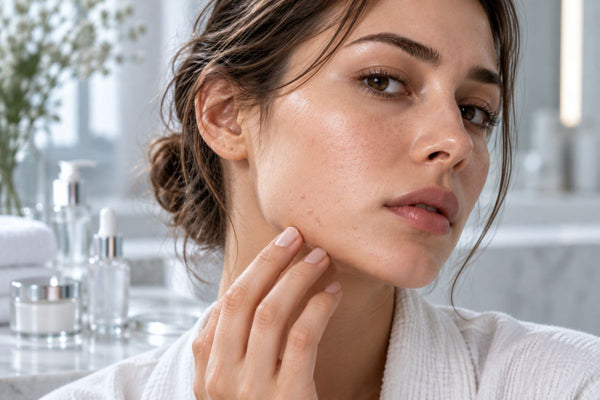



Micellar water made its way into bathrooms as a solution for people who don't have time: one cotton pad, two swipes, and the face seems clean. It is a useful product. But it is also one of the most commonly misused, because it behaves like water but isn't water.
In brief
- Micellar water is a solution of mild surfactants organized into micelles, which capture sebum and light makeup.
- It works well as a quick makeup remover. On its own, it is not enough for waterproof makeup and water-resistant sunscreen.
- If it is not rinsed off, the surfactants remain on the skin. For sensitive skin, this is the first thing to change.
- The most common damage does not come from the product, but from rubbing the cotton pad over the same spot three or four times.
Article written by Elisa Avalle, founder of LeLang Skin Care and dermocosmetics specialist. Cover image generated with the support of artificial intelligence.
[INDICE:h2]
What is a micelle?
Surfactants are molecules with one part that likes water and another that likes oils. When they exceed a certain concentration in a solution, they spontaneously organize into small spheres: the parts attracted to oils stay inside, while the parts attracted to water remain on the outside. These spheres are micelles.
Their lipophilic interior is where sebum, makeup residue, and oily particles end up. The soaked cotton pad carries them away. This is why micellar water cleanses without producing foam: foam has never been an indicator of cleansing, as explained in the guide on how to choose a facial cleanser.
Micellar waters use surfactants selected to be very mild, usually nonionic or amphoteric, at low concentrations. This is what makes them well tolerated, and it is also their limitation.
What it can and cannot remove
It works well on sebum, light makeup, and overnight residue. It struggles with anything formulated to last: waterproof mascara, long-wear foundation, and water-resistant sunscreen. These products require an oil phase, which dissolves oily substances through affinity: this is the principle behind double cleansing.
There are also bi-phase micellar waters, with an oil phase that must be shaken before use: they are more effective on long-wear makeup and leave a slightly oilier residue.

CLEANSING GENTLE OIL Makeup-removing facial cleansing oil non-comedogenic, the first step of double cleansing Dissolves makeup, including... Discover CLEANSING GENTLE OIL
Does it need to be rinsed off?
Many packages say no, and this is understandable: it is the reason the product is convenient. The point is that what micellar water removes is dissolved in the micelles, and micelles that do not end up on the cotton pad remain on the skin, together with the surfactants.
On normal, not very reactive skin, this residue is generally well tolerated. On sensitive skin that becomes red or tends to be dry, it is daily stimulation that can be avoided with one simple step: rinsing with lukewarm water, or following with a gentle cleanser. This is even more relevant for anyone whose skin barrier is already compromised, as described in what sensitive skin is.
There is one situation in which no-rinse micellar water offers a real advantage: where tap water is very hard and the skin does not tolerate it well, or while traveling, when a sink is not available.
How to use it properly
- Soak the cotton pad so that it is wet, not just slightly damp: a dry pad rubs instead of gliding.
- Place it on the skin and hold it still for a few seconds, especially over the eyes, to give the micelles time to work.
- Swipe it once, gently, from the inside outward.
- Change the cotton pad instead of going over the same dirty one again.
- Rinse or follow with cleanser if your skin is sensitive or if you wore makeup and sunscreen that evening.
The next step, if you use it, is toner: it does not replace micellar water, but comes afterward.
When it makes sense and when it doesn't
- Yes in the morning, when there is little to remove; while traveling; as a quick first step for light makeup.
- Yes, with rinsing for sensitive, reactive, or dry skin.
- No as the only cleansing step in the evening after a day of long-wear makeup and sunscreen.
Frequently asked questions
Is micellar water suitable for the eyes?
Yes, if the formula is also intended for the eye area. People who wear contact lenses or whose eyes sting easily should choose one tested for that use and avoid rubbing.
Can it cause blemishes?
Indirectly, yes: residue left on oily or blemish-prone skin every day, together with makeup that has not been completely removed, can make the situation worse. Rinsing solves the problem.
Is it better than soap and water?
It is gentler than traditional soap, but less thorough than a good facial cleanser. The two are not alternatives: it depends on the time of day.
The next step
If you have been using micellar water on its own for years and your skin feels tight or becomes red, try adding rinsing for two weeks: it is the simplest test there is. To find a cleanser to use alongside it, you can discuss it with a pharmacist at LeLang partner pharmacies and para-pharmacies.
Sources for this article
- Ananthapadmanabhan K.P., Moore D.J., Subramanyan K., Misra M., Meyer F. (2004). "Cleansing without compromise: the impact of cleansers on the skin barrier and the technology of mild cleansing". Dermatologic Therapy, vol. 17, suppl. 1, pp. 16-25.
- Draelos Z.D. (2018). "The science behind skin care: Cleansers". Journal of Cosmetic Dermatology, vol. 17, n. 1, pp. 8-14.
Where to continue: double cleansing · how to choose a facial cleanser · the skin barrier
Discover the products: facial cleansers · soothing treatments for sensitive skin