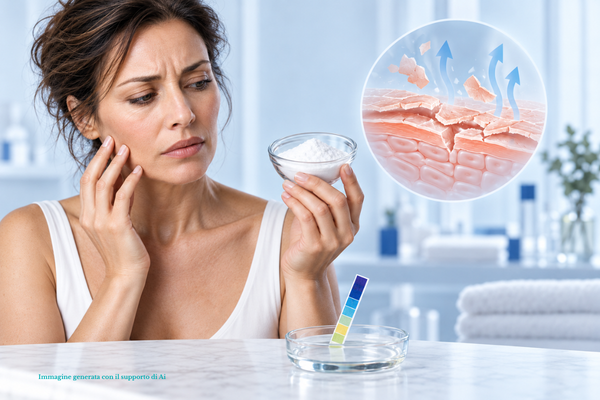



In 1985, a British doctor, Douglas Model, wrote in the British Medical Journal something that many colleagues thought but no one had put into writing: you can recognize a smoker by their face. He called this set of signs smoker's face. Since then, that clinical impression has been confirmed by studies of identical twins, skin biopsies, and research into molecular mechanisms.
In summary
- Along with sun exposure, smoking is one of the two external factors with the most documented effect on skin aging.
- It acts on three fronts: less oxygen to the tissues, more enzymes that break down collagen, and less new collagen.
- The typical signs are wrinkles around the mouth and eyes, a dull complexion, and less elastic skin.
- Smoking and sun exposure do not merely add up: together, they worsen each other's effects.
- No cream can offset smoking. Skincare works on the damage, not the cause.
Article written by Elisa Avalle, founder of LeLang Skin Care and a dermocosmetics specialist. Cover image generated with the support of artificial intelligence.
[INDICE:h2]
How to recognize a smoker's face
Model's description was precise: fine lines radiating from the lips and corners of the eyes, more hollow features, a grayish complexion, and skin that appears thicker and less radiant. Not one particular wrinkle, but a pattern.
The most convincing confirmation came from identical twins. Same DNA, same age: if one smokes and the other does not, the differences in their faces can reasonably be attributed to smoking. In a study of dozens of pairs of twins, evaluators found that the smoking twin had more excess skin on the upper eyelid, more pronounced bags under the eyes, deeper nasolabial folds, and more wrinkles around the lips. The authors also observed visible differences between twins who had both smoked, but for different lengths of time, with a five-year difference in duration.
What happens inside the skin
Less oxygen reaches the skin
Nicotine constricts the small blood vessels, while carbon monoxide in smoke binds to hemoglobin instead of oxygen. The result is skin that receives less oxygen and fewer nutrients. This is why the complexion looks dull, and also why skin wounds heal more slowly in smokers.
The enzymes that break down collagen increase
Matrix metalloproteinases are enzymes that break down collagen and elastin. A study published in The Lancet measured higher levels of metalloproteinase-1 in smokers in an area of skin that had never been exposed to the sun. This detail matters: it means the effect does not depend on the sun, but on the smoke itself, which reaches the skin through the bloodstream.
Less new collagen is produced
Laboratory studies show that components of smoke reduce new collagen synthesis by fibroblasts and increase oxidative stress. The balance shifts: more is destroyed and less is rebuilt. There is a dedicated in-depth article on the role of free radicals in skin aging.
Smoke and sun together
As early as 1991, a study in the Annals of Internal Medicine observed that heavy smokers had a much higher risk of premature wrinkles than non-smokers, and that the combination with heavy sun exposure increased it further. For this reason, in the skin exposome, the collection of external factors that age the skin, sun and smoke are grouped together at the first level.
Why wrinkles appear specifically around the mouth
A mechanical factor is added to the biological mechanisms. Smokers purse their lips around the filter with every puff and squint to protect their eyes from the smoke. With a pack a day and around ten puffs per cigarette, that amounts to hundreds of contractions a day and tens of thousands a year, always involving the same muscles.
On skin that already has less collagen and elasticity, those repeated movements leave their mark sooner. The causes of and treatment options for wrinkles around the mouth are explained in a separate article.
What about e-cigarettes?
The question is legitimate, and the honest answer is that there is still little data on the skin. Long-term studies comparable to those on tobacco are lacking, partly because these devices have been widespread for too short a time.
Two points can nevertheless be established. If the liquid contains nicotine, the effect on the blood vessels remains. And pursing your lips around the mouthpiece is the same motion. Anyone who has switched to e-cigarettes should not consider them neutral for the skin: it is an open question, not a settled one.
What you regain by quitting
Wrinkles that have already formed do not disappear. What improves is the functional aspect: circulation in the small blood vessels resumes, tissue oxygenation returns to more normal levels, and the skin repairs daily damage more effectively.
A pilot study conducted in Milan on people who had quit smoking found an improvement in some skin parameters measured several months later. It was a small study and should be viewed as an indication, not definitive proof. However, its direction is consistent with everything else: the sooner you quit, the more skin you save.
A cosmetic acts on the superficial layers of the skin and does not treat any addiction or clinical condition, pursuant to EC Regulation 1223/2009. To quit smoking, the right place to turn is your family doctor or a smoking cessation center. The Italian National Institute of Health's Green Phone Against Smoking, 800 554 088, provides information about services available in your area.
What skincare can do afterward
There is an important distinction: a cream cannot do anything about smoking as a cause. For the damage it leaves behind, some choices make sense.
- Sun protection every day. Since smoking and sun exposure reinforce each other, removing sun exposure from the equation is the most useful step a person who smokes or has smoked can take for their skin. For choosing a product, see the guide to facial sun protection.
- An antioxidant in the morning. Vitamin C, ferulic acid, and vitamin E work together against oxidative stress, which is higher in smokers.
- A well-nourished barrier. Less well-hydrated skin is often drier and duller: gentle cleansing and a cream suited to your skin type.
- Targeted attention to the lip contour, the area that shows signs first.

FERULIC + HA SERUM Vitamin C and ferulic acid face serum Antioxidant and tone-evening, with dual hyaluronic acid. Helps prevent dark sp... Discover FERULIC + HA SERUM

Face Sunscreen SPF 50 Pocket Size, Travel Size (5 pcs) Pocket-sized SPF 50 facial sunscreen in single doses The problem isn’t applying sunscreen. It’s reapplying it. Smalle... Discover Face Sunscreen SPF 50 Pocket Size, Travel Size (5 pcs)
The next step
If you have smoked for years, or still smoke, and want to understand where to start, the pharmacist at LeLang partner pharmacies and parapharmacies can assess your skin in store and recommend a routine tailored to what they see.
Want to understand where to start?
Book a free virtual consultation: together we will assess your skin and create a tailored protocol.
Sources for this article
- Model D. (1985). "Smoker's face: an underrated clinical sign?". British Medical Journal, vol. 291, pp. 1760-1762.
- Kadunce D.P. et al. (1991). "Cigarette smoking: risk factor for premature facial wrinkling". Annals of Internal Medicine, vol. 114, no. 10, pp. 840-844.
- Lahmann C. et al. (2001). "Matrix metalloproteinase-1 and skin ageing in smokers". The Lancet, vol. 357, no. 9260, pp. 935-936.
- Morita A. (2007). "Tobacco smoke causes premature skin aging". Journal of Dermatological Science, vol. 48, no. 3, pp. 169-175.
- Okada H.C. et al. (2013). "Facial changes caused by smoking: a comparison between smoking and nonsmoking identical twins". Plastic and Reconstructive Surgery, vol. 132, no. 5, pp. 1085-1092.
- Serri R. et al. (2010). "Quitting smoking rejuvenates the skin: results of a pilot project on smoking cessation conducted in Milan, Italy". Skinmed, vol. 8, no. 1, pp. 23-29.
- Krutmann J. et al. (2017). "The skin aging exposome". Journal of Dermatological Science, vol. 85, no. 3, pp. 152-161.
- Regulation (EC) No 1223/2009 of the European Parliament and of the Council on cosmetic products.
Where to continue: Skin exposome · Skin aging · Skin glycation
Discover the products: Prevent the signs of aging · Photoaging